The Leader’s Biggest Stories Last Year

The start of a school year can be an especially difficult and nerve-wracking time for first-year and transfer students, and we would like to help you out a bit by summarizing some of the coverage The Leader provided last semester. Whether you’re looking over a friend’s shoulder out of curiosity or reading alone, hopefully, it will offer some indication as to what have been just a handful of the hottest topics on campus.
Without further ado, let’s dive into a brief overview of the Spring 2026 term at EU.
Turning Point: A Breaking Point?
Arguably the most followed coverage The Leader provided last semester concerned Turning Point USA (TPUSA), a conservative nonprofit that reported having received more than 121,000 requests from college and high school students nationwide to open a chapter or become involved with an existing chapter. The spike in interest came after one of the organization’s founders, right-wing political commentator Charlie Kirk, was assassinated while speaking at an outdoor campus debate event at Utah Valley University on Sept. 10, 2025.
“If people aren’t debating, you don’t know what the other person’s thinking, and that’s when violence arises,” the president of EU’s TPUSA chapter, then-junior Timothy Dudasik, told The Leader after the chapter’s founding. “So that’s why [this chapter] was really important to me. We don’t really have political clubs here at school, so as soon as he [Kirk] was assassinated, I reached out to Turning Point that same day.”
Although EU’s Student Government Association (SGA) originally denied the creation of a TPUSA chapter at EU that fall, the association approved the chapter in April. This decision drew immediate backlash from students, including then-junior Jeanne Mardegan.
“This is a school about inclusivity, and Elmhurst stands for that,” Mardegan said. “It just feels like they’re going against what they stand for.”
Bridget O’Rourke, a professor of English at EU, voiced a very similar view: “This group, as a national organization, is not consistent with our values of stewardship, or community, or social responsibility.”
Speaking to The Leader following the controversial decision, several members of SGA cited the EU Student Handbook, paying careful attention to avoid voting with bias, and making sure the organization had met all requirements.
“We did it the way we had to,” said then-junior Sam Cotton, the treasurer of SGA. “We did it by the book. We did it by what’s in the constitution, and, yeah, it was stressful.”
“This is a situation [that is] hard, still, for students. SGA is still here to serve the students no matter how you feel about the situation,” Cotton added. “We understand some people may love it and we understand some people may hate it. You are totally okay to have your opinion. I don’t want everyone to start hating each other on this campus.”
Campus Dining
Dining at EU has also been a contentious subject, particularly because students living in residence halls are required to register for a dining plan, which can range from $2,161.55 per semester to $3,784.05 per semester.
As student frustrations with campus dining continued from the Fall 2025 semester into J-term, EU’s dining services team operator, Chartwells, announced a variety of changes for the Spring 2026 term to accommodate student concerns. The changes included expanded hours, the removal of the gap between lunch and dinner, and a new Italian station to offer expanded pizza and pasta choices, as well as additional protein options.
“I like that they made an effort. It’s nice to see that they’re listening — it’s not that all of this is in vain,” then-sophomore Malak Aziz said at the time. “But, I don’t think they will listen to everything that we want. They won’t ever have people pay less for the meal plans, because that’s how they make a lot of their money.”
EU’s dining situation became further complicated when disposable paper and plastic plates were introduced, as many reusable metal plates were being lost due to being accidentally thrown away or taken out of the cafeteria and not returned.
“Our team reached a point where we no longer had enough plates, bowls, and silverware to consistently make it through an entire meal period,” explained Chartwells’ marketing manager, Elizabeth Walters. “We had to make a quick operational decision. Rather than risk running out of dishes during service, we temporarily introduced disposable ones.”
Complaints with EU’s dining services were not new to the Spring 2026 semester; on Sept. 20, 2025, a Change.org petition was created by “Armitus Kingdom,” who hoped to “ensure safe and adequate food at EU.” The petition quickly received over 100 verified signatures, and just three days after the petition’s creation, the Office of Student Affairs announced that several changes would soon be implemented, including daily late-night meal options in the Roost.
“The school heard our concerns and is now taking into consideration reforming the meal plans and much more,” Armitus Kingdom wrote in a subsequent update to the petition. “We made tons of progress and have much more to work towards!”
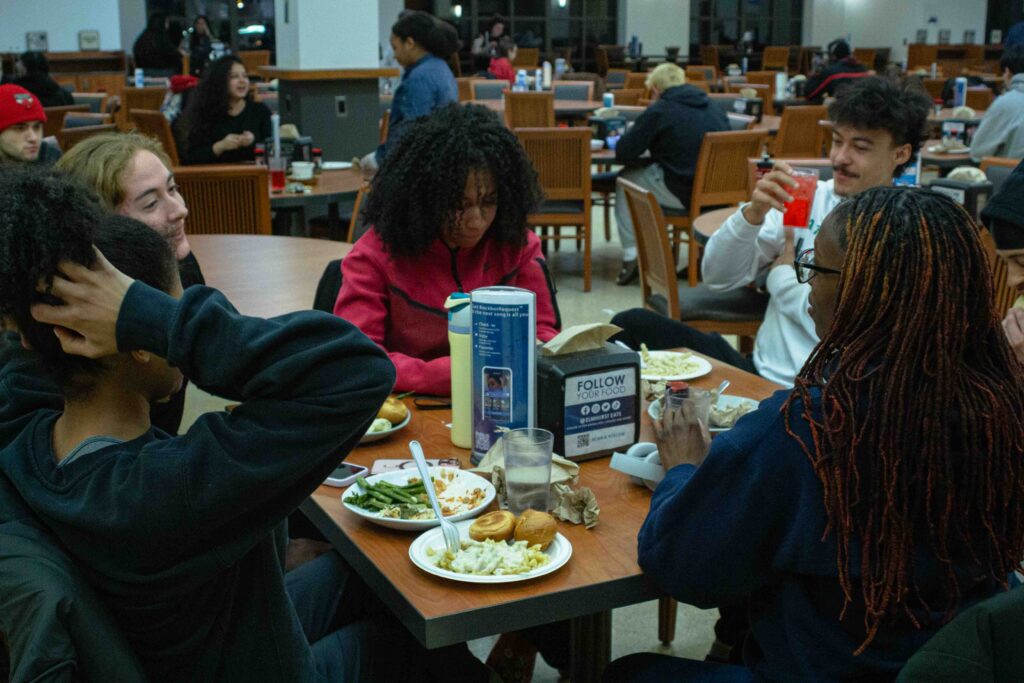
Students eat off a combination of disposable and reusable plates in the Main Café on March 13. || Photo by Star Herring
Lectures Under Trump
EU hosts multiple lectures throughout every academic year, including certain annual intercultural lecture series, such as the Martin Luther King Jr. Intercultural Lecture and the César Chávez Intercultural Lecture (though the latter was renamed the “Hispanic Heritage Month Lecture” in April after The New York Times published an investigative report detailing extensive sexual assault evidence against the late American labor unionist and civil rights activist). For the past two years, the unprecedented second presidency of Donald Trump has greatly impacted the focuses and messages of these lectures.
The MLK Lecture was delivered on Feb. 18 by the Rev. James E. Shannon, MDiv, a pastor and community activist who outlined his experiences with growing up in racially segregated Montgomery, Alabama, which led to a bus boycott that lasted more than a year and resulted in the bus company’s bankruptcy.
During the lecture, Shannon made connections between the Civil Rights Movement and modern demonstrations against U.S. Immigration and Customs Enforcement (ICE) agents in Minnesota, which intensified following the fatal shootings of protesters Renee Good and Alex Pretti.
“When they say ‘Make America Great Again,’ when do you think America was great to them?” Shannon said. “It was great during segregation and discrimination. And if we don’t wake up, we’ll be back there.”
The Genevieve Staudt Intercultural Lecture was given on March 11 by Tisha Rajendra, Ph.D., an associate professor in Loyola University Chicago’s Department of Theology who highlighted the mistreatment of detainees of the Trump administration, drawing parallels to Christians’ historical enabling of persecution under the Nazi regime.
“Christianity does not protect them [ICE agents], nor does it protect us, from this kind of complicity,” warned Rajendra.
On April 19, EU’s 36th annual Holocaust Service of Remembrance and Lecture honored the life and legacy of Carl Lutz, a Swiss diplomat credited with saving over 62,000 Jewish individuals throughout the Holocaust and World War II. The lecture was given by Amy Lutz (no known biological connection to Carl Lutz), while Rabbi Steven Bob of Congregation Etz Chaim presided over the accompanying service, concluding the event by noting the Jewish teaching that there are three dozen righteous people hidden throughout every generation.
“The question for us is, how can we be one of these 36 righteous people?” asked the rabbi. “What can we do, in our own small way, in the world in which we live, to lift people up?”
The Spring 2026 lectures rounded off with DePaul University political science professor Kathleen Arnold’s discussion of totalitarianism in the annual Niebuhr Lecture on April 14, in which she warned of the United States’ ongoing descent toward authoritarianism.
“If we care about our friends or neighbors, we have to consider this civil war,” Arnold stated.
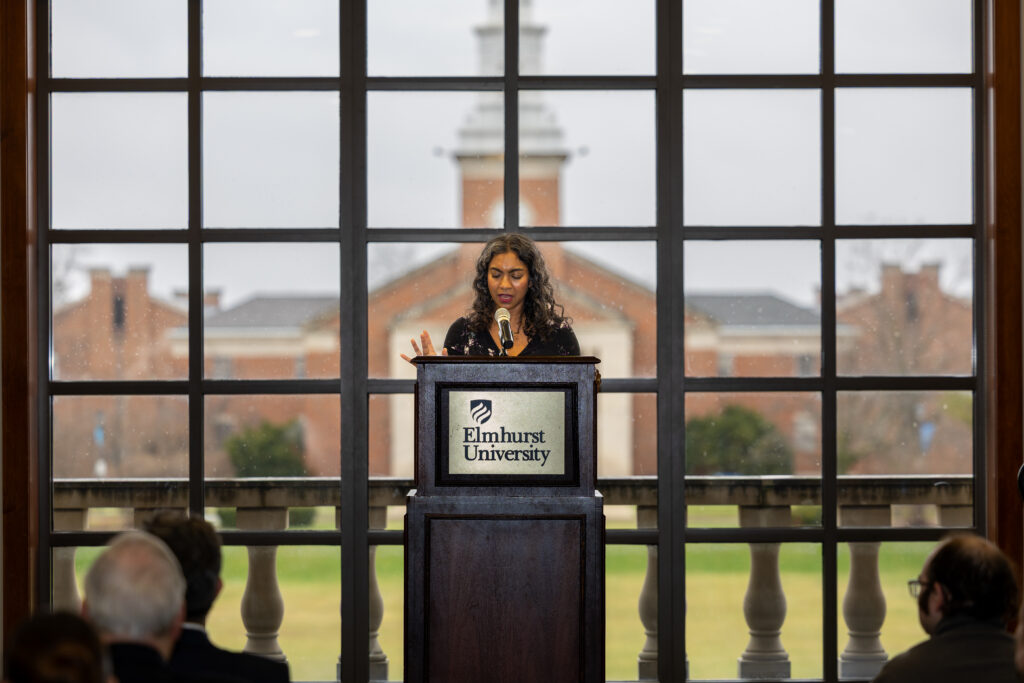
Tisha Rajendra, Ph.D., delivers the Genevieve Staudt Intercultural Lecture in the Frick Center Founders Lounge on March 11. || Photo by Gerardo Trujillo
(Another) Iran War
Beginning in late February, Elmhurst (along with the rest of the United States) was unexpectedly thrust into an international conflict when 86-year-old Ayatollah Ali Khamenei, who had been serving as the second supreme leader of Iran since 1989, was assassinated in a series of Israeli missile strikes alongside dozens of other Iranian officials.
These officials included Khamenei’s 70-year-old political adviser Ali Shamkhani, as well as several of Khamenei’s relatives. Khamenei’s son Mojtaba Khamenei, who was injured in the same airstrike that killed his father, would later be appointed Iran’s next supreme leader, though he has not been seen in public since.
More than a year prior to these attacks, in June 2025, a 12-day war had occurred between Iran and Israel, which formally ended via a June 24 ceasefire mediated by the U.S. and Qatar, although the agreement was violated by both Iran and Israel shortly thereafter.
Weeks after the 2026 ambushes, the crisis remained bleak, with 13 U.S. service members having been killed in the conflict and the Pentagon projecting that the operation had already cost almost $12 billion.
Months after that, the situation had only become more complicated, with an F-15E fighter jet being shot down over mountainous terrain in southwest Iran on April 3. The pilot was rescued on the day of the attack, while the weapons system officer was discovered alive on April 5. The conflict also saw a blockade of the Strait of Hormuz, the waterway between Iran and the United Arab Emirates, as an effort to disrupt Iran’s economy by preventing the country’s access to oil, its primary source of revenue.
And that concludes The Leader’s recap of the Spring 2026 semester at EU. If you’re interested in learning more about any of these topics, you’re always welcome to visit our website. And there will certainly be no shortages of stories for us to cover this semester…especially with a pivotal midterm election cycle just on the horizon.