SGA Bound by Internal Anti-Bias Rules, “Can’t Say No” to TPUSA
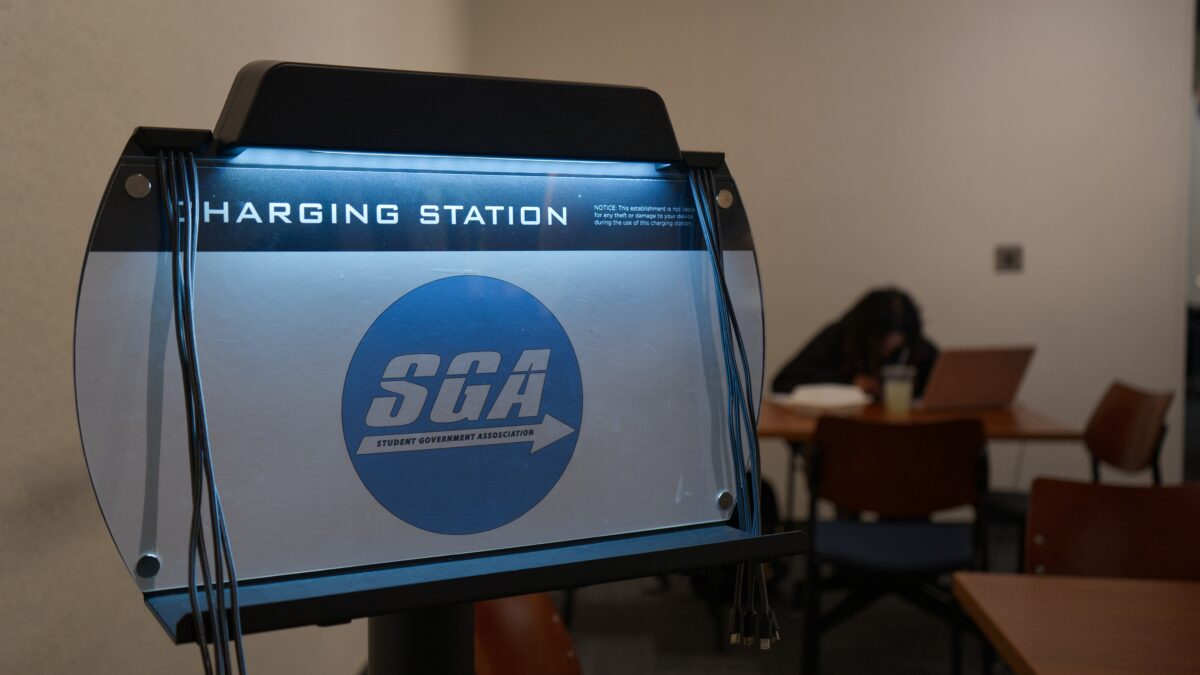
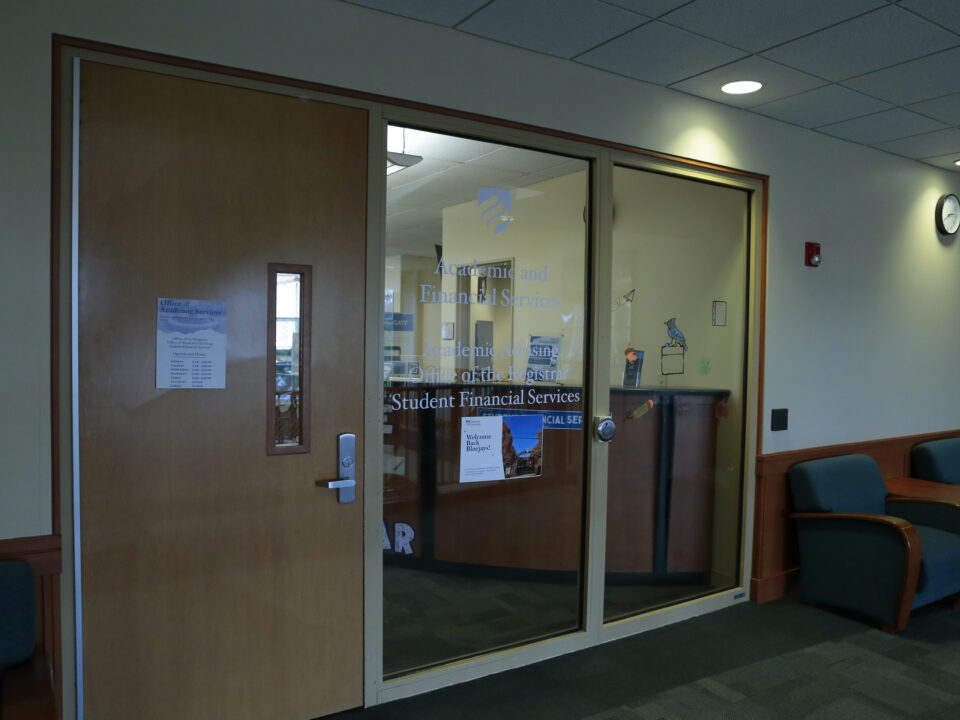
A student studies in the Frick Center on April 19 behind an SGA funded and installed mobile device charging stand. (Ian Murphy)
Senior Roohana Amin didn’t learn about the vote to approve the Turning Point USA chapter at Elmhurst University until the day after it happened, when she came across a student petition opposing the decision, which has received more than 900 verified signatures as of publication time.
“Why are we trying this again? What is going on?” asked Amin. “How does Elmhurst, the most diverse and inclusive campus I’ve ever seen, approve something like this? Especially considering the values of Elmhurst — they’re always preaching diversity, they’re always preaching inclusion.”
The chapter — which is a part of TPUSA, a national nonprofit founded by late conservative activists Charlie Kirk and Bill Montgomery that promotes politics aligning with President Donald Trump’s MAGA movement among students — has faced significant backlash by those at EU who extensively questioned the approval process.
EU’s Student Government Association (SGA) approved the chapter earlier this month, following an initial rejection last fall. Speaking to the Leader, multiple SGA members cited EU’s Student Handbook, paying careful attention to avoid voting with bias, and said the organization met all requirements.
“We did it the way we had to,” said SGA Treasurer Sam Cotton. “We did it by the book. We did it by what’s in the constitution, and, yeah, it was stressful.”
According to Tim Dudasik, EU’s TPUSA chapter president, SGA initially rejected the chapter for four main reasons: It lacked a clear plan to prevent open dialogue from becoming hostile, showed close alignment with Kirk’s rhetoric and beliefs, provided weak rationale for why the club needed to be affiliated with TPUSA specifically, and demonstrated a lack of professionalism.
While Dudasik worked to revise the student organization’s policy approval to resubmit in the spring, SGA began additional research and further deliberation on the issue. SGA Vice President Avaion Viverette explained that SGA concluded the initial reasons for rejecting the chapter were unfair.
“We don’t compare them to any other branch [or] chapter. We go specifically off their presentation,” said Viverette. “Any outside comparisons would be considered biased.”
The executive board of SGA met with Vice President of Student Affairs Keri Alioto, who provided advice on what was considered biased, according to Viverette.
“She just helped provide advice in terms of categorizing bias, which is the difference between last semester and now,” said Viverette. “We just weren’t aware of what was considered bias prior.”
Alioto did not return an immediate request for comment.
While SGA’s club approval policies are not public, Viverette referenced EU’s Student Handbook and their bias incident response procedures.
The section on “Additional University Policies and Procedures,” begins with “Bias Incidents,” which in part reads, “Bias incidents may fall below the threshold of violating laws and other campus regulations, but still have an impact on an individual, a subset of the campus community, or the campus community at large.” This information in full can be found in the Student Handbook on pages 36-38.
“With SGA, there’s probably a lot of misconceptions,” said Viverette. “I know one of the major ones is the voting process. I think a lot of people misconstrue it as based on personal beliefs, but instead we’re following the basis of the University policy.”
Supporting Viverette, an individual familiar with SGA’s approval process explained that SGA’s voting process is based solely on the club’s written and stated goals in relation to EU and SGA’s requirements, and there isn’t much room for discretion.
“If you check all of the boxes, technically you can’t say no,” they said.
They further explained that for example, “if a fraternity hazed at another school, they cannot be denied at this school, because it’s a completely separate set of people.”
Viverette explained that SGA encouraged students to come to them with any questions they have: “We want to be as transparent as possible.”
The most contentious issue that continues to dominate campus discourse is whether TPUSA aligns with campus values. Some students and faculty point to the handbook, which states: “Student organizations, fraternities and sororities, intercollegiate athletics, intramural sports, and performing arts groups that are consistent with the University mission and values may be established (p. 59).”
To prevent bias, the chapter is evaluated based on its presentation and shared mission during the approval meeting, not its national affiliations or other chapter’s actions. Despite this, many remain discontent with these procedures.
“It feels like a huge slap in the face because we all came here for the same reason of diversity and inclusion,” said Amin. “We felt like we’re safe here, and then to see that we even needed a petition, to see that all of us have to come forward to get some attention for us, it just kind of shows that the administration doesn’t really care about the student body.”
Former SGA President Esther Pereira ‘18 served during EU President Troy VanAken’s inauguration, and among being involved in many organizations, was honored as Senior of the Year in 2018. She said her experience at EU was very positive — that she worked closely with VanAken, senior leadership, and students. However, she said she does not agree with the decision to approve the chapter.
“At a time like this for our community — it’s very vulnerable — and the fact that this organization passed, or that SGA even tolerated that is very unacceptable in my opinion,” said Pereira. “As [SGA] president, your job is to host public forums and hear directly from the students what they want.”
“As a student of color, I would not feel safe stepping on a campus that has this, so my heart goes out to like the 57% of students that are BIPOC at that campus, in that institution, because it’s just, it just sucks to even think about and my heart is with them,” Pereira added.
Junior Kallia Memtsas, vice president of Alpha Psi Omega, EU’s theatre honor society, attended the approval meeting for the chapter. She said she feels differently about SGA since the vote.
“After this whole situation, I have lost the trust in their decisions. Because, I feel like if we can’t rely on them to vote fairly on an organization that has a lot of hateful history, how are we supposed to rely on them to just do their job in the first place?” said Memtsas.
Former Vice President of SGA Emelio Davalos ‘18, served as the chair to the committee that processed club approvals and is currently studying to pass the bar in Illinois. Davalos said he wasn’t surprised to see the chapter approved. He said that the association is a representative, but still has to follow procedural rules, and that he understands the backlash, especially in regard to campus values.
“In the Student Handbook, the first thing that it says is for [a student organization] to first be recognized by the University, it has to follow our values,” said Davalos. “I don’t have an answer to that question. I think the appropriate venue or the appropriate people to answer this is going to be the campus itself.”
Multiple students raised concern over a lack of transparency, saying that the meeting was not adequately publicized.
“When I heard that [the chapter] got approved, I was so confused,” said Amin. “I was like, ‘When did they even have that meeting?’ I’ve noticed that nobody else is talking about it other than the petition, which was literally the day after [the approval] that I saw it. The fact that they kept it so low-key the second time, the fact that they approved it, I still can’t believe it.”
Viverette said that SGA followed their standard procedure to promote any general meeting, which included sending out an email to student legislators and referencing a pinned post with the semester’s meeting dates on Instagram. SGA does not promote anything on the agenda besides the general meeting time and location.
“We heard about the petition, and if a student brought it up, then we would acknowledge it,” said Viverette. “However, it would still come down to alignment with the University’s values, for better or for worse.”
Additionally, since fall 2024, votes cast by the SGA members have been kept private. Viverette explained this change was made during his and SGA President Davionne Jakes’ first term, after SGA noticed some clubs were possibly being approved despite not fully meeting the criteria due to pressure created by the clubs’ presence during the voting process.
The TPUSA chapter at EU will also not draw from Cooperative Funding (COOP)’s budgeted funding. Instead, according to Dudasik, it will rely on “unlimited” funding from the national organization that funds chapters across the nation. Multiple students and faculty felt that this should have been a stronger line of questioning by SGA.
“I was talking to a bunch of other students when the vote was going down and we were just wondering, ‘Why is funding like that fair?’ Because every other organization on campus has to get funding approved and has a budget,” said Memtsas.
Pereira questioned the funding of the chapter as well: “I would be curious why a university, not even just a club, why the University would welcome that, and why would they even consider taking money from Turning Point USA. To me, that represents that [EU] is aligning with those values and I think that’s where all the alumni are very upset by this. I’ve had alumni tell me that their donations are probably not going to continue to support them, and that just breaks my heart.”
Funding is not a requirement for organizations to pass and would be handled outside of SGA, according to Viverette.
Cotton also acknowledged the uncertainty about the chapter’s budget: “I know a lot of people had questions about them having more money. Technically, that has nothing to do with us approving or denying an organization based on if they have money.”
Once a student organization is approved and recognized, oversight of clubs falls to the Office of Student Affairs and the Office of Student Involvement & Frick Center. While SGA controls the COOP budget, the approval of events is handled by Assistant Director of Student Involvement Daniela Barca, while reserving spaces are handled by Dean of Students and Director of the Frick Center Cheryl Leoni, alongside Director of Conference and Event Services Daphanee Lewis. Cotton said that SGA is still available to help students tackle problems.
“This is a situation [that is] hard, still, for students. SGA is still here to serve the students no matter how you feel about the situation,” said Cotton. “We understand some people may love it and we understand some people may hate it. You are totally okay to have your opinion. I don’t want everyone to start hating each other on this campus.”