Students Campaign for Human Labor Rights at EU’s First May Day Celebration
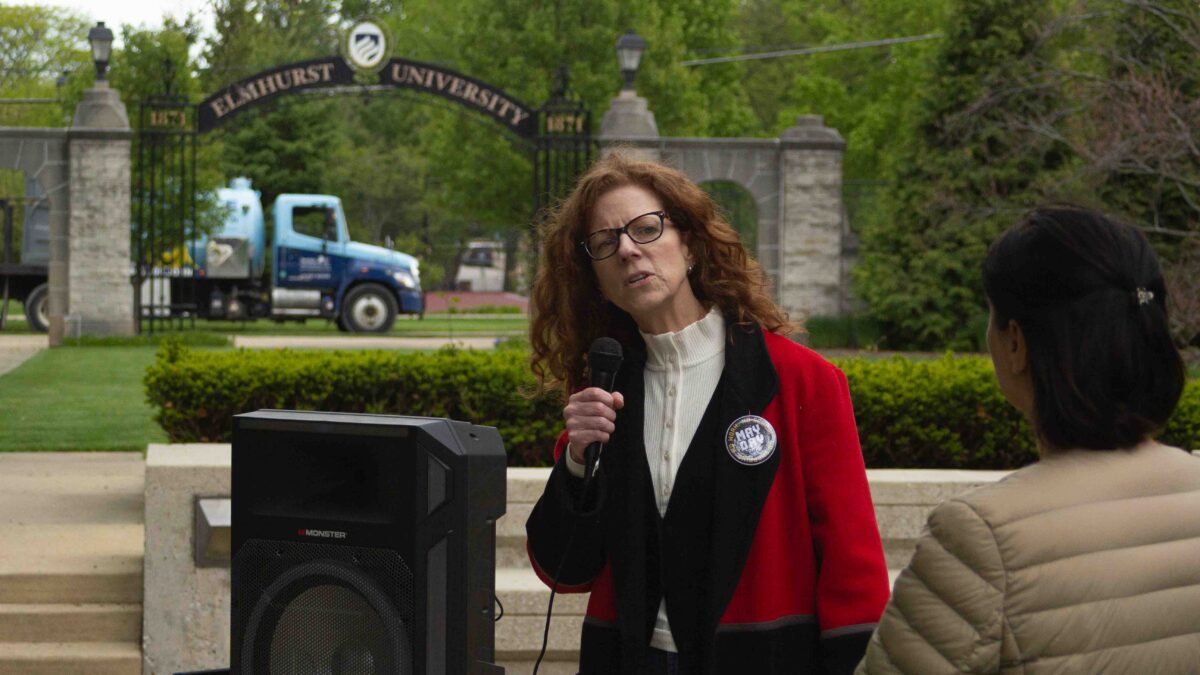
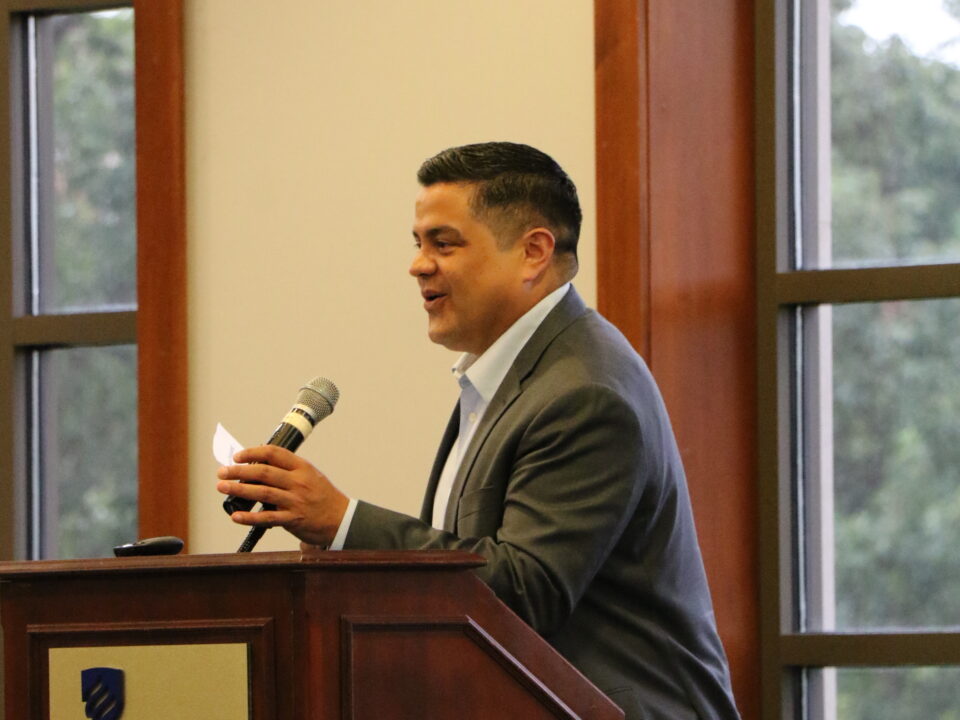
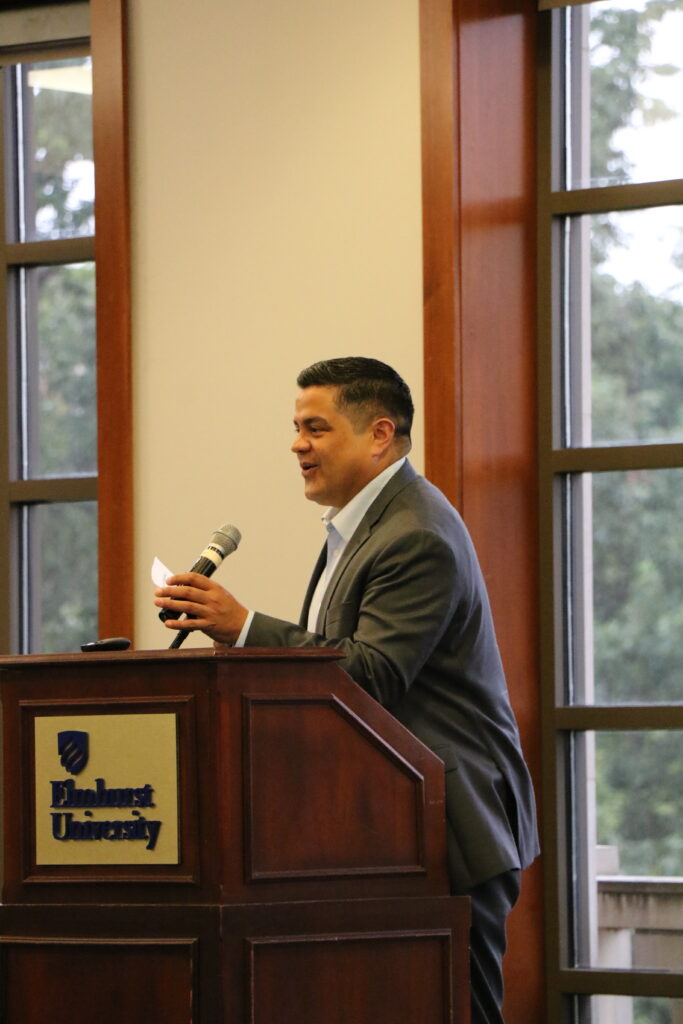
English faculty and advisor to Sigma Tau Delta, Bridget O’Rourke, speaks at May Day in the Kranz Forum on May 1. (Star Herring)
Under the watchful gaze of Elmhurst University’s statue of Reinhold Niebuhr, the air was filled with fresh coffee, tacos, and a call for shared prosperity over free market politics. On Friday, May 1, the EU community transformed the space into a circle of activism, historical remembrance, and conversation for its first May Day celebration.
The event, a student- and faculty-led event, aimed to bridge the gap between the historical struggles of the 19th-century labor movement and the modern economic pressures the community is facing today.
May Day’s origins are rooted in the late 1800s, when the working class was fighting for the right to an eight-hour workday. The historical weight of the day was underscored by the Chicago workers’ walkout of 40,000 on May 1, 1886, which the organizers of EU’s event hoped to honor by bringing these conversations to campus.
For many students, the rally was more than a history lesson on workers’ rights, but also an acknowledgment of workers over billionaires. Junior Gianna Saraceno, president of Sigma Tau Delta, highlighted how economic policies are hitting students here.
“I mean, we’re all affected by the economy… Our tuition was all increased this year. So, we’re all feeling some economic imbalance,” Saraceno commented. “But I think as a whole, we want to come together and support the workers.”
Saraceno expressed a hope that the administration at EU would see the value in gatherings like these. “I hope that they support us just as much as they support any other club,” Saraceno stated.
The most moving moments of the day came from those sharing personal stories of loss and systemic failure. Senior Roohana Amin spoke of her father, a 63-year-old restaurant owner and taxpayer who was detained by ICE in September 2025 and deported on Jan. 1, 2026.
Amin shared with the May Day crowd the circumstances that her father faced, “During his detention, he was severely neglected.”
“His medication was inconsistent, and his health declined,” Amin added. “At one point, he went 3 1/2 days without his diabetes medication and ended up in the emergency room. That is not just a mistake, that is a failure to basic human care.”
Despite the pain this experience has caused Amin and her family, she feels a necessity to share this message because “there is nothing more American than standing up for what’s right because that’s how we became America.”
Going forward, after speaking at EU’s May Day event, Amin aims to spread the message of empathy, “I just hope that people remember that at the end of the day, we’re humans. We all bleed the same…there is no difference between us. The only difference is the color of our skin and other stuff that doesn’t really matter as much as who we are as people.”
The event included a diverse lineup of speakers, including John Dorhauer, past president of the United Church of Christ, who led the crowd in a chant of affirmation of human self-worth. Dorhauer acknowledged the importance of humans’ imaginations and creativity.
Dorhauer called out, “Your imagination matters. Repeat that,” and the crowd responded, “We matter.” He acknowledged a variety of groups, “to the women on this campus…to the trans community who is being dehumanized and demonized…to the immigrants and refugees among you today… Repeat that.”
The crowd graciously responded with more and more passion, “We matter.”
As students braved the cold first day in May, the sense of purpose and community soared, as the nationwide demand for May Day was addressed. These demands included but were not limited to taxing the rich, ending ICE operations, achieving education freedom, and expanding democracy against corporate power.
For Amin and all attendees, EU’s May Day success wouldn’t be measured by immediate policy action, but rather by the awakening of peer activism.
Amin concluded that “overall awareness of what May Day is” would be a potential “win” for the event. “I feel like awareness can go such a long way…if there’s something wrong, we stand up for it, and we call out when there’s something bad going on.”