EU’s Holocaust Service Honors “the Forgotten Rescuer” Carl Lutz
Carl Lutz, a Swiss diplomat who has been credited with saving more than 62,000 Jewish individuals throughout the Holocaust and World War II, received a formal commemoration at Elmhurst University’s 36th annual Holocaust Service of Remembrance and Lecture.
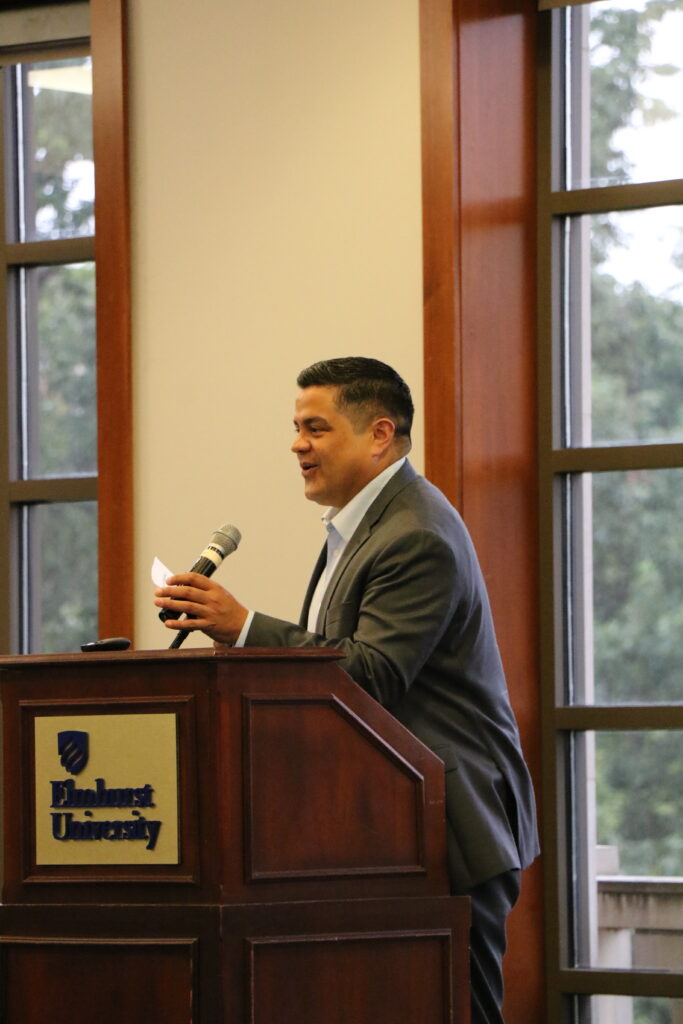
The event was held in the Frick Center Founders Lounge on the evening of Sunday, April 19. The lecture portion was delivered by Amy Lutz (no known biological relation to Carl Lutz), a historian and writer from the St. Louis area whose education includes a bachelor’s degree in history from Saint Louis University and a master’s degree in history from the University of Missouri.
Amy Lutz served for more than five years as full-time director of marketing and communications at the St. Louis Kaplan Feldman Holocaust Museum, holding this position from July 2020 to September 2025. She now serves as the director of marketing and communications at the St. Louis Shakespeare Festival.
Amy Lutz noted that Carl Lutz’s bravery was unfortunately rare during a time in which most people wished to simply continue their lives as normal, even as countless Jewish individuals were being actively persecuted and murdered.
“Carl Lutz was the exception, not the rule,” Amy Lutz stated.
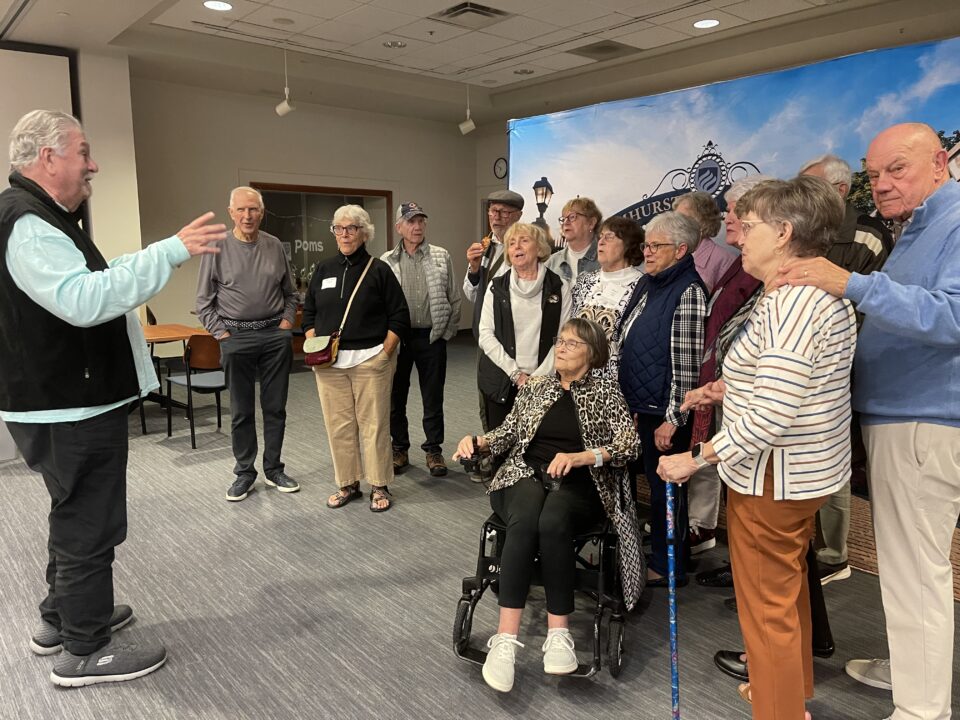
The lecture was preceded by a memorial service in which seven candles were lit by six students (Olivia Dreyer, Robin Leonard, Audrey Hayes, Patrick Lingner, Patricia Perez, and Sydney Holmberg) and one faculty member (English professor and chairman Nicholas Behm), all of whom had recently returned from a trip to Washington, D.C., to visit and study at the United States Holocaust Memorial Museum.
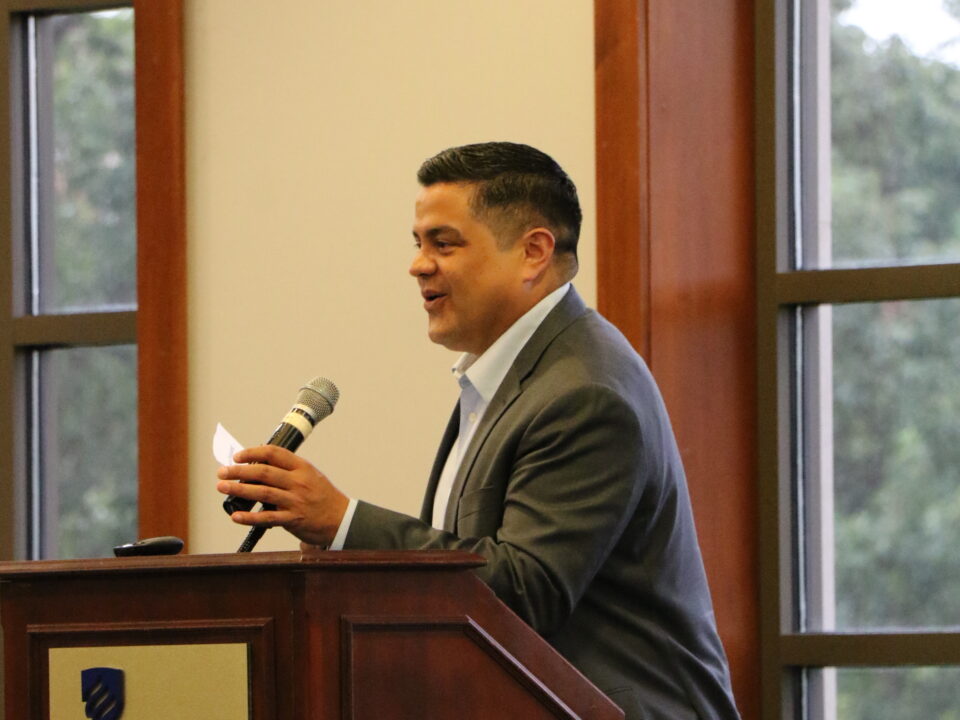
Rabbi Steven Bob of Congregation Etz Chaim, a synagogue in Lombard, Illinois, presided over the service, while Cindy Michelassi of the same congregation provided music for the event.
“Because the Holocaust stands as testimony against everything we stand for — everything we stand for as a university, everything we stand for as a society — we have to confront it,” the rabbi told the audience. “We can never make sense of the Holocaust, but we can hope to make sense of the meaning of leading our lives after the Holocaust.”
Throughout her lecture, Amy Lutz delved into the life and legacy of Carl Lutz, explaining that he was born into a Methodist family in Switzerland in the late 19th century. In 1913, he immigrated to the United States, where he resided and worked in Granite City, Illinois, for about five years.
Carl Lutz attended Central Wesleyan College in Warrenton, Missouri, as he initially desired to be a pastor, traveling around the world as a missionary. However, as Amy Lutz explained, Carl Lutz quickly learned that he was not a proficient public speaker, as he was a perfectionist who was uncomfortable speaking in front of large groups.
Realizing that a path to the pulpit was therefore likely not for him, Carl Lutz transferred to George Washington University in Washington, D.C., graduating in 1924 with a bachelor’s degree. Following this, he entered diplomatic service, initially as a Swiss consul in Philadelphia and St. Louis. While working in the latter city, he met fellow Swiss national Gertrud Fankhauser, whom he married back in Switzerland in 1935.
After more than three decades in the United States, Carl Lutz was sent to Palestine, which was under British mandate at the time. He worked 20-hour days negotiating the release of German prisoners of war, earning praise from his superiors and becoming “kind of known in diplomatic circles as this well-spoken, efficient, German-speaking diplomat,” according to Amy Lutz.
In 1936, Carl Lutz and his wife witnessed the lynching of a Jewish man in the streets. The following day, Carl Lutz wrote a letter to his brother in which he stated, “I swore to the victims, as they suffered hits and stabs, that one day I would speak up for them.”
In early January 1942, Carl Lutz was transferred again, this time to Budapest, Hungary, being promoted to vice consul. Following the Nazi invasion and takeover of Budapest in 1944, which led to the beginning of deportations of Hungarian Jews to the Auschwitz concentration camp, Carl Lutz acted swiftly by authorizing around 7,800 protective documents, which he claimed were for families rather than individuals, multiplying their effect.
In addition to this large-scale covert rescue operation, Carl Lutz once jumped into the freezing-cold Danube River to rescue a Jewish woman who survived being shot by the Arrow Cross Party, a Hungarian fascist political party allied with the Nazis. Carl Lutz spoke so confidently to these machine gun-wielding soldiers that he was able to convince them to allow him to take the woman to a safe zone known as the “International Ghetto.”
On a separate occasion, Carl Lutz saved two teenage Jewish boys who were to be executed for stealing a rotten carrot from a nearby field. In the meantime of these heroic acts, Gertrud Lutz-Fankhauser would often bribe Hungarian officers with candy “to look the other way.”
The Lutz couple were later jointly awarded the title of “Righteous Among the Nations” for risking their own lives to save those of Jewish individuals during the Holocaust. Additionally, Carl Lutz was thrice nominated for a Nobel Peace Prize in the 1960s.
Closing the event, Rabbi Bob noted the Jewish teaching that there are 36 righteous people hidden among every generation. The rabbi said that Carl Lutz’s example shows he could have been one of these 36 righteous people, though anyone can follow in his footsteps.
“The question for us is, how can we be one of these 36 righteous people?” the rabbi asked. “What can we do, in our own small way, in the world in which we live, to lift people up?”