“Bad Theology Kills”: Tisha Rajendra Challenges Christian Hypocrisy in the Staudt Intercultural Lecture
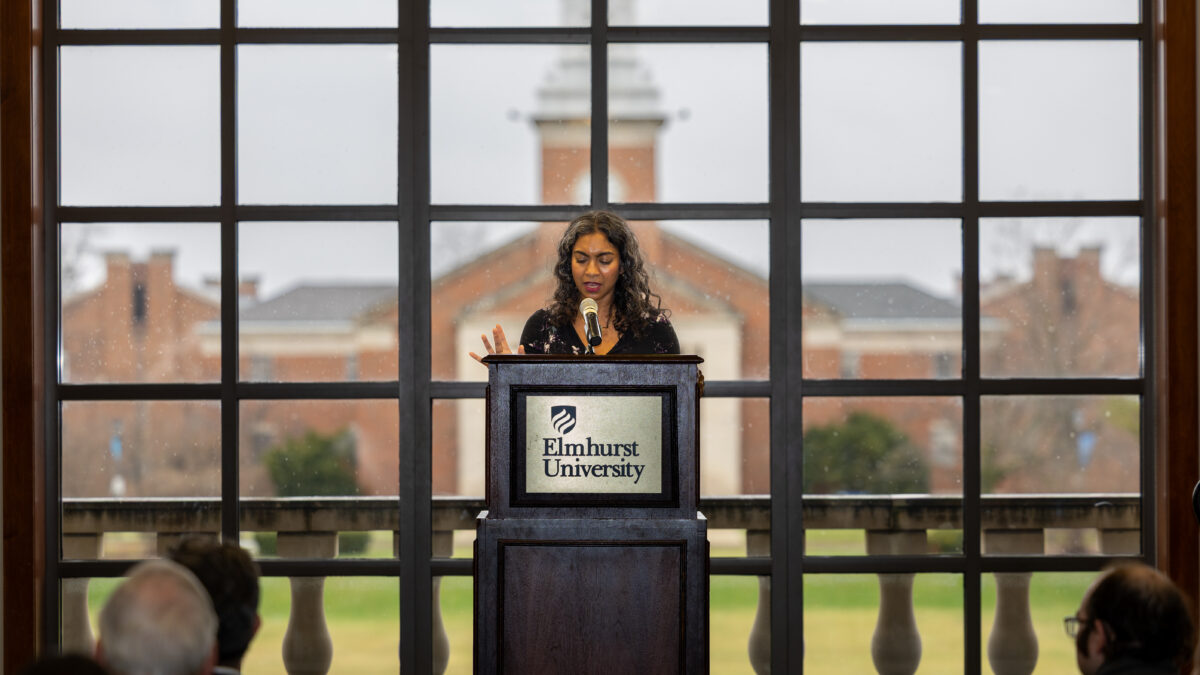
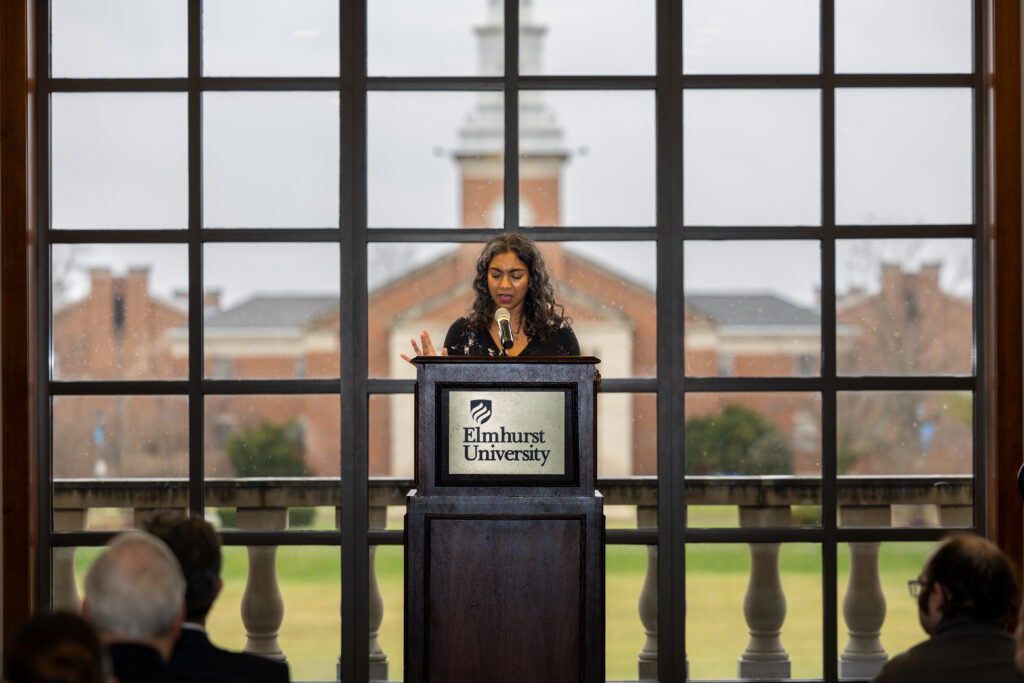
Tisha Rajendra speaks during the Staudt Intercultural Lecture as part of EU’s annual intercultural lecture series on March 11. (Gerardo Trujillo)
Tisha Rajendra, Ph.D., questioned the sincerity of Christian ethics under the second presidency of Donald Trump throughout her iteration of the Genevieve Staudt Intercultural Lecture, “Immigration: Lessons of Resistance and Hope,” delivered in the Frick Center Founders Lounge on Wednesday, March 11.
The Staudt Intercultural Lecture was established in 2002 and is held each spring, usually in March, in coincidence with Women’s History Month, in addition to being part of Elmhurst University’s Women’s History Celebration.
The lecture series is named for Genevieve Staudt, who served as a member of Elmhurst’s faculty from 1931 to 1961, beginning her tenure one year after the university became a coeducational institution in 1930. During her time at Elmhurst, Staudt worked her way up to becoming dean of women, then dean of students in 1948.
In her letter of acceptance to Timothy Lehman, who served as Elmhurst’s seventh president from 1928 to 1948, Staudt closed with the statement, “I am eager to measure up to the standards you’ve set for me, but even more to the ones I long ago set for myself.”
During this year’s adaptation of the lecture series, Rajendra, an associate professor in Loyola University Chicago’s department of theology, highlighted the mistreatment of detainees of the Trump administration, many of whom remain nameless to the public. Rajendra added that many detainees have been starved and denied medical care in detention facilities, which she said have been referred to as concentration camps.
“And the thing that I just really can’t get my head around is that a lot of this is actually legal, according to the courts,” Rajendra said. “And even if some of it is not legal, who is going to argue with the gun in their face?”
Rajendra’s education includes a Bachelor of Arts in linguistics from Bryn Mawr College, a Master of Theological Studies from Harvard University, and a Doctor of Philosophy in theological ethics from Boston College.
Additionally, Rajendra authored “Migrants and Citizens: Justice as Responsibility in the Ethics of Immigration,” published in 2017, and is working on a second book about immigration, which focuses on the new immigration policies of the Trump administration. Rajendra shared several excerpts from her upcoming book — which she said she hopes to complete by May — with the dozens of attendees at the lecture.
Rajendra stated that “Christians made this moment possible,” pointing to a 2024 exit poll by the Public Religion Research Institute, which showed that 81% of White evangelical Protestants voted for Trump, along with 63% of Hispanic Protestants, 60% of White Catholics, and 57% of White nonevangelical Protestants.
“So that means that long list of awful things going on is made possible by people who are at least nominally Christian,” Rajendra said.
Rajendra drew parallels to the democratic election of Adolf Hitler, at which time at least 98% of Germans were baptized Christians.
“This meant that the people who voted for Hitler were Christian,” Rajendra said. “The people who implemented the Final Solution were Christian. The people who didn’t say anything were Christian. The people who were too concerned with their own problems were Christian.”
Rajendra noted that a few Nazis, especially at the higher levels, actually renounced Christianity, instead proposing a variant known as “German Christianity,” which she described as “like Christianity with the symbols, but none of the ethical demands.”
Rajendra highlighted Catholic prelate Michael von Faulhaber, Lutheran pastor and theologian Dietrich Bonhoeffer, and student Sophie Scholl, all of whom were Germans who fought against the Nazi Party. Bonhoeffer and Scholl were both sentenced to death and executed, aged 39 and 21 respectively.
Rajendra explained that many defended their lack of resistance to the Nazi regime by arguing that their efforts wouldn’t have done any good anyway, with one German soldier testifying in court that although he knew it was wrong and would have died for it, “totalitarian governments always have a way of disappearing people.”
Shifting the focus to the present, Rajendra spoke of violent acts by U.S. Immigration and Customs Enforcement (ICE) agents, many of whom, she acknowledged, are Christians. In addition to the fatal shootings of protesters Renee Good and Alex Pretti by federal agents, Rajendra highlighted Marimar Martinez, a 30-year-old woman who survived being shot five times in Chicago by a U.S. Border Patrol agent on October 4, 2025, only to be charged the very next day with assaulting federal officers, with these charges being dismissed in November.
With the March 17 primary elections for the 2026 midterms rapidly approaching, Rajendra advised voting, telling attendees that “if Republicans lose control of Congress, there’s a lot that a Democratic Congress can do.”
Rajendra also recommended finding and joining immigration advocate groups, whose work includes patrolling neighborhoods and distributing food to immigrant families.
“Christianity does not protect them [ICE agents], nor does it protect us, from this kind of complicity,” Rajendra warned.