From Fundraising to Depop: How Students Are Embracing Thrift Culture
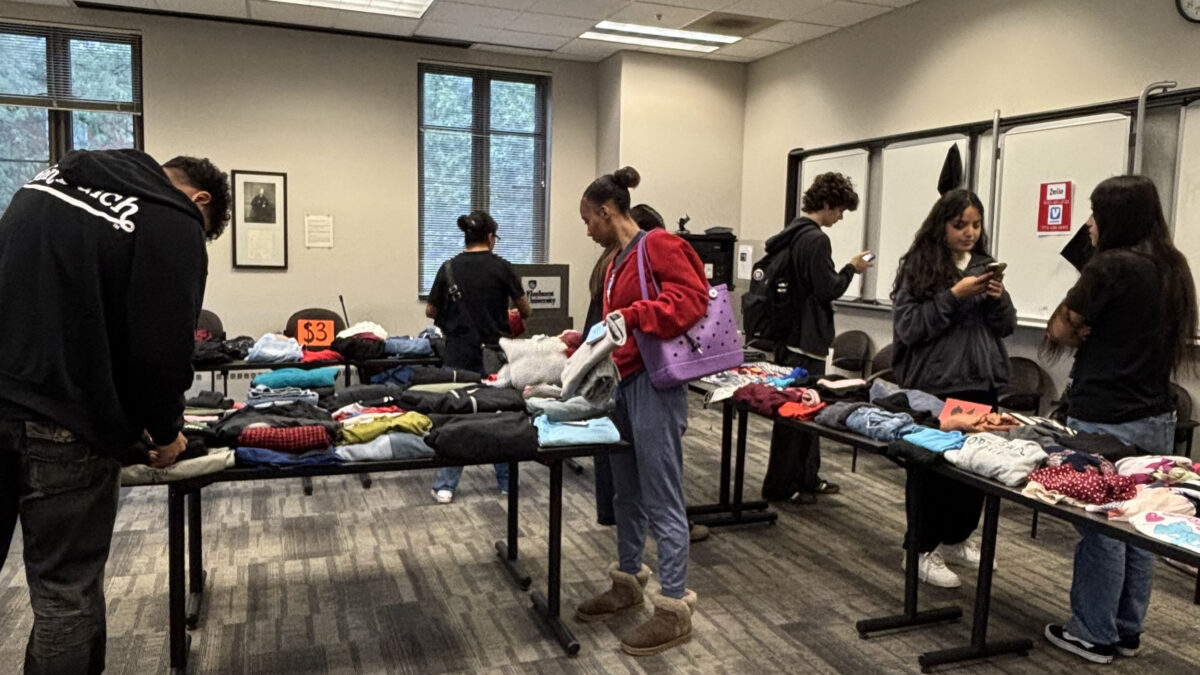

Students thrift for clothes at the EU Latin Dance Troupe fundraiser, “Sazon & Style.” || Photo by Emanuella Rey
Students gathered Oct. 1 in the Bryan Room of the Frick Center for a thrifting event, Sazon & Style, hosted by the Elmhurst Latin Dance Troupe (ELDT). For ELDT Captain Nely Zavala, the event’s turnout showed just how interested students are in secondhand fashion.
“This Sazón and Style might be the most successful so far,” Zavala said, as many students attended the event and left with new pieces for their closets.
For the dance team, choosing a fundraising event meant finding something that students could benefit from, including affordable pricing. Holding the event on campus also made thrifting more accessible.
ELDT’s event shows one way students are participating in secondhand fashion, but the appeal of thrifting goes beyond finding inexpensive or unique clothing. For some, it might be a way of making some extra money.
The interest in secondhand fashion extends beyond campus; thrifting has become increasingly common among Gen Z. According to a 2026 Resale Report by ThredUp, a large online consignment and thrift store, 62% of Gen Z shoppers purchased secondhand clothing in 2025, while 58% say they prioritize secondhand over buying new.
This interest is also reflected in the growing popularity of resale platforms. The Harris Poll reported that Depop saw a 12% increase in brand equity among Gen Z adults between the fourth quarter of 2024 and the first quarter of 2025.
For senior Auris Partida, Depop offers a way to resell clothes she no longer wears while giving them a second life.
“I started selling on Depop because I know the clothes I no longer wear can still be loved by someone else, and that makes me really happy,” Partida said.
Although Partida describes herself as someone who loves fashion and a “shopaholic,” she realized that just because she no longer wants to wear something does not mean it has lost its value. Someone else might be looking for the exact piece she has, and by letting it go, she can make room for new items in her closet.
When selling clothes, she makes sure to choose pieces that she would personally buy from someone else, and that they are in great condition. Beyond reselling, Partida also turns to thrifting to find unique and special pieces that are no longer considered “trendy” and can be difficult to find in regular stores.
Whether students are buying secondhand at campus events or reselling clothes online, one argument for thrift culture is its potential environmental impact.
“Buying and selling secondhand clothing is a smart choice — for the environment and for your wallet,” said Tamara Marsh, professor of environmental policy. “Plus it’s fun to hunt for the ultimate bargain.”
Marsh explained how buying new clothes is more likely to have a significant impact on the environment due to its manufacturing, such as synthesizing fabrics from petroleum, producing microfiber, and microplastics particles that can move into water sources, or by transporting goods from international manufacturers.
“There are always externalities in any manufacturing process, however, the more that we can buy and sell secondhand the less impact there will be on the environment,” Marsh said.
Additionally, Marsh mentioned that many unwanted clothing ends up in landfills, where space in the U.S. and abroad is becoming increasingly limited. According to the U.S. Government Accountability Office, 66% of textiles were discarded in landfills in 2018. Recent reports note that national disposal data is limited.
“Preventing textiles that still have some value and ‘life’ in them from entering a landfill, keeps these materials out of the waste stream,” Marsh said.
She also said that many people assume that materials in landfills will degrade over time.
However, the degradation process relies on the availability of oxygen, which is usually quite limited in landfills. If discarded clothing contains any synthetic fabrics, such as polyester, rayon, polyamide, acrylic, and modal, any degradation that may occur will be incredibly slow and generate microplastics that can move into the water cycle, according to Marsh.
Zavala from ELDT also sees sustainability as being part of the purpose of Sazón & Style. Because they can reuse leftover clothing or collect new donations, Zavala said the team hopes to continue hosting the event throughout the school year.