Justice, Equality, and Faith at EU’s Annual MLK Lecture


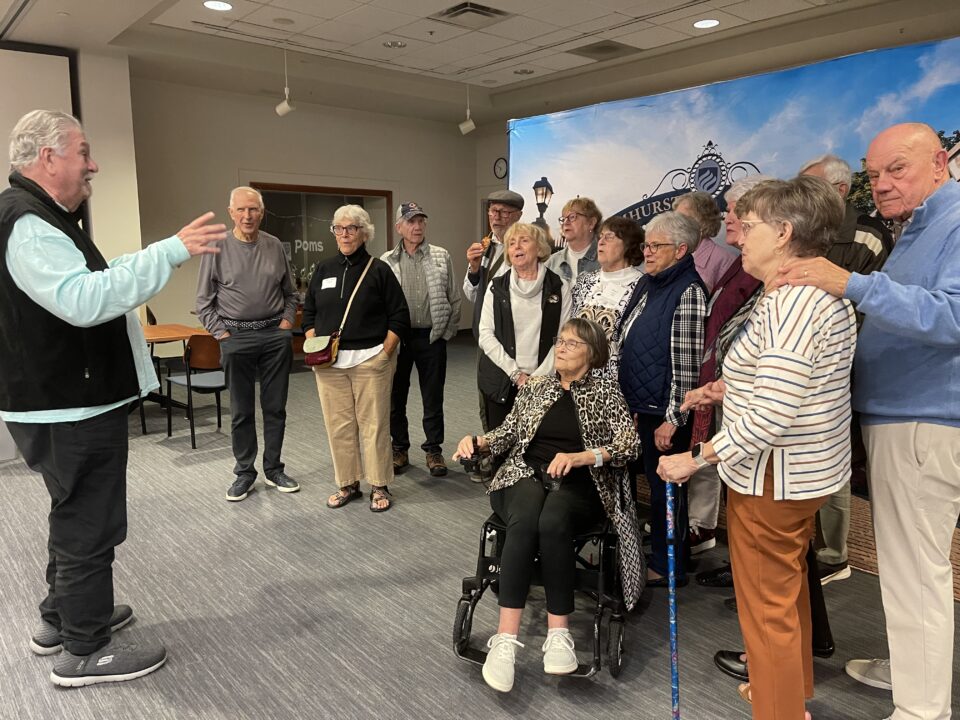
The Rev. James E. Shannon points to the crowd during EU’s annual MLK Intercultural Lecture Feb. 18. (Gerardo Trujillo)
The Rev. James E. Shannon, MDiv, interwove the history of the Civil Rights Movement with themes of spiritual empowerment at this year’s installment of the Martin Luther King Jr. Intercultural Lecture, delivered in the Frick Center Founders Lounge on Wednesday, Feb. 18.
The MLK Lecture debuted back in 1993 and is held annually in February in celebration of Black History Month. This year’s lecture was held 60 years after King spoke to an audience of more than 1,000 white suburban people in Hammerschmidt Memorial Chapel in 1966. Incidentally, the lecture also took place the day after the death of fellow American civil rights activist and Baptist minister Rev. Jesse Jackson.
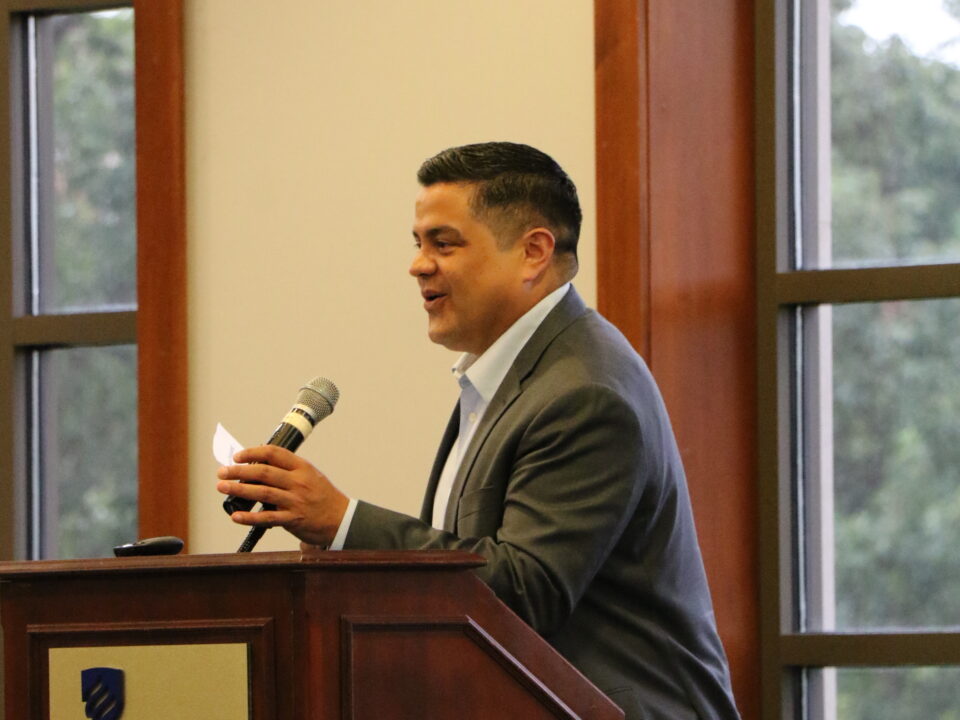
Shannon, a pastor and community activist, was introduced by Alexander Blumenberg, Elmhurst University’s executive director for inclusion and belonging, who noted that the Civil Rights Movement is an ongoing battle.
“We are reminded that the work of civil rights and public service continues through generations — sometimes imperfectly, but always with the weight of history behind it,” said Blumenberg. “The movement is not a chapter we read about, but it is a living story that we are still writing.”
Shannon, baptized at the age of 12 by none other than King himself, graduated from Booker T. Washington High School and later from college before relocating with his wife to Chicago, where he taught in the Chicago Public Schools systems and worked in management for several large corporations.
Shannon served for 25 years at the Leadership Council for Metropolitan Open Communities, one of the largest fair housing organizations in the United States. In 2007, he opened Peoples Community Church in Glen Ellyn, Illinois, becoming full-time pastor in 2013.
In April 2023, Shannon made history by becoming the first African American to be elected to the Glenbard District 87 School Board, pledging to ensure that “every student, regardless of race, creed, color, gender, sexual orientation or nationality has access to a quality education.” Additionally, he is the first African American to be named Glen Ellyn Man of the Year, receiving this honor in 2024.
After holding a moment of silence and prayer for Jesse Jackson, Shannon delved into his experience growing up in Montgomery, Alabama, where he witnessed segregation everywhere from buses and schools to movie theaters and cemeteries.
This racial discrimination was compounded by the 1955 abduction and lynching of 14-year-old Emmett Till in Mississippi, as well as the 1958 electric chair execution of 22-year-old Jeremiah Reeves in Alabama. Reeves, who attended the same high school as Shannon, had been convicted of raping a white woman in 1952, when he would have been 16 years old.
Despite these tumultuous circumstances, King oversaw the Montgomery bus boycott, which lasted 381 days, involved 50,000 Black Americans, and led to the bankruptcy of the bus company.
Shannon told those in attendance that King had been given a special purpose from God.
“God had to raise up someone that would deliver,” Shannon preached. “God had to raise up someone that would raise some justice.”
“And I want you to understand that God created you for a purpose, and nobody can do it but you, and you have to do it, and you are not going to be happy until you do what God created you to do,” Shannon added. “Man has many plans. But it’s the plan of God that prevailed.”
Shannon drew parallels between the Civil Rights Movement and contemporary demonstrations against U.S. Immigration and Customs Enforcement (ICE) agents in Minnesota, which escalated in the aftermath of the fatal shootings of Renee Good and Alex Pretti.
“The power is in the protest,” Shannon said. “The victory is always in the protest.”
Shannon also offered a warning about ongoing events in Washington, D.C.
“When they say ‘Make America Great Again,’ when do you think America was great to them?” asked Shannon. “It was great during segregation and discrimination. And if we don’t wake up, we’ll be back there.”
Shannon emphasized an importance of embracing God’s gifts, just as King utilized his.
“Don’t always let money be your motivator. Let God’s purpose be your motivator,” Shannon instructed the attendees toward the end of his speech. “And when God’s purpose be your motivator, you can do some powerful things in life. God created you for a purpose.”