Antonio Ramirez Details Venezuela in Sylvia Mendez Lecture
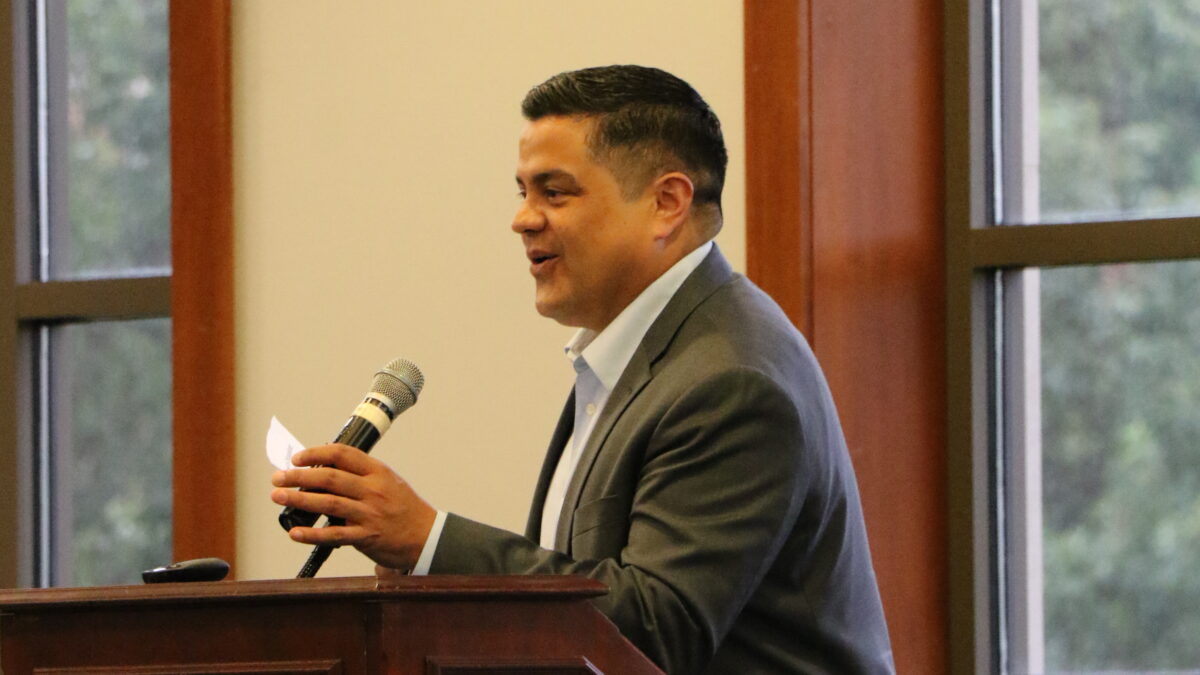
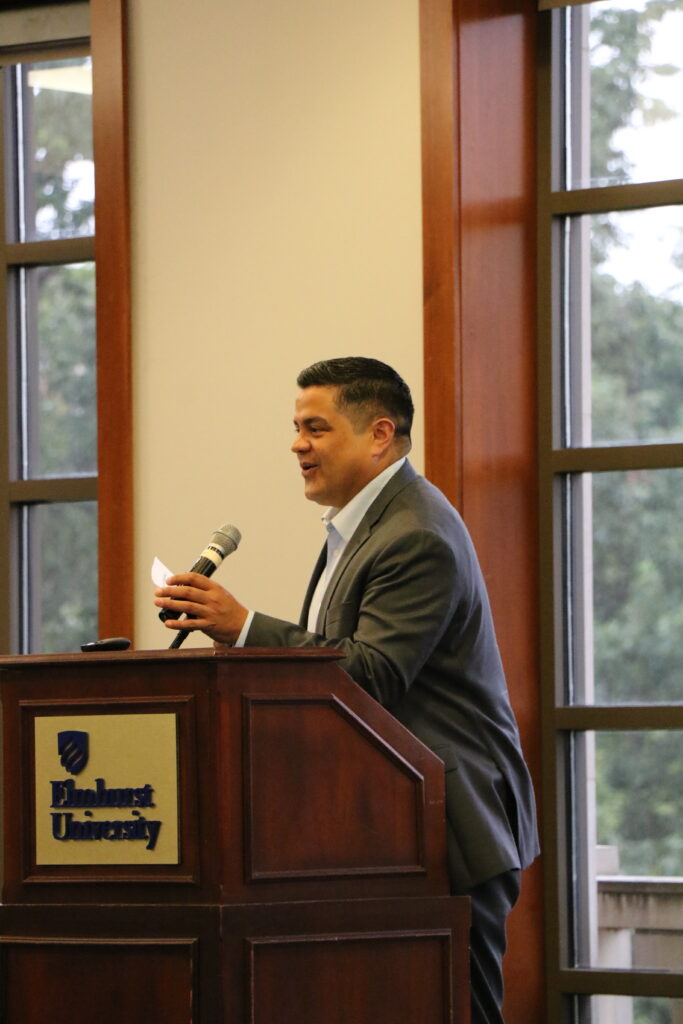
Antonio Ramirez, Ph.D., speaks at the inaugural Sylvia Mendez Intercultural Lecture in the Frick Center Founders Lounge on Wednesday, Sept. 16. || Photo by Ava Valderrama
Antonio Ramirez, Ph.D., an associate professor of history at Elgin Community College in Elgin, Illinois, outlined a rich cultural history of Venezuela and its inhabitants throughout the inaugural Sylvia Mendez Intercultural Lecture, delivered in the Frick Center Founders Lounge on Wednesday, Sept. 16.
The lecture, held every September as part of Elmhurst University’s Hispanic Heritage Month celebration, is one of four in the university’s annual intercultural lectures series, preceding the William R. Johnson Lecture in October, the Martin Luther King Jr. Lecture in February, and the Genevieve Staudt Lecture in March. Originally established in 1996 as the César Chávez Intercultural Lecture, the lecture series was renamed this April in light of extensive sexual abuse evidence against Chávez.
As explained by Beatriz Gómez Acuña, Ph.D., professor of Spanish in EU’s Department of World Languages, Literatures and Cultures, Mendez “is an extraordinary civil rights icon whose family changed the course of American educational history.”
Mendez was born on June 7, 1936, in Santa Ana, California, to father Gonzalo Mendez, an immigrant from Mexico who worked his way up to managing a successful agricultural farm, and mother Felicitas Mendez, a passionate civil rights organizer from Puerto Rico.
In 1944, seeking better economic opportunities, the Mendez family moved to an apartment in Westminster, California, though the district refused to admit Sylvia and her brothers to the local elementary school due to their dark ethnicity and Spanish last name. They were instructed to instead attend Hoover Elementary School, a segregated Mexican school with a curriculum focused on preparing female students for domestic housekeeping and male students for manual farm labor.
Refusing to accept this second-class status for his children, Gonzalo Mendez hired civil rights attorney David Marcus alongside four other Mexican American families. Marcus filed what would become the landmark class action federal lawsuit Mendez v. Westminster against four school districts in Orange County, California, representing more than 5,000 Hispanic schoolchildren.
On Feb. 18, 1946, federal Judge Paul J. McCormick ruled that forced segregation violated the 14th Amendment, a decision that was upheld on appeal in 1947. Seven years after this verdict, NAACP attorney Thurgood Marshall would use the legal arguments and briefs in the Mendez v. Westminster case as a blueprint to integrate schools nationwide via the 1954 landmark case Brown v. Board of Education.
Sylvia Mendez went on to earn a bachelor’s degree in nursing and dedicate 33 years of her life to public healthcare as an assistant director of pediatric nursing, after which she became a full-time civil rights advocate, visiting schools across the United States to share her story and encourage young students of all backgrounds to pursue higher education. On Feb. 15, 2011, Mendez was awarded the Presidential Medal of Freedom — the highest honor a U.S. citizen can receive — by President Barack Obama.
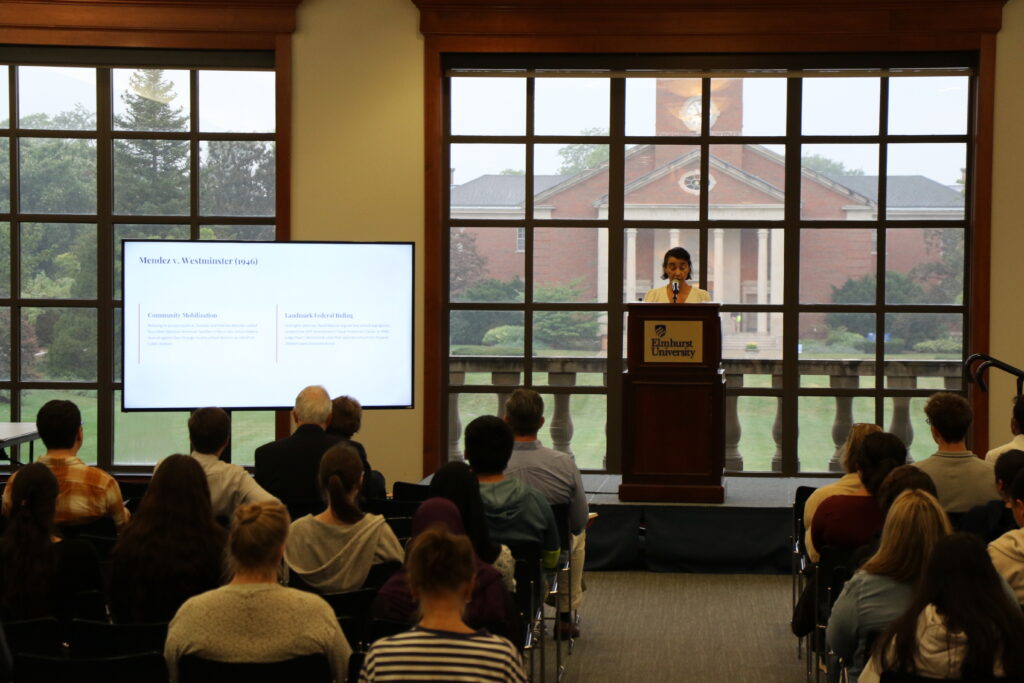
Beatriz Gómez Acuña, Ph.D., overviews the life of civil rights activist Sylvia Mendez, the lecture’s new namesake, prior to Ramirez’s lecture. || Photo by Ava Valderrama
Ramirez, who previously delivered the 2023 installment of this lecture series, began this year’s lecture, entitled “From Venezuela to Chicago: The History of a Mass Migration,” by describing his personal experiences with Venezuelan individuals in the Chicagoland area, including Venezuelan students at Elgin Community College, as well as a Venezuelan woman who had purchased his previous home in Elgin after fleeing Venezuela.
“Part of the reason that I am interested in Venezuelans as well is that their new presence in the United States is going to diversify not only our country but also our understanding of what it means to be Latino in the United States,” said Ramirez.
Ramirez explained that although Venezuela has a current population of about 30 million people, the country has lost more than 25% of its entire population in recent years due to various social, political, and economic crises. This would be equivalent to the United States losing between 75 million and 100 million people, Ramirez said.
Oil has dominated Venezuela’s economy, with the nation becoming the world’s second-largest exporter of petroleum by 1928 and the world’s largest exporter of petroleum by 1935. In the mid-1970s, whereas a typical farmworker in Venezuela earned about 500 bolivares per year, oil field workers earned about 72,000 bolivares per year.
However, due to oil prices declining in the 1980s, the bolivar became devalued, leading to Venezuela’s per capita spending falling by about 40% and minimum wage falling by about 60% during this period. Ramirez likened this reduction to a $15 per hour minimum wage falling to $6 per hour.
Venezuela’s economy only worsened under President Nicolás Maduro, with the country’s gross domestic product (GDP) shrinking by 67% between 2013 and 2020, the largest documented depression in Latin American history as well as one of the 10 largest in world history.
To make matters even worse, hyperinflation in Venezuela rose to 130,000% in 2018. For comparison, Ramirez said, if the United States experienced that level of inflation, $100 would suddenly be worth only $8, while a $100 product would suddenly cost $130,000.
Amidst crises such as these, the Venezuelan population in the U.S. has grown by at least 300% since 2010, with tens of thousands arriving in Chicago alone. The city’s migrant crisis has been facilitated by governors in states such as Texas and Florida busing migrants to Democratic-led sanctuary cities, which Ramirez referred to as a cruel political scheme.
Furthermore, although the Biden administration granted temporary protection status to nearly half a million Venezuelans, within the first week of his second presidency, Donald Trump removed all of these protections, leaving hundreds of thousands of Venezuelans at imminent risk of deportation.
“It’s not a great note to end on, not a happy note to end on. But 2026 has seen lots of changes in Venezuela,” explained Ramirez. “We’ve seen the United States and Venezuela become closer allies than perhaps they have been since those heady days of the oil boom, but it seems more like allies of mutual benefit rather than allies that are trying to benefit the people of Venezuela.”
However, Ramirez also reminded attendees that despite the unprecedented struggles Venezuelans continue to face, these difficulties have shown people’s willingness to help those in need, often in the form of becoming involved with mutual aid organizations.
“And fortunately, there are lots of people doing that mutual aid work around the Chicagoland area,” Ramirez noted.
The next intercultural lecture at Elmhurst University, the William R. Johnson Lecture, is set to be delivered by University of Illinois Chicago communication scholar Billy Huff in the Founders Lounge on Wednesday, Oct. 14, in honor of National Coming Out Day and the university’s commitment to the LGBTQ+ community.