EU Admin Streamlines Academic Dishonesty Process with New Flowchart
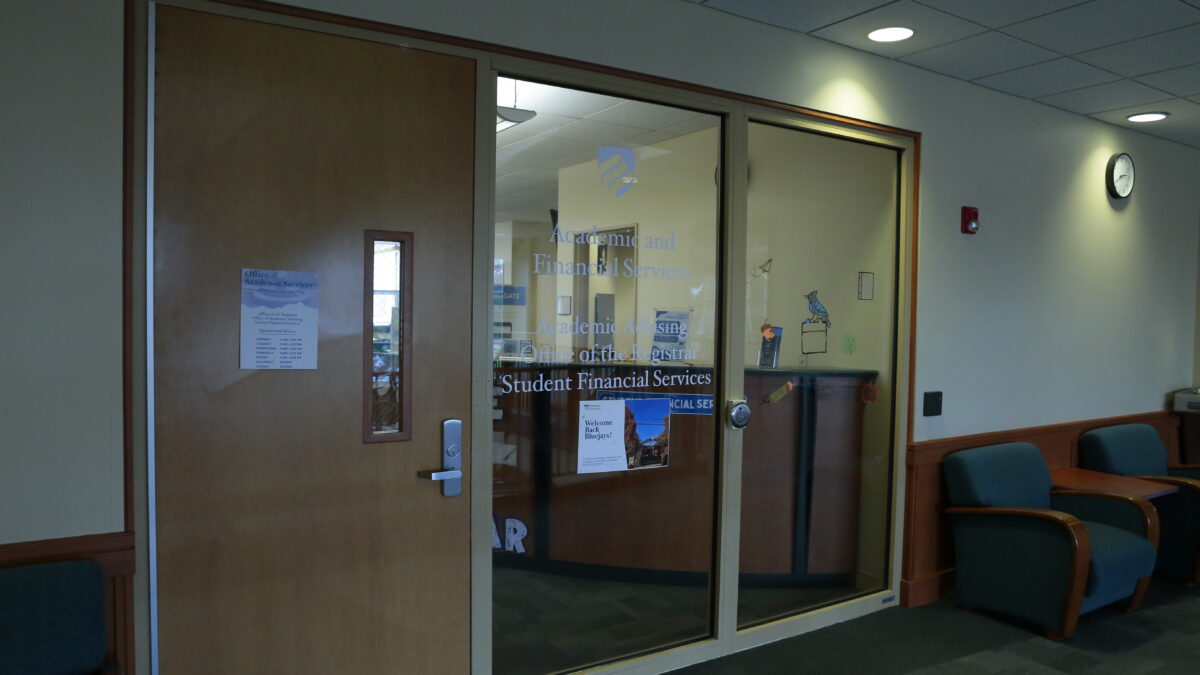
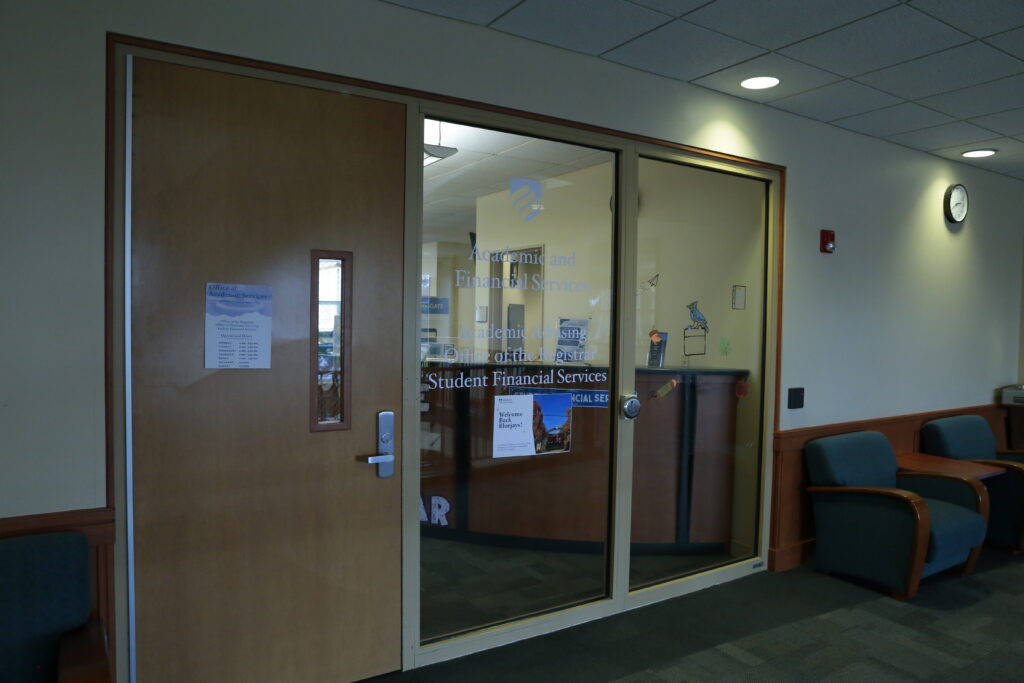
The Elmhurst University Office of Academic Services and Office of Student Financial Services, located on the second floor of Jean Koplin Memorial Hall. || Photo by Star Herring
Earlier this semester, faculty gained access to a new flowchart detailing how to deal with academic dishonesty. While there are no major changes in protocol for faculty, the chart is meant to streamline the process and clear up any transparency concerns or confusion, according to Tina Kazan, Ph.D., associate dean for academic success and professor of English.
“What the flowchart is, it was meant for faculty to be able to have a visual for the various steps when there is a concern that a student has violated the academic integrity policy,” Kazan said.
This year faculty are being asked to send an alert through Navigate when they suspect an academic integrity violation, Kazan said. Previously, faculty would file an incident report first.
The Navigate academic alert is visible to students, which aims to foster better communication between the faculty and the student involved.
Students have the same rights as years prior, and if a complaint is filed or a Navigate notice is issued, they will meet with faculty and staff, and have 10 days to appeal the decision.
If a student appeals, “a panel will then be convened consisting of the Vice President for Academic Affairs or their delegate, who shall chair the panel; the Vice President for Student Affairs or their delegate; two faculty members; and two students selected in consultation with the chair of the Academic Review Board,” according to the Student Handbook.
Tyler Fagan, Ph.D., assistant professor of philosophy, said the frequency of students who engaged in academic dishonesty pre-ChatGPT is about the same as those engaging in it now.
Fagan said it’s rare he’ll report a student for academic dishonesty — maybe once or twice a semester, though sometimes it’s zero.
When junior Alexis Delapaz first attended college in 2019, he said, it was impossible to get away with cheating.
“As a young student back in the day, I tried to find ways to obviously make it easier, but you really had to force yourself to do your work,” Delapaz said. “Even if you did cheat, the professors already knew because back then the professors had a connection with the students — they kind of knew how someone wrote.”
Now, he said, faculty can’t keep up with how students use AI to cheat. While he personally doesn’t use the technology on assignments because he’s “kind of old school,” and his pre-AI experience in college helped him develop stronger work habits, he said it’s become all too tempting for students to use.
But while students like Delapaz are experiencing an evolving college experience, faculty are also navigating the process of responding to suspected academic integrity violations.
“I think [the flowchart] was helpful in putting out a more consistent and standardized way for a bigger swath of faculty who maybe weren’t as clear or maybe thought that they were clear or maybe thought some version of, ‘This is how we do it, but I’m not totally sure that that’s how they do it everywhere on campus,’” Fagan said.
He said before mainstream AI, it was easier to point to exactly where a student used a source without the proper citation. Now, it’s almost impossible because the technology takes in huge amounts of data to be trained on and then generates novel outputs.
In response to AI, Fagan changed a few things about the way he teaches to make using AI less possible and less tempting. He often gives his students low-stakes, in-class writing assignments towards the beginning of the semester.
“It’s helpful for me to get a feel for how my students think and write and talk so that when one of them suddenly turns in something that sounds completely different from everything that they’ve said and written up to this point it sets off some alarm bells.”
Sophomore Kevin Barker said he thinks cheating is harder to catch if you can change the output to look less artificially generated. He also worries that professors might wrongly accuse students of using AI.
“It does raise a little bit of concern to just be mislabeled, ‘cause I’ve had a couple of papers where I’ve written them by hand, and it’s come back and said that 20% of it was AI,” Barker said. “I could tell you for a fact that I wrote everything that was on that page. How are you gonna tell me that this was written by AI?”
Barker said he thinks cheating is more prevalent now with AI, and that the technology is tempting for a lot of students.
“It’s just very difficult for some people to make a better choice when the worst choice is so easy for them to make,” Fagan said. “It would be like, if you took an exam in class or something and I’m gonna say, ‘Here’s the book with all the answers in it.’”