Ira Flatow: A Communicator of Science in an Era of Misinformation
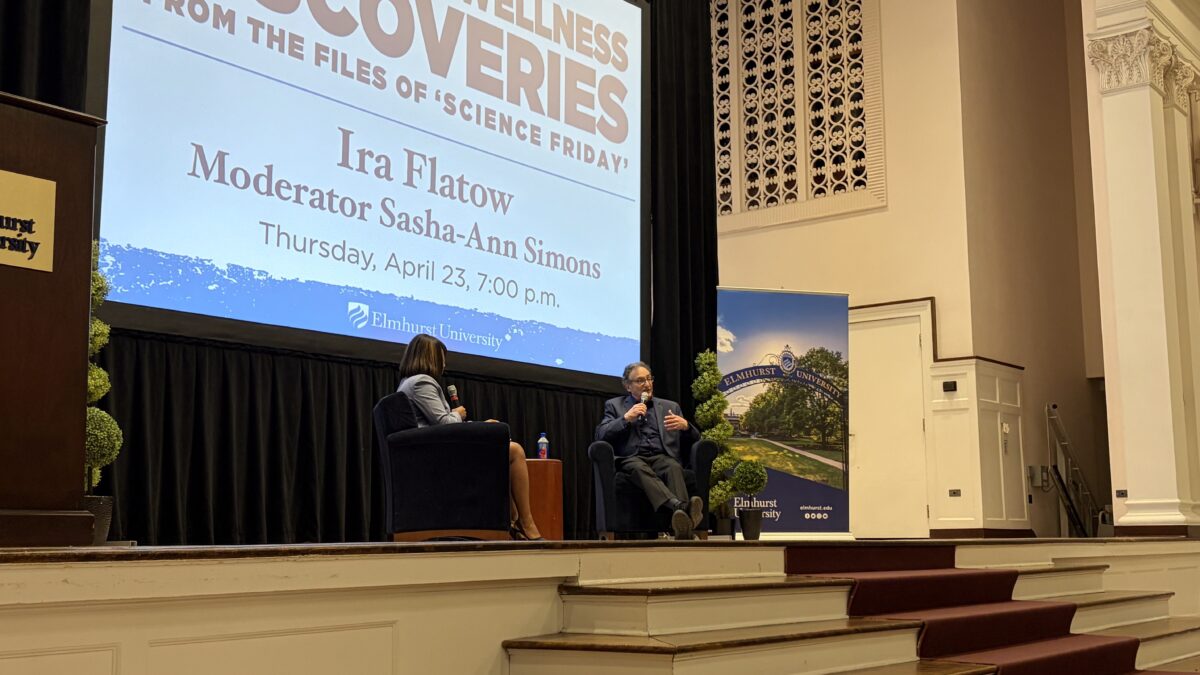
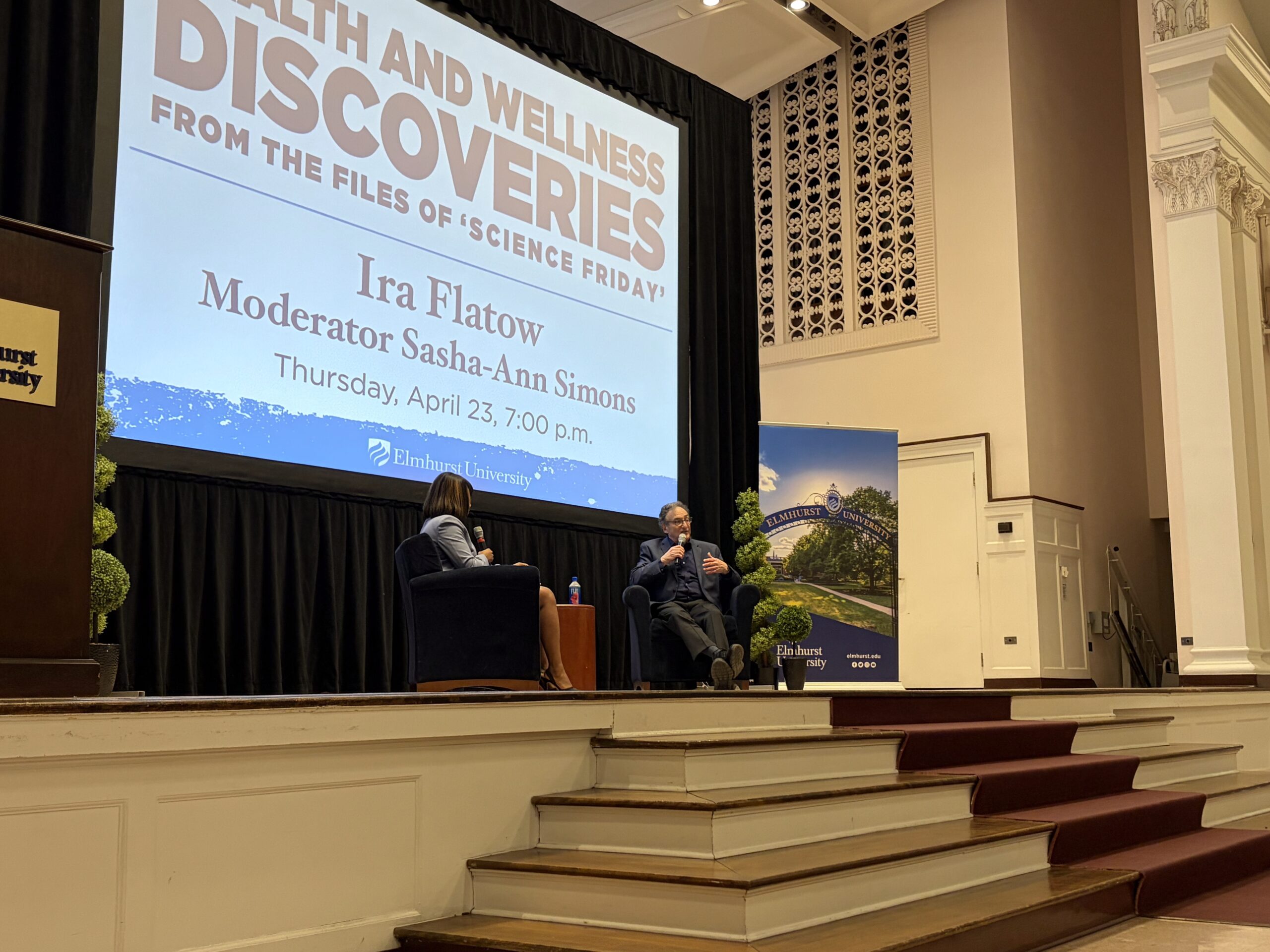
Moderator Sasha-Ann Simons and Ira Flatow speak during the Roland Quest lecture on Thursday, April 23 in Hammerschmidt Memorial Chapel. (Ashley Vanderhoff)
Ira Flatow, award-winning science journalist and host of “Science Friday” — a radio program that transforms complex subjects into accessible information for millions around the world — once had a scientist throw him out of his office.
“He just thought I was too dumb, because I was asking basic questions,” Flatow said. “I’d ask the same question over and over again in a different way until I got an answer I could understand.”
That persistence — or as Flatow would say, “curiosity” — has bound together his decades-long career.
Flatow visited Elmhurst University on Thursday, April 23, for an annual lecture honoring alumnus and aerospace engineer Roland Quest. In conversation with WBEZ Chicago’s “In the Loop” host Sasha-Ann Simons and in an interview with The Leader, he discussed key questions in science and reflected on the challenges of communicating it in an increasingly polarized and misinformation-heavy media.
The Politicalization of Science
Over the course of his career, Flatow said, the most surprising shift in public perception he’s witnessed is the recent politicalization of science.
“The politics we have now, that’s bashing science — I’ve never seen this before. I’ve been doing this for over 50 years,” Flatow said in an interview with The Leader. “I’ve never seen this total dismantling of our science institutions, and that’s just terrifying.”
“Science Friday” has been on the air since 1991, and has witnessed six different presidential administrations. Before recent years, Flatow said, booking guests across political lines was routine, but now many public officials are unwilling.
“We never had any trouble getting Bush Republicans on the radio,” Flatow said to The Leader. “The science advisors, the Congress people who vote for money — they don’t even answer the phone now.”
Following the Trump administration’s weakening of federal science, Flatow’s comment highlights the erosion of science advisory bodies across government, including at the Environmental Protection Agency and the Centers for Disease Control and Prevention. In total, nearly 95,000 employees have left federal science agencies.
“We can’t question [the administration], and they’re not really interested in advancing science,” Flatow said. “They’re interested in denigrating it — vaccinations, health, even the space program is being ripped apart.”
While “Science Friday” is certainly a passion, Flatow notes it also holds a responsibility. He said he and his team debunk as much misinformation as possible through its episodes. He also encourages his audience to think of science as a methodology of finding out the truth — a moving target — not, as many think, purely binary questions. The general public, he said, had the opportunity to witness this concept during the COVID-19 pandemic and the development of vaccines.
“If we learn nothing else from this, it is that science is just a snapshot in time of what we know, and we have to be ready to change what we know when the data changes along the way — doubt is good in science; failure is a great option in science,” said Flatow.
Flatow stressed the importance of preserving science institutions: “Democracy can’t survive without science, and science can’t survive without democracy.”
Artificial Intelligence and Accountability
Flatow also shared his perspective about AI, which he described as both promising and potentially dangerous.
Flatow pointed to research showing AI can help doctors diagnose diseases, including cancer, more efficiently. Still, Flatow said he is worried about the future of the technology.
“I’m worried that AI is going to take over a lot of jobs,” Flatow said. “I think we need to regulate it, meaning Congress has to come up with a way, like it regulates health, food, and the environment — or it used to — and that has to happen with AI.”
For journalists in particular, Flatow said, AI reinforces the importance of fact-checking. He said that AI is a tool like anything else, and that some people put too much trust in it.
“You can’t trust it. You have to be comfortable with it like any other tool — know its limitations and always check the sources,” Flatow said.
The Moon and 95% of Our Universe
Flatow also discussed the Artemis II program, a crewed, 10-day journey around the moon in early April. It was the first crewed mission to the moon since 1972, when the final mission of NASA’s Apollo program was completed. Flatow said, while recalling the Apollo program, that this event was for a different purpose: money.
“Just about everything in our society is about making money,” Flatow said. “So now they’re trying to find places where they can set up moon bases, places they can live there, so maybe there’s a way to make tourism or mine.”
Flatow also emphasized the broader value of space exploration. Not only could the moon be a jumping-off point for Mars, but it was the image of Earth from space, he noted, that helped fuel environmental awareness in the 1970s.
“After the first moon missions, when we saw the Earth rise above the moon, we realized how fragile the Earth was,” Flatow said. “I’m hoping that feeling will be kindled again and help us understand how we have to take care of the Earth more than we do now.”
Flatow also talked more broadly about cosmology, as well as his curiosity surrounding dark energy: a mysterious repulsive “force” pushing the universe apart, an unknown property of space that, along with dark matter, is proposed to make up 95% of the universe. Yet, scientists still don’t know what it is.
But beyond being one of Flatow’s favorite topics, it belongs to an area called basic, or foundational, research. And while the government has historically been at the forefront of conducting foundational research, the funding for this work is often under stress.
“There was a researcher studying dark energy, and I said to him, ‘Of what practical value is knowing about dark energy?’ There was a little bit of a pause, and he said, ‘Absolutely nothing.’” Flatow said, paraphrasing.
Flatow also reminisced on his time co-starring on CBS’s “The Big Bang Theory,” where the script at the time asked a similar question: Why can’t we do science for the sake of doing science? The show, Flatow said, ended with a tribute to Nobel Prize-winning physicist Richard Feynman, who expressed a similar idea of doing science for the joy of knowing things.
“And kudos to that,” Flatow said.
Microbiomes and Microplastics
Other parts of the discussion turned inward, focusing on emerging research about the human body, particularly the microbiome — a complex ecosystem of trillions of bacteria, viruses, and fungi living in and on the human body — most notably in the gut. Despite our own bodies holding trillions of their own cells, there are more foreign microbial cells.
“We are a minor part of our own body,” Flatow said.
Additionally, Flatow pointed to research showing that a healthy microbiome from one person can be transplanted into someone with an unhealthy microbiome, through what he described as an “obvious and disgusting” process where a microbiome can be sampled through feces.
Flatow also discussed microplastics, now found in water, air, and human tissue, as an example of a developing scientific issue where many questions remain unanswered.
“I’m just hoping it doesn’t turn into the asbestos of our generation,” Flatow said.
The Future of Science
Despite the challenges Flatow discussed surrounding political polarization and emerging risks, he ended on an optimistic note by answering a final question from Simons: “What is giving you hope right now?”
“Young people,” Flatow said.
In conversations with younger generations, Flatow said he sees strong awareness of issues like climate change, as well as a willingness to engage with them directly.
Flatow echoed a similar sentiment with Simons, of turning awareness into action.
“We need people to stand up and let their voices be heard,” said Flatow.