
It’s About Time (And Neutrinos): Students Help Build Revolutionary Neutrino Detector
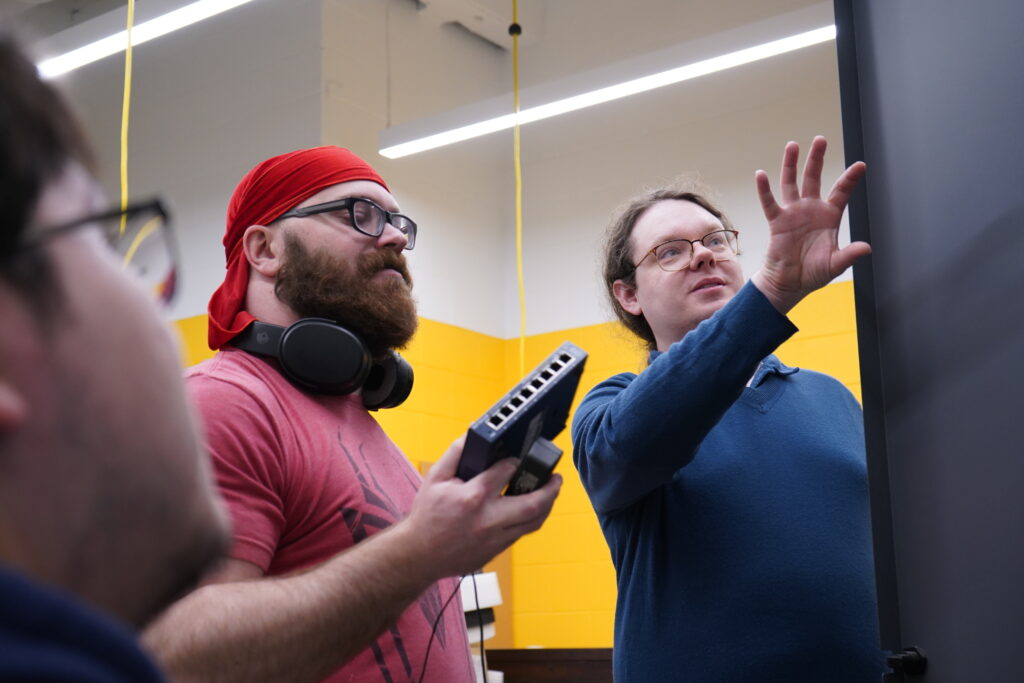
Robert Halliday describes the local network in the physics lab to Fred Fuchs and Axel Magaña Ponce on March 12. (Ian Murphy)
To explore the universe’s most extreme environments — where black holes swallow light, neutron stars bend spacetime, and stellar explosions tear matter apart — physicists track cosmic neutrinos, ghostlike particles that slip through the darkness carrying messages from regions whose light never reaches us.
Neutrinos, the subatomic dust of the universe, are incredibly abundant. In the time it takes to read this article, about 55 quadrillion neutrinos will pass silently through your body, roughly 100 trillion every second.
Only interacting through the weak nuclear force, neutrinos can pass through entire planets as they travel through the universe at nearly the speed of light. Because they interact with so little, neutrinos travel in an incredibly straight line. When they do rarely collide with the nucleus of an atom, physicists can detect the reaction and trace the neutrino back to its origin.
To do this, physicists and engineers built giant neutrino detectors, placed in quiet environments deep within the Earth. IceCube, located at the Amundsen-Scott South Pole Station in Antarctica, is one of these detectors. Its structure, born from 100,000-year-old Antarctic ice and arranged in a grid of sensors across a cubic kilometer, is generally considered one of the most successful high-energy neutrino detectors.
But many of the same physicists who worked on IceCube are now launching a new neutrino detector: the Pacific Ocean Neutrino Experiment, or P-ONE. Robert Halliday, Ph.D., an assistant professor of physics at Elmhurst University, is among the researchers involved in the international collaboration. He brought that research to EU, where he worked with students to build the central timing system crucial to any detector.
Senior Fred Fuchs, one of the students who worked on the timing system, first got involved when he asked Halliday for research to work on over the summer.
“I just kind of walked up to [Halliday] and he was like, ‘Well I did kind of tell P-ONE Elmhurst would take care of the central timing system,’” said Fuchs, paraphrasing. “At that moment he was like, ‘Yeah we’ll just throw you on it and we’ll do it this summer together.’”
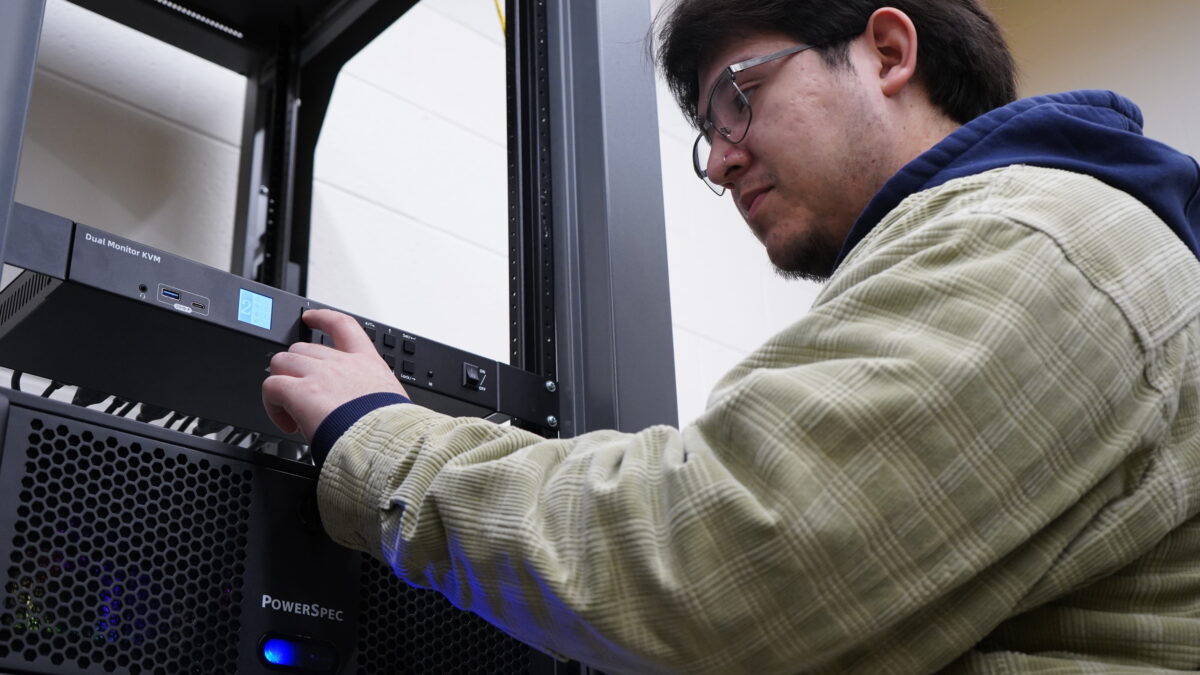
Through funding from the Creative and Scholarly Endeavors Program, Fuchs and senior Axel Magaña Ponce designed, built, and tested the Opto-Widget, hardware central to the timing system. Their skills complemented each other. Magaña Ponce, who taught himself how to code, focused on ensuring the system could communicate and send its signals. Fuchs focused on the hardware, cultivating a design in which the components were laid out smoothly.
Students learning physics don’t just focus on theory. The P-ONE research alone required Magaña Ponce and Fuchs to learn serial communications and coding. They also soldered chips to electrical boards, ran complex simulations, and balanced the tradeoffs between different design decisions.
“You have to tackle math, computer science — it’s all interconnected,” said Magaña Ponce. “There’s a reason people say that all science is rooted in physics.”
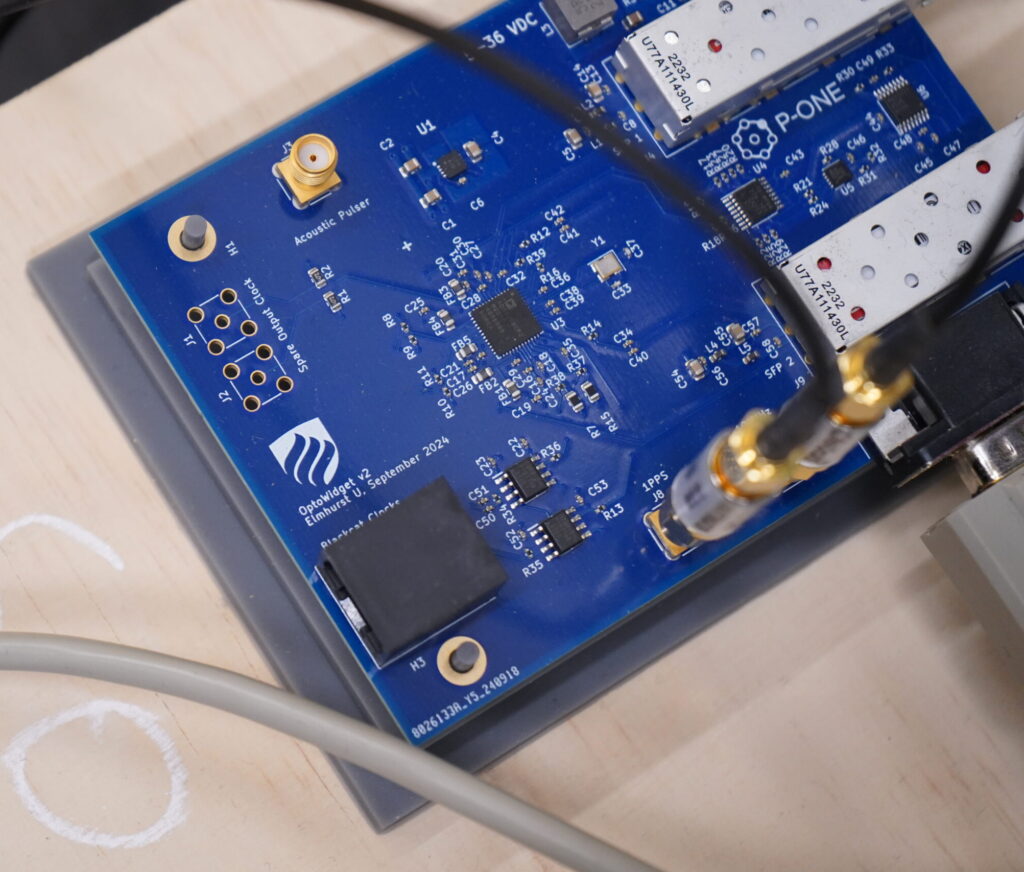
An OptoWidget v2 timing controller, similar to the models deployed on P-ONE off the coast of Canada. (Ian Murphy)
Magaña Ponce said much of the troubleshooting was a team effort between him, Fuchs, and Halliday — often tense but rewarding as deadlines approached.
“When it finally works, it’s like those pop-science movies where they hack into the mainframe,” said Magaña Ponce. “It’s like, ‘Oh my god, I can’t believe we actually just did this.’”
The timing system has to coordinate well over 1,000 optical modules — sensors equipped with photomultiplier tubes that detect incoming light called Cherenkov radiation, a faint glow produced when charged particles travel through a medium faster than light can move through that same medium.
When a neutrino interacts with atoms in the water, it can produce particles that generate this flash of light, which the photomultiplier tubes pick up. Precisely measuring when each module detects that light is where the central timing system becomes essential.
“The faster or more in sync you can have all of those together for timing, the more accurately you can retrace the linear trajectory of a neutrino,” said Fuchs.
The timing system for P-ONE relies on a leader clock called the Meinberg Sync Box that distributes time to BlackCat modules and the Opto-Widgets. Those components distribute precise timing signals to the rest of the systems, ensuring every sensor deep in the ocean records flashes of light from neutrino reactions with picosecond precision. A picosecond is a trillionth of a second.
“We were asked to build something that synchronized clocks to about a 100th of a nanosecond, but actually, we quote the clock’s synchronization accuracy at about a picosecond,” said Halliday. “And the reality is we do it even a little bit faster in the lab.”
Once P-ONE is deployed, it will resemble a forest of cables emerging from the bottom of the ocean. The detector is connected to an 800-kilometer fiber loop called the Neptune Observatory. From there, a fiber-optic cable plugs into the string junction box — a giant box at the bottom of the structure containing the timing system.
P-ONE will be composed of 70 cables, each twice the height of the Willis Tower, that stretch upwards towards a buoy at the top. The cables are lined with sensor-packed modules that detect the light from neutrino reactions.
Neutrino research works in two directions at once. The particles carry information from the universe to help scientists study cosmic phenomena, but at the same time, those signals reveal fundamental properties of neutrinos themselves.
In these environments of black holes and supernovae remnants, light can be absorbed or trapped by dense matter, making it hard for scientists to study these illusive areas. Neutrinos don’t have this problem; they fly straight through.
“We are such creatures of light. We think of discovery in the traditional sense of seeing things,” said Halliday. “And neutrinos give us another channel where we can, by detecting these particles, backtrack them to have a different map or vision of what we’re looking at.”
In 1987, beneath a Japanese mountain, the cavernous tank of the Kamiokande neutrino detector captured supernova neutrinos, allowing us — for the first time — to gaze into the core collapse of a dying star, warning us it had happened even before light could.
But why should we study these chaotic environments that hold black holes and supernovae?
When physicists investigate unexplained phenomena, they develop new theories, and sometimes, those theories eventually lead to new technology. One example is the medical imaging technique known as a PET scan, which relies on antimatter to produce detailed images inside the body that detect cancer.
“PET scans rely on having an understanding of what antiparticles are,” said Halliday. “So we won’t know; we can’t know right now, what technologies might eventually stem from better theories about where neutrinos come from. We can say, though, that if we make better theories of where neutrinos originate, it improves our understanding of what neutrinos are, and we improve our understanding of matter itself.”
For a particle so abundant, neutrinos pose several significant mysteries. They are unusually light, and their identity varies as they undergo oscillations, shifting between their three states (known as flavors) — electron, muon, and tau. Physicists also believe that understanding neutrinos could help further explain the rules of antimatter in our universe — why matter exists and is so abundant in our world.
“Whenever there’s something that doesn’t quite make sense, it’s an indication that there’s new physics there,” said Halliday.
Astronomers believe most of the universe is made of something they cannot see. Galaxies spin too quickly and clusters bend light too strongly — indicating something else is pulling at the cosmos.
The invisible substance, called dark matter, is thought to make up about 85% of all matter in the universe. No one knows what it is, but some physicists believe that dark matter particles meet their anticounterparts, annihilating each other and producing a spray of new particles.
Among the possible byproducts are neutrinos, meaning if detectors on Earth catch neutrinos arriving with the correct pattern of energies, they could reveal the hidden places where dark matter conspires, offering clues about the substance that quietly holds the universe together.
Physicists also believe primordial neutrinos, created shortly after the Big Bang, may still be traveling through the universe today.
“Do astrophysical neutrinos trace out what the first moments of the universe as we know it would look like?” questioned Halliday. “Can we tell something about the very early structure, before it started evolving matter in the universe?”
While neutrinos escape the chaotic environments light often cannot, until recently, when detecting a neutrino, the best scientists could measure was half a degree on the sky. While this may seem small, the universe is enormous.
“If you look in a half-degree circle, you can find just about anything you want out there,” said Halliday. “So the hope with P-ONE is that we’re going to narrow that window and make it much smaller.”
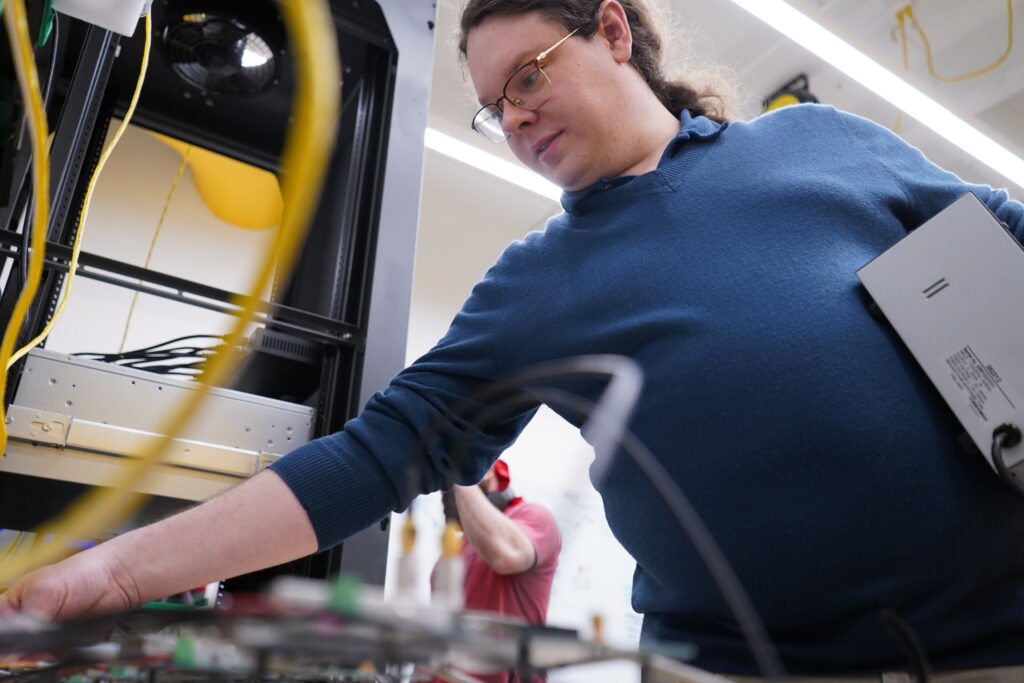
Robert Halliday works in the physics lab in Schaible Science Center on March 12. (Ian Murphy)
While P-ONE will be revolutionary, detectors across the globe don’t compete, they complement each other. The story of P-ONE’s creation echoes the immense progress we’ve made in our understanding of the universe, progress made possible by the detectors that came before it.
“The way to think of it is not how much volume does IceCube instrument, or how much volume does P-ONE instrument — it’s how much volume does humanity instrument,” said Halliday. “We work together to collect a bunch of data and then put it together to figure out where, hopefully, all the sources of neutrinos are in the universe.”
Still, P-ONE will be practical in the ways other detectors sometimes aren’t. While IceCube itself is revolutionary in detecting neutrinos, its location at the South Pole presents some challenges. Every watt of energy used at the base is brought down as jet fuel by the Air Force. Then, it has to travel on a giant sled across the ice; there’s nothing else efficient enough to run the South Pole on.
And while it might be easy to assume ice behaves similar to seawater, its crystal structure causes the light from a neutrino reaction to scatter — blooming across the ice and making it tricky for the sensors to determine where it originated. IceCube can measure energy very well because so much light spreads through the ice, but that scattering limits how precisely scientists can time when the light arrives.
In seawater, light doesn’t rattle around, and it’s a more accurate depiction of where the light from the neutrino reaction originated from, so you can time its precision as accurately as you can build the technology to do so.
Additionally, for P-ONE, everything has been moved to fiber optics, which makes the amount and speed of data collected much more efficient.
While these detectors complement each other, they can focus on answering different questions. Different detectors focus on collecting neutrinos at different energy levels.
Super-Kamiokande studies low-energy neutrinos streaming from the Sun and Earth’s atmosphere, as well as manmade neutrinos produced by particle accelerators and nuclear reactors. IceCube looks for rare, high-energy particles launched by the universe’s most violent events.
And soon, deep in the Pacific, the planned P-ONE neutrino telescope will listen for those high-energy neutrinos, a whisper from some of the most violent parts of space, expanding the data we are able to gather.
“P-ONE was designed to do the most successful aspects of IceCube just as hard as it possibly can,” said Halliday. “We’re leveraging all of these new, very fancy electronics so we can handle a much higher rate of background radiation, and so that opened up the window into using seawater instead of ice.”
While the ocean offers its benefits, it also has its unique set of challenges. While ice is suited to keeping detectors confined to one spot, ocean currents will sway modules of P-ONE up to 50 meters, something that, if not accounted for, will completely misrepresent any data collected.
Polina Senyk, an EU student in her sophomore year, joined the P-ONE project shortly after Magaña Ponce and Fuchs, devoting her research towards this problem.
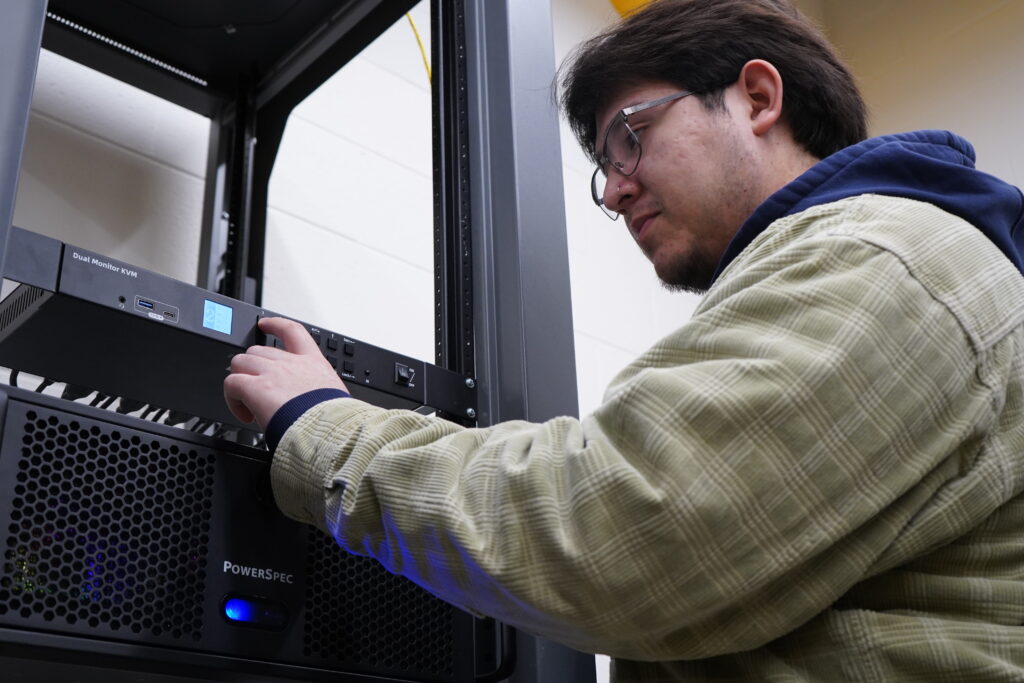
EU Senior Axel Magaña Ponce sets-up a computer in the physics lab in Schaible Science Center on March 12. (Ian Murphy)
“These kilometer strings are kind of free floating in the ocean, and there’s a lot of forces that can act on them,” said Senyk. “So, in order to get an accurate reading, we have to know exactly where the position of the detectors are.”
Senyk creates simulations in Python to understand how the strings will behave in the water. With an error margin of 10 centimeters and the inability to see the sensor’s positions through cameras due to the dark depth they sit at, Senyk’s task is very technical. Her work is especially international, drawing from information provided by colleagues around the world.
“The time difference and distance does not play a big role, because every week or so, there’s a meeting where all the teams come together,” said Senyk. “There are some people that are deeply involved in pretty much every part of the project who connect the different teams.”
Senyk’s research is just one factor of the many considerations taken because of the ocean environment. Even plankton emitting bioluminescence can interfere with the research, and the ocean is filled with debris that can stop light in its tracks.
So far, one cable of P-ONE is fully built and slotted for deployment this summer, with the rest scheduled to continue releasing throughout the decade.
“It’s honestly ridiculous. I can’t believe people let us do this,” said Halliday. “But, to that point, we are curious, and mysteries deserve to be solved.”