Venezuela: The History that has Led us to Trump’s “Special Operation”
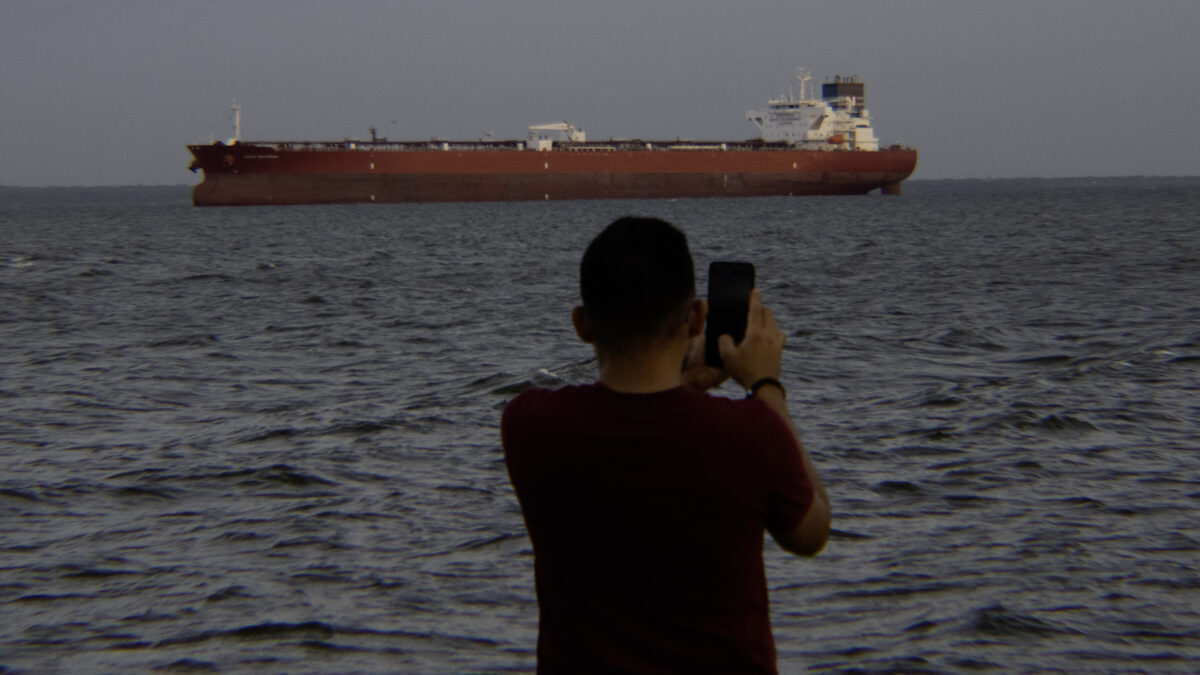

A man takes pictures of a crude oil tanker at Maracaibo Lake in Maracaibo, Venezuela, on Jan. 12. After the US raid that deposed Nicolas Maduro as Venezuela’s leader, U.S. President Trump made clear remarks about plans to invest in Venezuelan oil. (Margioni Bermudez/AFP via Getty Images/TNS)
The capture of Venezuelan President Nicolás Maduro and his wife by United States forces on Jan. 3 has led to a massive amount of confusion and speculation about potential U.S. motivations. A brief examination of a timeline of U.S.-Venezuela relations reveals that U.S. involvement in Venezuela likely extends beyond humanitarian interests.
Pre-1998: Venezuela had the world’s largest oil reserves, with the largest stakeholder being the U.S. oil company Exxon. During this time, a vast amount of profit from Venezuelan oil went directly to Exxon, resulting in a capital outflow from Venezuela to the U.S. As a result, the country’s economy was failing and experiencing widespread disparity.
1998: Hugo Chávez was democratically elected president of Venezuela. After taking office, he started reducing the checks and balances of the Venezuelan government and began rewriting the constitution (allowing himself to remain in power), sparking the rise of his own authoritarian regime.
2002: A woman named María Corina Machado attempted to overthrow Chávez’s government by founding an organization called Súmate, funded by President George W. Bush’s administration through the National Endowment for Democracy. This rebellion attempt was not successful, and the Bush administration denied any involvement with the organization. This ended in Machado being completely removed from all political affairs in Venezuela moving forward.
2007: Chávez nationalized Venezuelan oil, meaning almost all profits generated from Venezuelan oil returned to the Venezuelan economy. This basically flipped the share percentage between Venezuela and Exxon, leaving the American company with very little money. Exxon then sued Venezuela and won a claim of $1.4 billion (the claim was never paid). This power shift caused Venezuelan oil sales to drop from 3 million barrels a day to a mere 170,000, due to political corruption with formal sanctions placed by the U.S. government.
2013: In the wake of Chávez’s death, his vice president, Maduro, assumes power in Venezuela and expands his government’s powers. President Barack Obama labels Maduro’s government “a threat to democracy and national security in the United States.”
2017: President Donald Trump imposes economic sanctions, further preventing trade and sales, in an attempt to get Maduro’s government to reverse its economic measures over Venezuelan oil.
2025: Machado wins the Nobel Peace Prize for her efforts to promote democratic rights for the people of Venezuela, later dedicating the award to Trump. Trump’s administration calls Venezuelan boats drug cartels with little to no grounds, continues to talk about Venezuela being a threat to U.S. national security, and emphasizes the need for “revitalizing and restoring democracy to Venezuela.”
What is going to happen next?
Trump, the U.S. government, and American oil companies want to regain power and seek to influence the heavy crude oil in Venezuela.
After many months of escalating military pressure in Venezuela, Trump authorized an operation aimed at seizing Maduro and transporting him to the U.S. to face trial. Delcy Rodriguez, the former vice president of Venezuela, has been serving as the country’s acting president since Jan. 5, after the Supreme Court named her to the position following Maduro’s capture.
Following their capture, the Maduros were transported to New York, where they both pleaded not guilty to drug trafficking charges. Their next court date has been set for March 17.