Elmhurst Clones a One-of-a-Kind Plant in its own Front Yard


Multiple attempts at cloned Elmhurst Yews. (Ashley Vanderhoff)
To look past a tree’s bark and learn what species it might be — and whether it might hide anticancer compounds — sometimes, you have to clone it.
The Elmhurst Yew, the only known one of its kind, stands alone. In a small, suburban arboretum at a private university, quietly photosynthesizing its way through Midwestern winters, no one quite knows what it is.
According to department lore, the tree was first singled out nearly 50 years ago by a former groundskeeper, Ragnar Moen, who noticed that it didn’t resemble any of the other yews planted around campus. When no one could match it to a known type, it was given a name of its own — Taxus elmhurstii, the Elmhurst Yew — and left to grow under that uncertainty.
While genetic testing is almost certainly the answer to unpacking the mystery of this tree, it’s expensive, time-consuming, and not easy for a small university to accomplish. And to even consider genetic testing, you need material from the plant itself — precious material from a tree that stands only about a meter tall and doesn’t have infinite samples to give. A solution then, is to make more material — to clone the tree.
Cloning a tree is not inherently difficult. The propagation methods currently used at Elmhurst by student Monika Zdun are common.
To clone many houseplants, for example, would be simple. It would easily survive, root almost immediately — probably within a month. The species type, the yew’s longevity, and how long it takes to mature — 10 to 20 years — inhibits the process.
Zdun started the cloning process in Fall 2024. She works with a species of common yew on campus, as well as the Elmhurst Yew. Cloning the yews starts with a walk across campus and a pair of shears.
Zdun looks for branches that are still young — new growth that runs a lighter green and reaches for the sun — and clips 8 to 10 centimeter pieces just below a growth node. The nodes are small, about the size of a Q-tip, and the cut has to land at just the right angle beneath them; nick the node, and that cutting won’t become anything.
Back in the lab, Zdun strips the leaves from the bottom half of each stem and uses a scalpel to peel away the thin outer layer so the living cells underneath are exposed. She dips those raw ends into different strengths of rooting hormone (indole-3-butyric acid) and sets them into small pots filled with carefully mixed substrates — peat with perlite or vermiculite, in different ratios — then waters them and adds fungicide.
The cuttings disappear into a growth chamber that must mimic the sun: about 24 degrees Celsius during the day, 18 degrees Celsius at night, 70% humidity, and 12 hours of light. Every couple of weeks, she feeds them with diluted fertilizer and waits to see which combination of node, angle, hormone, and soil will persuade a clipped twig to start growing roots.
Then begins a long wait to see whether the process will work. Root formation for her first clones took about 16 weeks, and the leaves followed around 20 to 24 weeks.
The Elmhurst Yew clones finally looked promising: Zdun follows a long line of students and faculty at EU who have tried to clone this plant for more than a decade. She was the first to see root growth — an essential step if the plant is going to survive.
But research, especially work as complicated as Zdun’s, faces a multitude of challenges, and over the summer, problems with lab access prevented her from watering her clones. By the time she got into the lab, the plants were already dead.
“I just remember emailing my professor and saying I don’t know what to do. I ended up just taking all of them home,” said Zdun. “It was pretty annoying, I’m not going to lie. But I think it makes me feel better that my lab partner took on the project, and it made me feel better that it’s reviving. We do have setbacks, but the process is continuing; we’re not losing all hope with it.”
Zdun describes it as a “labor of love.”
Junior Alisha Khan, Zdun’s research partner, is continuing the cloning process. Currently, five clones are doing well, tucked away safely in that growth chamber. The two take turns watering the plants, and while Zdun has focused this semester on studying the leaves of the yews, her research still requires many creative solutions to many obstacles.
Studying and Cloning a Difficult Tree
When honor projects are typically only a semester long and the plant you’re studying takes 16 weeks just to form roots, it becomes clear how much the research depends on the plant staying alive. Zdun, who has cloned both common yews around campus and the Elmhurst Yew, took 40 different cuttings to account for the ones that wouldn’t make it.
Timing mattered too. It was essential the cuttings were taken at the right time of year; the wrong season would mean they had little chance of surviving. Zdun recounted how even checking to see if roots were forming turned out to be one of the hardest parts.
“Everything had to be submerged so that I could shake off the excess and see what’s growing. That was definitely the most difficult part, and that was the part we stayed away from,” said Zdun. “Whenever we were curious about a plant, if it had grown roots, we put it off until the last minute, because we did not want to disturb it and ruin anything that was growing. No matter what the plant is, you never want to disrupt its root system because that’s their whole lifeline.”
The research often had to rely on what was happening above the soil. New leaves were one of the few safe signs that roots were quietly forming below.
This semester, Zdun spent hours measuring leaves, collecting 199 from common yews — she was very disappointed it wasn’t an even 200 — and carefully taking just 10 from the Elmhurst Yew. Next semester, she’ll feed them into new software that can analyze them, which meant first photographing every single leaf she collected. Even that, it turned out, proved not to be an easy task.
“I put the leaves on the lab bench, but the shadows were horrific,” said Zdun. “My professor and I were struggling badly with these pictures, and then he finally thought maybe his wife’s light panel for cross stitching could help. And so he brought hers in and it changed the whole trajectory of the research. He had the lab manager order one for me.”
Zdun, who feels bittersweet about graduating and leaving the research behind, knows that cloning won’t lead to species identification. Despite past research suggesting the Elmhurst Yew might be a hybrid — and Ragnar Moen himself being convinced of it — nothing is confirmed. It doesn’t quite look like an English or Japanese yew, the two common species you’d expect to find in the area,
Throughout Zdun’s research, she’s reached out to specialists beyond EU for help. A Taxus specialist at the Morton Arboretum confirmed the tree was like nothing he’d seen before, and suggested Zdun pursue genetic testing. She contacted the Field Museum and explored other possibilities, but so far none of the options for testing have been realistic for a small university lab.
“It’s so difficult because unfortunately, Elmhurst does not have the resources to do something so big as genetic testing,” said Zdun. “We do have professors that are geneticists and that do work in the field, but they only know so little about plants — they do more, human, chromosomal things — not very much on the plant side of it.”
In another project, Zdun needed a $200 air quality monitor, and it took a couple of weeks of convincing before the school agreed to buy it. Still, the research continues.
“Even my professor can tell that sometimes I’m down about something or feeling unmotivated. But I think that’s why research is so interesting, because it’s okay not to get the right answer,” Zdun said. “Of course I would love to do genetic testing and figure out the species, but I’m also taking the steps to get to that point. I’m definitely telling myself it’s okay. I know I graduate, but I’m still doing something. I’m still researching. I’m still contributing to the science.”
Decades of Questions About a Single Tree
There are few projects that have been picked up across decades like this one has at Elmhurst. Honors Program Director Mary Kay Mulvaney noted how projects are typically distinct each term.
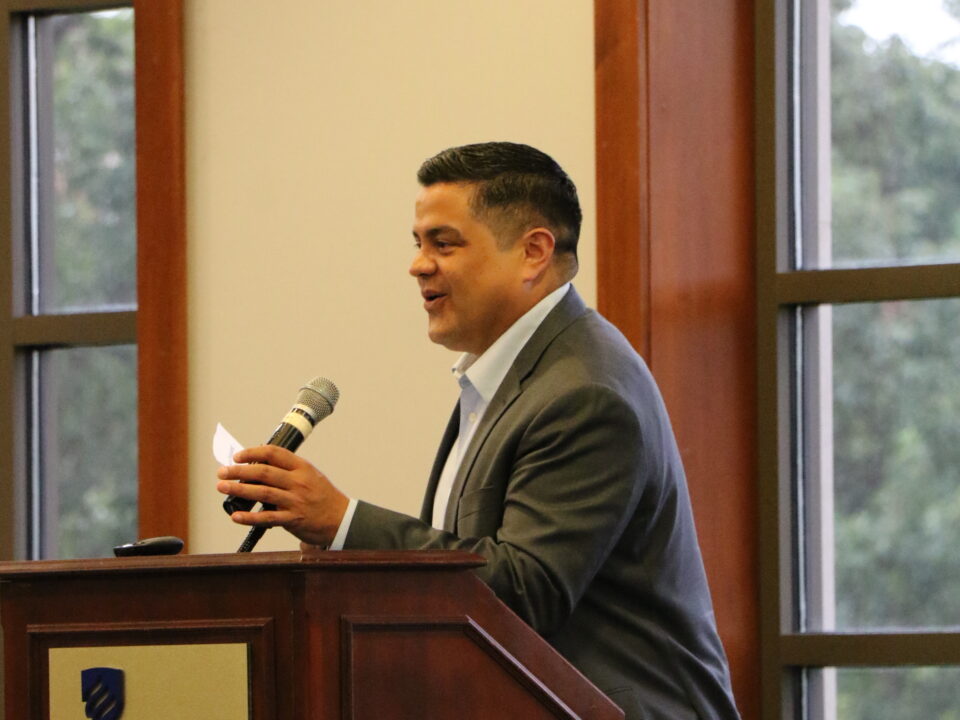
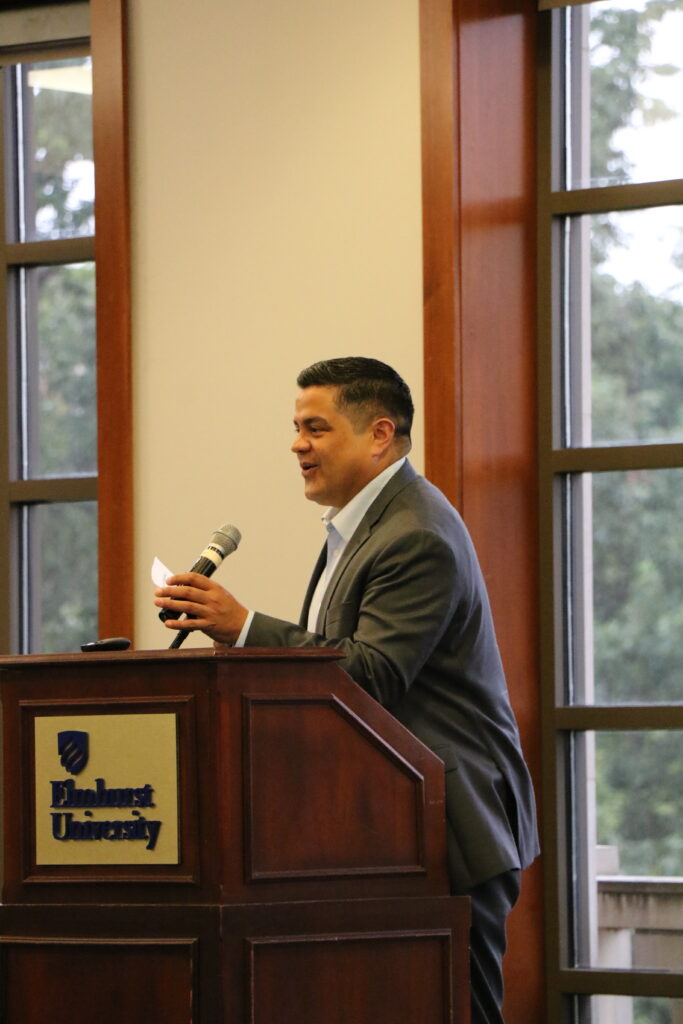
Sometimes, though, whether because of a professor’s persisting passion or an inspired student’s curiosity, that research refuses to die. Paul E. Arriola, a professor of biological sciences, has known about this yew for about 30 years and oversees the project with Zdun. He spoke with Ragnar Moen and even tried to clone the tree himself with a different groundskeeper before Zdun’s work — without success.
“We are focusing on propagation because I’ve been reluctant to continue to cut on this thing. We need more plant material,” said Arriola. “That’s where Monika came in at the beginning of this year. She picked up all the different threads that have been sort of started and stopped. She managed to make another one.”
Previous students have tried to use DNA from the Elmhurst Yew to analyze the tree, but found no clear markers to help determine genetic relationships. If the clones continue to grow, more genetic work could be done with them. Still, the yews seem stubbornly resistant to rooting, which makes Zdun’s and her professor’s breakthrough all the more impressive.

The sole, fully-grown Elmhurst Yew located near the Kranz Forum on Nov. 26. (Ashley Vanderhoff)
“It’s hard to get these things to root. There are hurdles that we need to get over, but I don’t think anything insurmountable,” said Arriola. “It’s just a matter of time and perseverance.”
Why Saving One Yew Matters
At first glance, the Elmhurst Yew is just one tree, about 1 meter tall, in a small Midwestern arboretum. In practice, it stands for a group of plants that are under pressure even as we discover how medically valuable they can be.
Many yews grow in areas with heavy logging, and on top of that, rising carbon dioxide levels and warming temperatures are endangering some hybrid yews.
One species of yew has already changed modern medicine. From its bark, researchers isolated Taxol, a compound now widely used in cancer treatments. The discovery came at a cost: Yew trees were harvested faster than they could recover, and in many places their numbers and biodiversity shrank.
If students can develop reliable ways to continue to allow for the success of the clones, they won’t just be protecting a single tree — they’ll be refining methods that could help preserve other medically important yews.
It’s a plant that is both rare and at risk, but it’s also a reminder of why preserving as many different yew species as possible matters. If a livesaving compound can emerge from one yew, it’s possible another species could hold something just as important.
“We simply don’t know what they’re good for,” said Arriola. “Losing something before we get a chance to find out how useful it can be is a shame.”
There is a second reason, though, that cloning the Elmhurst Yew is important, besides making more material to work with.
“It’s to make sure there’s another one,” said Arriola. “Because if something happens to this one, then it’s gone forever.”
Khan and Zdun will continue this work next semester. Khan is hopeful she might get far enough with the clones that genetic work may once again be possible.
No matter the difficulties of taking hundreds of pictures, the heartbreak of watching a plant you cared for for weeks suffer, or the limited resources of a small college, students at Elmhurst, driven by a passion for research, persevere.
“[This project] is a uniquely Elmhurst thing,” said Arriola. “It’s a chance to do some really cool science, but it’s science that matters to us.”
CORRECTION: A version of this story in our printed issue had a layout issue and removed approximately 450 words from the end of the article. The Leader deeply regrets this error.