EU’s Dark and Witty Performance of “The Moors”
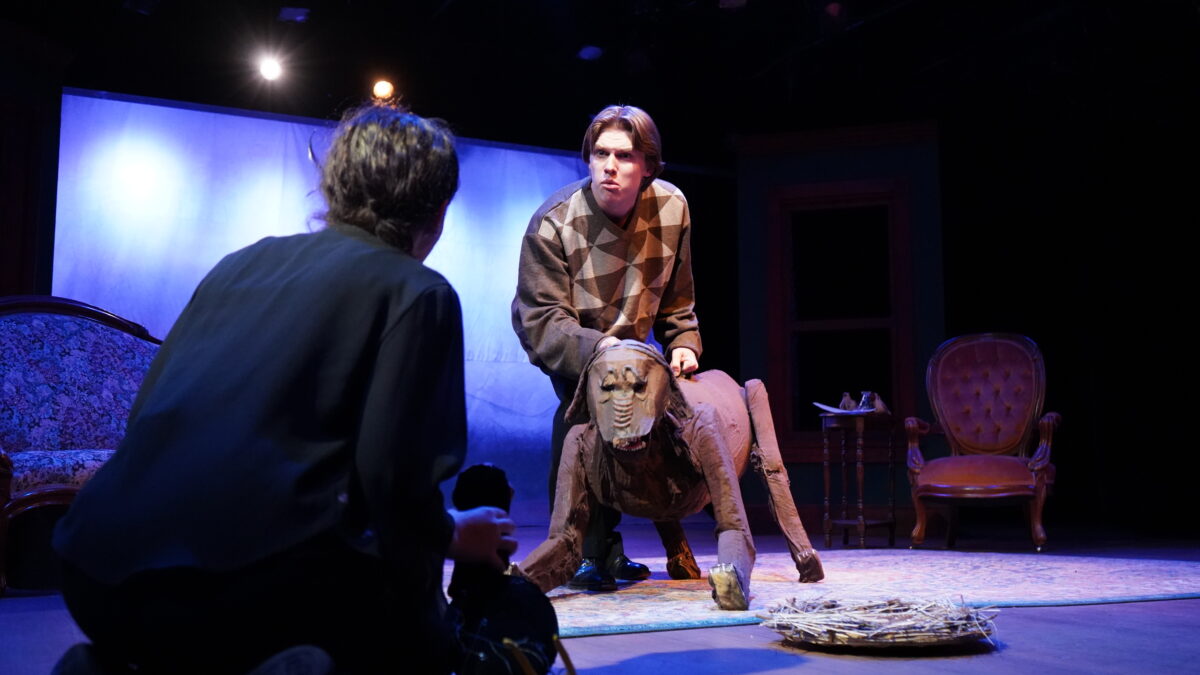
Mastiff (Maddux Masopust) attempts to reason with Moor-Hen (Nana Bormpoli) during a performance of “The Moors” at the Mill Theatre on Nov. 12. (PC: Ian Murphy)
What a delightfully dark and funny performance.
I had the privilege of photographing and previewing “The Moors,” the evening before opening night, directed by Elmhurst University senior Ella Leon. The production is about two sisters, their maid(s?), and a new governess who joins them in their home on the Scottish moors. Also, something to do with their pet mastiff and a moorhen.
A great departure from “Company,” the previous Mill Theatre performance, “The Moors” is twisted and hilarious. For an opening scene that details how bleak and evil their environment is, and how the Scottish moors are so quick to drive one crazy, I was impressed by how frequently I laughed at the characters’ line deliveries or even just the pure absurdity of the situation.
Maybe my favorite element was the puppeteering of Mastiff (Maddux Masopust) and Moor-Hen (Nana Bormpoli), both designed by Micaiah Brown. These two really drove home the core of the story.
What happens when you love somebody so much you’re willing to override your own human (or dog, or bird) nature? What happens when you realize you can’t?
Bormpoli and Masopust put on an evocative and emotional performance, including a powerful moment where Bormpoli and Masopust leave their puppets behind for a heart-to-heart.
The human characters were also delightful to see. Freshman Elizabeth Jarrett took to the Mill’s stage for the first time, playing Huldey, the younger sister and prospective killer of Agatha (Christine Rowe). Jarrett provides a chilling performance in the final act of the production and a truly gut-wrenching take on the psychotic break Huldey experiences.
Since mentioning Agatha, let’s discuss her and the queer undertones of the production. Agatha hires Emilie (Kallia Memtsas) as a governess with the intention of the two of them becoming the matriarchs of the family, using Agatha’s barely living brother as a medium to produce an heir.
It’s dark, but the two appear to genuinely fall for each other as Emilie discovers that the “man” she fell in love with is a woman, and she’s just as passionate for her. I loved this, and despite how contrastingly twisted “kooky-funny” other scenes were, Emilie and Agatha’s relationship was treated with dead sincerity.
It forces you to engage with them on a personal level and feel so much more invested throughout the end of the play.
Enough about the grim and gnarly. Let’s talk comedy.
Interspersed in the vast majority of scenes were characters making oblique jabs at each other, and on occasion, near-outright call-outs to how ridiculous a situation is.
The clearest jabs are the interactions between Moor-Hen and Mastiff, as the two constantly call out how the big, scary dog should be dead-set on eating the weak and cold bird, but they don’t, because they’re in love.
Or Huldey’s diary, and Marjory’s (Christopher Williams’) references to it, and her scheming to convince Huldey to kill her older sister.
Marjory stands out as the shining example of how the moors drive one crazy. She’s the parlour maid, and the kitchen maid, or sometimes goes by another name entirely. She has typhus, except when she doesn’t, and outright tells Emilie that all of her roles are but a farce to please the head of the house.
Williams was certainly a great choice for the role, as he effortlessly bounced between personalities and kept his wits as sharp as a tack.
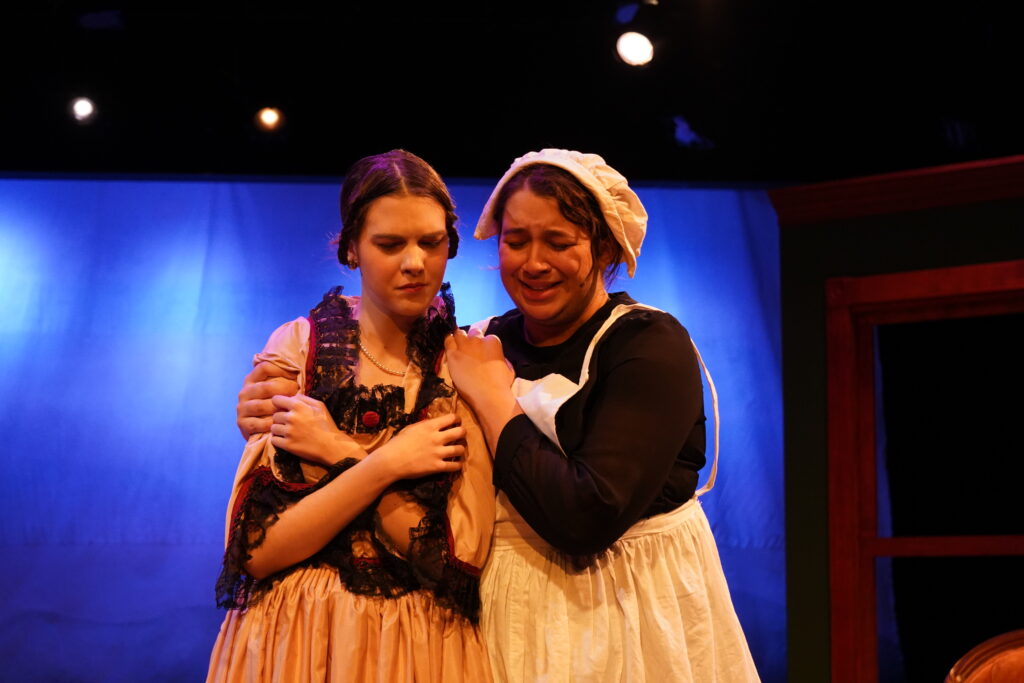
Huldey (Elizabeth Jarrett) is consoled and confided in by Marjory (Christopher Williams) during a performance of “The Moors” at the Mill Theatre on Nov. 12. (PC: Ian Murphy)