EU Student Skylar Stevenson’s Artistic Pursuit of Capturing Time
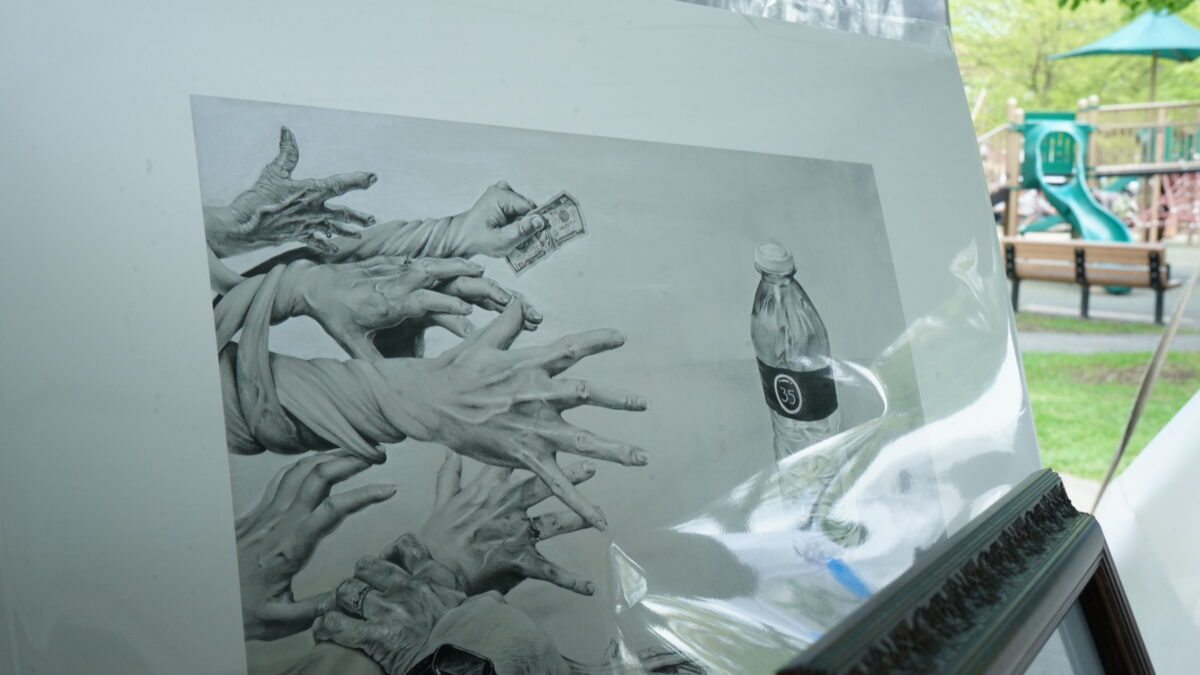
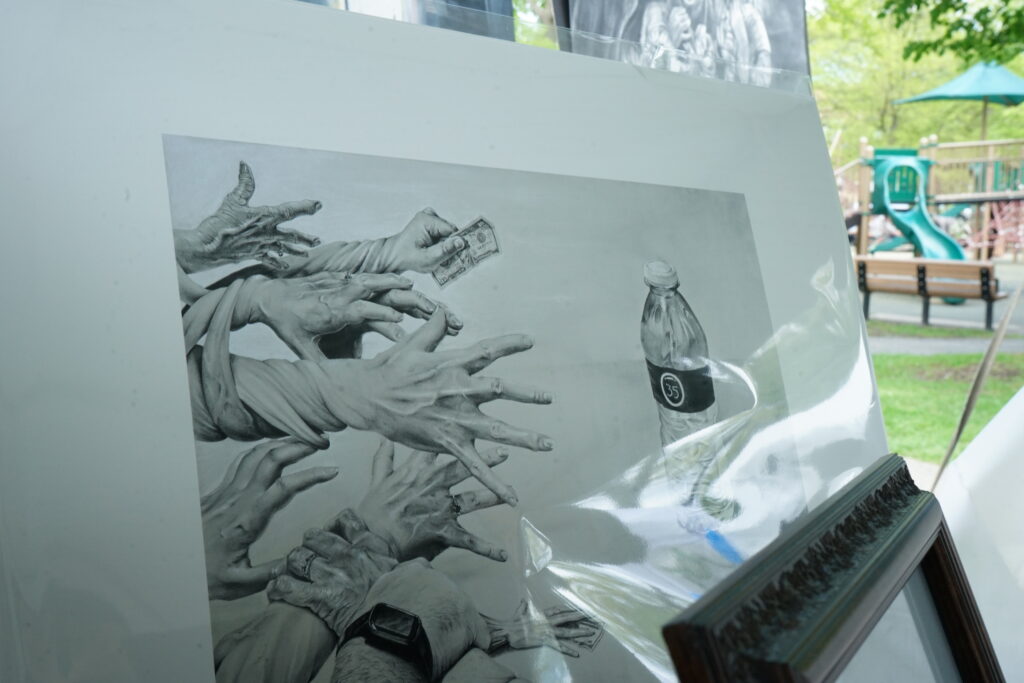
One of Skylar Stevenson’s pieces displayed at Art in Wilder Park on May 2. (Ian Murphy)
Aging is a concept that most people fear. From the first wrinkle you spot at the crease of your eyes to the skin that loosens ever so slightly. We have surgeries, vegetable mixtures, creams, and balms sold to you to slow the dreaded clock. It’s an impossible battle, yet one that we all will be, or currently are, fighting.
What so many people forget is that every wrinkle on that forehead is beautiful. It shows a wise mind and a life well-spent. It’s an aesthetic beauty that is authentic, not bought with a product.
On May 2-3, from 10 a.m. to 5 p.m., Skylar Stevenson, along with four other Elmhurst University students, Fatimah Farooqi, Ohana Jeron, Zoey Sperando, and Natalie Sanchez, showcased their works at the Art in Wilder Park event hosted at that very same park outside of EU’s campus.
Stevenson is on a mission to capture the elegance of age. Her tool of choice is an aged art form in itself: illustration.
Much of Stevenson’s work revolves around two things: eyes and the bane of most artists, hands. Yet, Stevenson takes on the challenge with much patience and skill.
Her work captures just what it means to grow old in a society that places so much emphasis on youth.
“I love showcasing wrinkles and veins on hands,” Stevenson said.
Every detail on the hands of her subject is carefully crafted. She blends in the perfect amount of shading to make those details pop. Every callous tells a story of a person who relied on their hands for everything, and every scar swells your heart with boundless empathy for the person behind the image.
There is an inherent politics she deliberately showcases in her work. One of which was her piece titled “Living With Capitalism,” which was featured in the Chicago Tribune. There, it showcased a herd of hands, some holding dollar bills, some grabbing others, some with fingerbones poking out from the back of their hands in a struggle, while others were adorned with hair. All of which are wrestling over a singular plastic bottle of water, standing alone, casting a shadow.
“I feel like I need to speak out.” Although an artist, she also has the heart of an activist. “My art is how I can reach a lot of people who are concerned about the same things I am.”
In a political landscape dominated by fear and control, it can be easy to feel as if small and simple actions are meaningless. Stevenson challenges that notion. Her art is her rebellion and middle finger to the idea of doing nothing.
Stevenson was always creative, although you couldn’t tell by looking at her high school transcript. She took no art courses in high school. Instead, she scoured YouTube tutorials on how to draw, choosing to hone her craft nontraditionally.
Her inspiration as a young artist-in-training was her father. Stevenson recounted watching old episodes of Bob Ross with him. Being the daughter of a painter, Stevenson was introduced to artistic concepts right away.
“I feel like I connect with my dad through art,” Stevenson said. “I see another side of him when he paints.”
Stevenson has a twin, who is another artist. Although not an illustrator or a painter, she elects to sculpt as her method.
Families are another motif in her work, particularly the interconnectedness and security that they bring.
“I love drawing families because I get to showcase how different traits are passed down,” Stevenson said. “Seeing shared mannerisms is incredible.”
Stevenson admitted to using her own family as a reference.
Stevenson didn’t start formally taking art classes until college, her first one being an online course taken at Kankakee Community College. It was her experiences at KCC and here at EU that she grew into her artistry.
“I didn’t consider myself an artist,” Stevenson said. “Elmhurst taught me to create art for me, not for anyone else. I found myself being more expressive.”
Stevenson was instructed by EU professor Dawn Kramlich. It was through Kramlich’s patience and guidance that Stevenson was able to hone her own sense of art and was able to look more deeply at the symbolism at other’s works.
“Professor K. pushed me to be more creative. She helped me open up to seeing the creativity in myself and others, too.” Stevenson said.
To Stevenson, capturing expressions is the keyhole into the lives of these people. Seeing the ways eyebrows furl similarly, how faces widen and narrow is what makes us human. Despite the ticking of the clock, there are some ways in which we don’t change at all, whether we are 20 or 80.
Art is powerful, but its strength comes from reminding us who we are: humans with different mannerisms and expressions who hold amazing knowledge. It seems like the older we get the more knowledge we hold. Don’t stop the clock. Let it tick. Being yourself and allowing those around you to be themselves is the ultimate act of revolution.
When you doubt the history behind your laugh lines, remember Skylar Stevenson, and embrace every giggle, sob, and snarl that made it so.