Elmhurst Native Wins Nobel Prize for Advancements in Medicine Thanks to New Technology
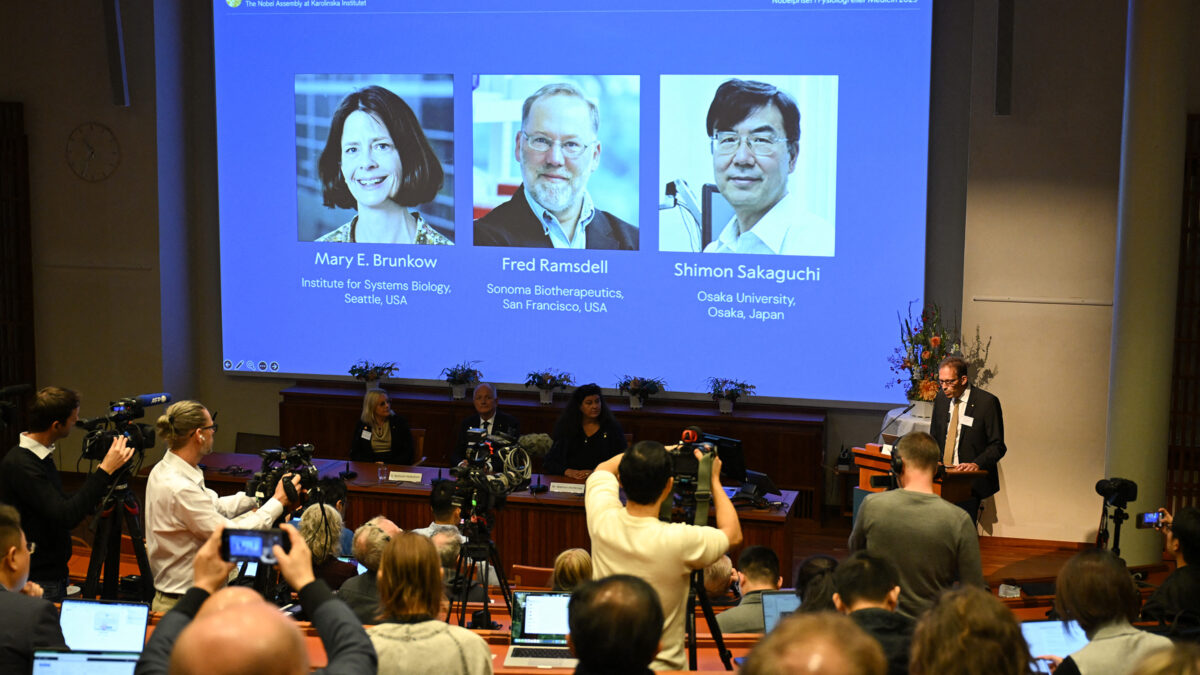
Nobel Committee Secretary General Thomas Perlmann (right) addresses journalists in front of a screen displaying the portraits of, from left to right: Mary E Brunkow, Fred Ramsdell and Shimon Sakaguchi during a press conference where the winners of the 2025 Nobel Prize in Physiology or Medicine are being announced at the Karolinska Institute in Stockholm, Sweden, on Oct. 6, 2025. Brunkow and Ramsdell of the United States and Japan’s Sakaguchi won the Nobel Prize in Medicine on Monday for research into how the immune system is kept in check. (PC: Jonathan Nackstrand/AFP via Getty Images/TNS)
Fred Ramsdell, who was born in Elmhurst, Ill., was awarded the Nobel Prize in Physiology or Medicine on Oct. 6 for his work with T cells and how they keep the immune system in check. This breakthrough is critical for understanding and possibly preventing autoimmune diseases.
Ramsdell was joined in his prize by Mary E. Brunkow of the Institute for Systems Biology in Seattle, Wash., and Shimon Sakaguchi of Osaka University in Japan.
Ramsdell is the current chair of the Scientific Advisory Board for Sonoma Biotherapeutics, Inc., “a clinical-stage biotechnology company developing engineered regulatory T-cell (Treg) therapies for autoimmune and inflammatory diseases by restoring balance to the immune system,” according to their website.
Ramsdell said that when he and his team first made their discoveries, there was “no way to put this into clinical practice,” because the technology was not available.
Over the last 20 years, as technology has advanced, their discoveries have been able to start being used in clinical trials within the last six to eight months.
Ramsdell said that these clinical trials involve taking cells out of a patient, slightly engineering them in the lab to be specific to whatever disease a patient has, and putting these cells back in the person.
“You’re basically getting treated with your own cells,’’ Ramsdell said. “And trying to reestablish your own normal immune system that most of us have who do not have autoimmune diseases.”
Ramsdell said that his interest in science began in high school with a biology teacher who was very inspirational and got him excited about science.
He then attended the University of California, San Diego, which pushed his love for science even more.
“I took a course in college that just turned on a light bulb for me,” Ramsdell said. “I just decided the immune system was the coolest thing I’d ever heard of.”
Ramsdell said he hopes that understanding how T cells work, as well as scientists’ ability to train and target them toward specific diseases, will lead to customizable medicines.
He said these treatments would be a drug a patient takes once to reset the immune system to function as it should, preventing patients from dying of autoimmune diseases.