Ivón Padilla-Rodríguez Outlines Troubling History of Migrant Youth in César Chávez Lecture
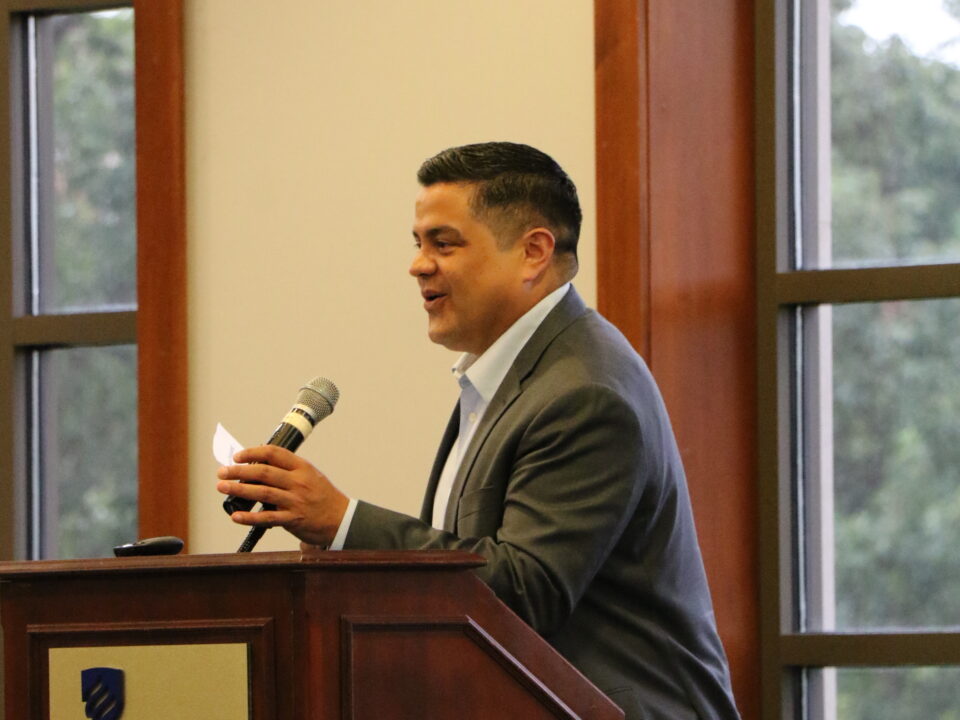
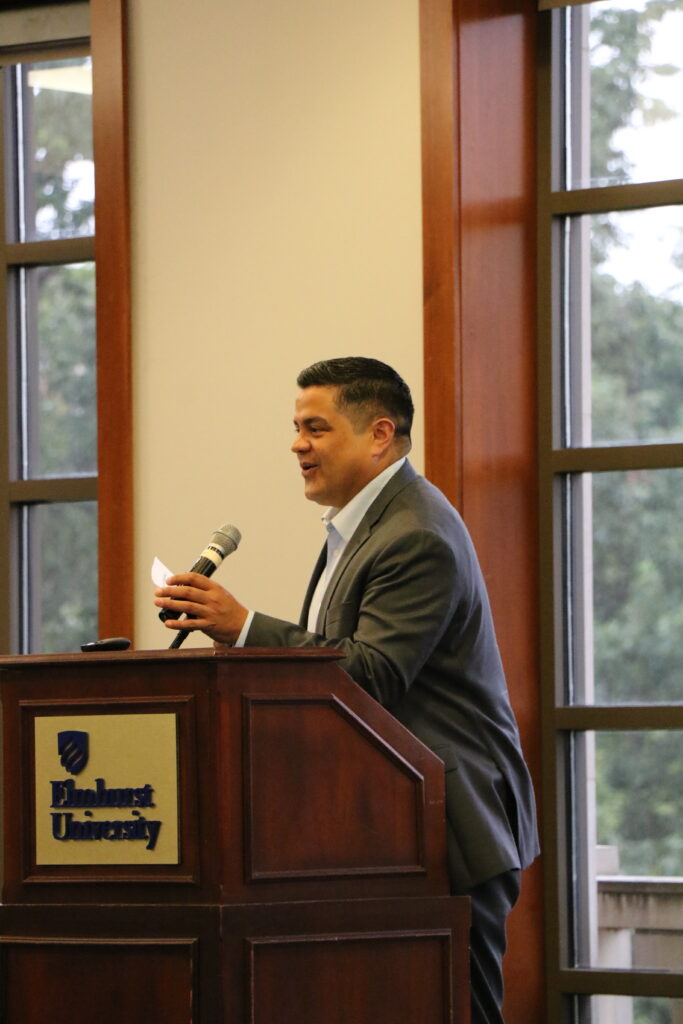
Ivón Padilla-Rodríguez, Ph.D., a sociolegal historian and assistant professor of history at the University of Illinois Chicago, highlighted the past and present difficulties facing migrant youth throughout this year’s César Chávez Intercultural Lecture, held in the Founders Lounge on Wednesday, Sept. 10.
Named for the labor leader and civil rights activist who helped found the United Farm Workers of America, the lecture is held annually, usually in September. This coincides with Elmhurst University’s Hispanic Heritage Celebration, as well as Hispanic Heritage Month, which is observed from Sept. 15 to Oct. 15.
Padilla-Rodríguez was introduced by Emily Navarro, an associate professor and chair of EU’s Department of Sociology and Criminal Justice.
“At this moment in the United States, when we are once again grappling with the exploitation of migrant child labor, the overcrowding of detention facilities, the criminalization of immigrant families, Dr. Padilla-Rodríguez’s scholarship could not be more urgent,” Navarro said. “Her research reminds us that these are not new crises, but deeply rooted patterns.”
Padilla-Rodríguez’s lecture was divided into three parts, beginning with an overview of the historical context for major moments in unauthorized Mexican and Central American migration to and within the U.S.
This was followed by a brief explanation of rights associated with childhood in the early 20th-century U.S. The lecture concluded with case studies in which border-crossing Mexican and Central American children were either denied or granted the rights and privileges of childhood.
Padilla-Rodríguez shared that although she was born in Southern California and has been a U.S. citizen for her entire life, her parents were formerly undocumented Mexican immigrants.
While growing up, Padilla-Rodríguez and her family moved constantly in search of economic opportunity and in fear of her parents being detected by law enforcement. Padilla-Rodríguez said that prior to living in Chicago, she had never lived anywhere for longer than four years.
“My citizenship felt denuded or lessened when I was growing up,” said Padilla-Rodríguez. “It felt less meaningful than the citizenship of my peers who had U.S. citizen parents, because my rights to educational continuity, to economic mobility and family unity, felt more at risk.”
Historically, Mexican youth were sometimes subjected to inhumane conditions when traveling with human smugglers, also known as coyotes, while others suffered in makeshift refugee camps. Migrant children’s presence in local communities and public schools was met with disdain and hostility, though their child labor was eagerly welcomed by employers, including farmers.
Beginning with mass deportation campaigns in the 1930s, deportations grew highly illegal, with some terming them crimes against humanity due to lacking due process. Mexicans were scapegoated as welfare burdens and job stealers, with even social workers helping identify them.
Padilla-Rodríguez concluded that although child labor violations in the U.S. have risen since 2015, there is nothing new about the exploitation and deprivation of migrant youth.
“Child migration is not a new phenomenon,” said Padilla-Rodríguez. “Rights violations against migrant youth are also not recent inventions.”
Toward both the beginning and end of her lecture, Padilla-Rodríguez posed the same question: “Who gets to have a childhood in the modern United States?”