New Course Restrictions Introduced for Music Students
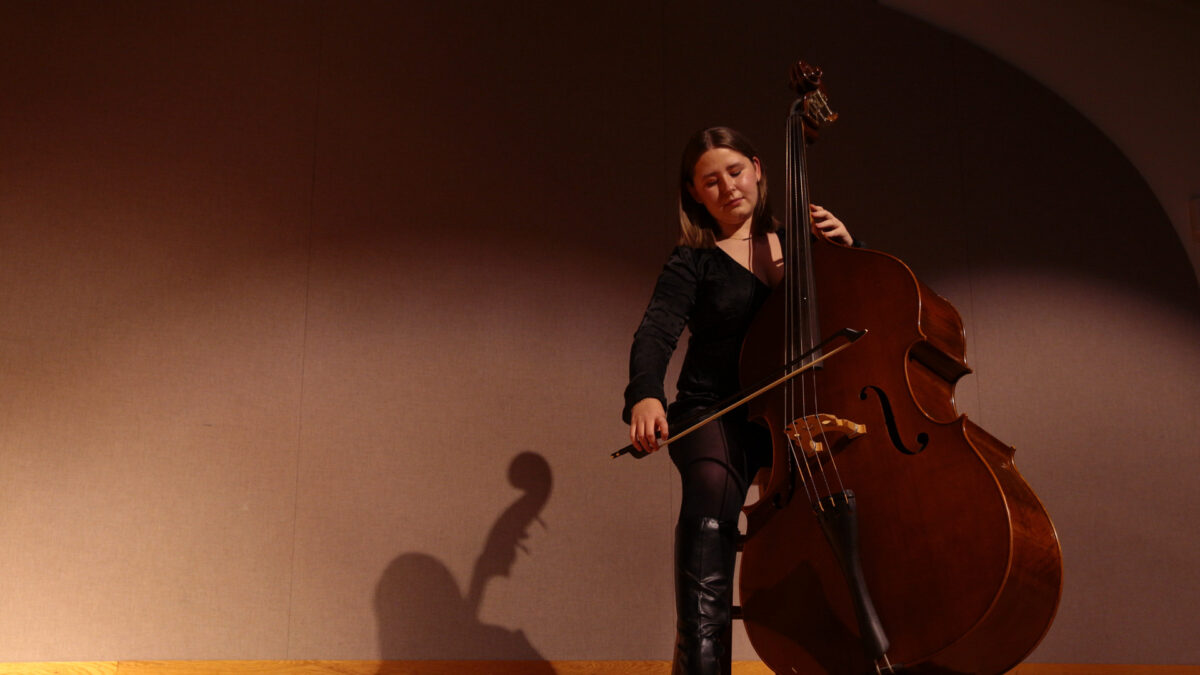
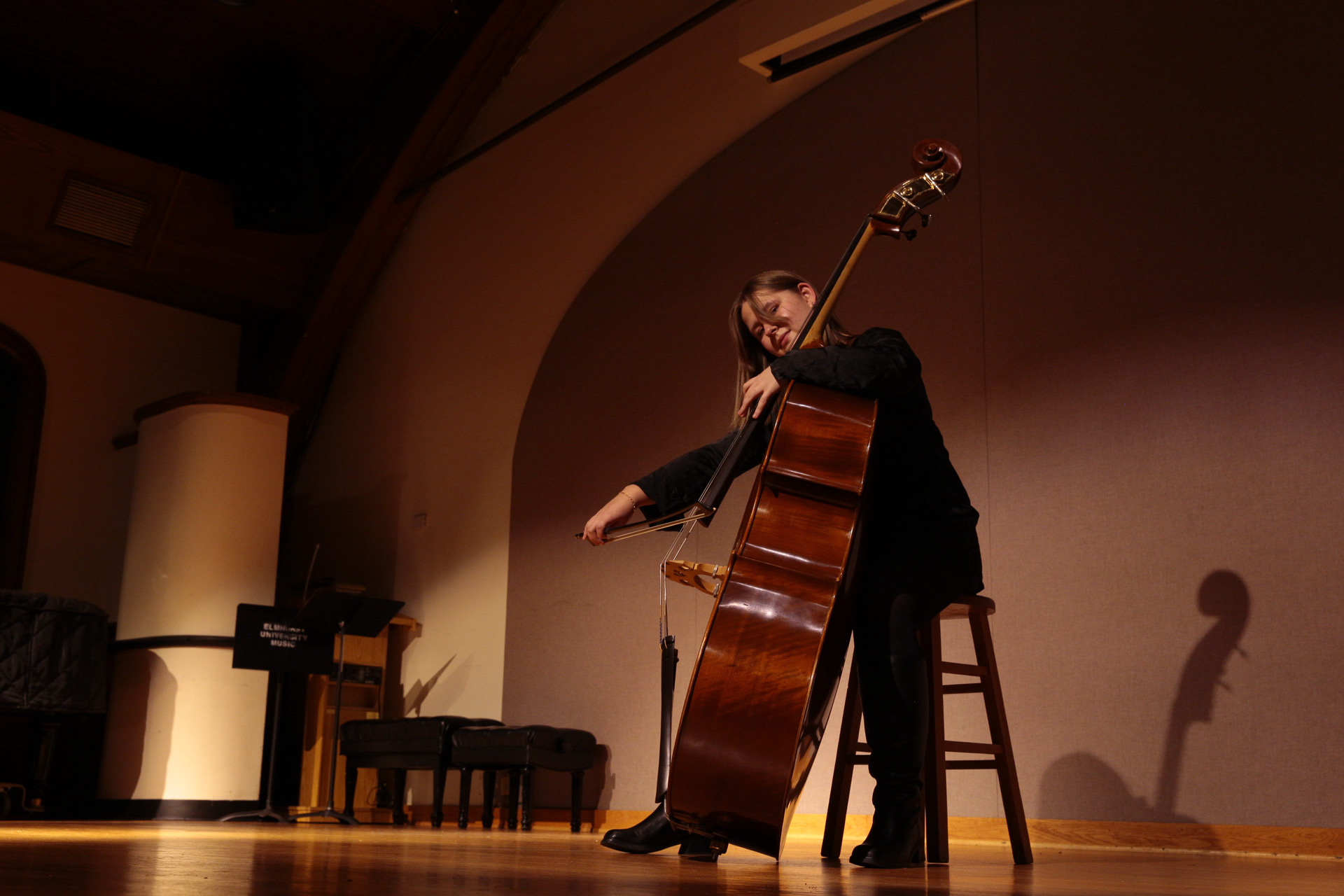
Sarah Weiberg plays bass in Buik Recital Hall. || Photo by Star Herring
Music students opened their emails on Oct. 20 to find out they will be limited to taking two zero-credit classes starting next semester, a restriction that was shortly revised to allow three courses.
Before this change, students could take an unlimited number of zero-credit classes. This news left a number of music students confused.
Music education students are maxed out on credits every semester since they must take MUS 100 (Concert Attendance) and their large ensemble for zero credit.
The email also stated that the only exception will be for seniors scheduled to graduate in May.
“This decision will impact students participating in multiple large ensembles, chamber ensembles, multiple lessons, and in some cases, the duration of studio lessons,” assistant professor and Department of Music Chair James Hile said in the email (which The Leader reviewed).
But for some students, the limit on zero-credit classes means they can no longer finish their minor or gain as much knowledge when they enter the workforce. Junior Armani Smith is majoring in music education with a minor in music performance. Smith said that he cannot finish his minor now because under the new rules, he would have to stay an extra semester.
Smith said that to finish his minor, he would have had to take lessons for credit, and because music students easily max out on credits every semester, that is not possible.
“The Elmhurst music department has always been presented as a place where you can do everything,” Smith said. “It feels like the things we are promising these prospective students and the things that we were promised coming here is now being taken away from us.”
Sarah Weiberg, a junior in music education with a minor in theatre arts education, felt very disheartened by the email when she received it. She said one of the great things about EU is how well rounded an education students have and now they have lost that.
Weiberg said that she wants the administration to know that she feels the amount music students are paying for tuition is not reflecting the education they get anymore. She said they are paying far too much for an education that is getting cut.
She worries how this will affect her when going into the workforce.
“In music ed you have to know how to teach everything.” Weiberg said. “You have to know how to teach every single instrument and choir. If I was basically forced to drop choir and then I ended up being told, ‘Can you teach our choir classes?’ I would have had one semester of choir.”
“The primary focus of the policy regarding zero-credit music courses is on academic planning, student workload, and timely progress toward graduation,” said Hile; Provost and Vice President for Academic Affairs Courtney Miller; and Interim Dean of the School of Arts, Humanities and Social Sciences Katrina Sifferd in a statement. “It was not primarily driven by financial considerations, nor was it adopted as a budget-reduction measure.”
They said that goal is to balance music students’ ability to participate in lessons, ensembles, and other music experiences while giving them the opportunity to explore other academic interests while staying on track toward timely graduation.
David DeVasto, professor of music theory and composition, said the cap on zero-credit courses will probably limit the number of lessons and ensembles a student may enroll in, but students should be able to maintain their full ensemble and lesson schedules within their degree plan.
He also explained that zero-credit classes are important to the music students as they provide extra supplemental experiences students do not get in a typical classroom, but it is also important to have the ensembles sound their best when they go on recruitment tours, which is part of the reason they want students to focus on their main ensembles.
“The music faculty understands how important these developmental experiences like ensembles and lessons are for students so we are working to trim some of the credit load within each of our music degree programs in order to facilitate more flexibility for our students,” DeVasto said.
Hile, Miller, and Sifferd said that the policy allows music students to take up to three zero-credit courses in addition to a full 4.75-credit academic load, and that they also recognize that individual circumstances can vary, and exceptions are still available.
But Smith, who is in lessons for voice, piano, saxophone, and two choirs, has to drop saxophone lessons and limit himself to one choir.
“I think if the administration saw more of the effects of these musicians and the people they’ve been serving, they’d be more inclined to let them be a part of the thing,” Smith said.
He said he urges the administration to come to a concert and see the effects of the Department of Music in real time.