Mathematician’s Love for the Abstract
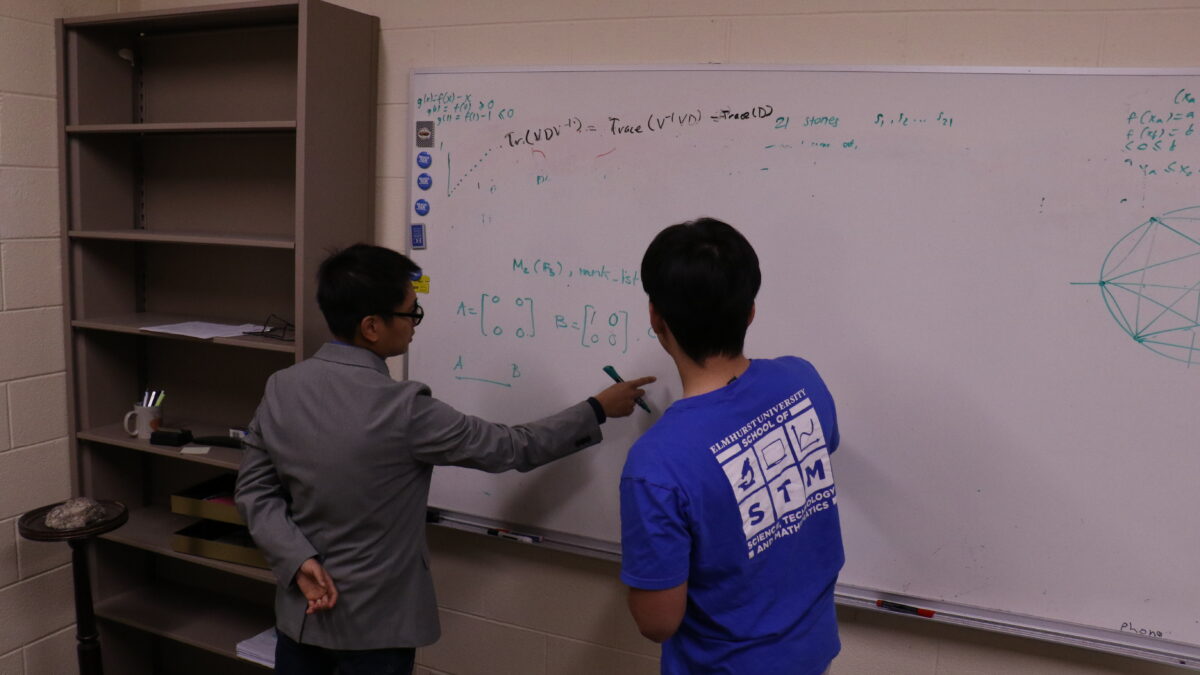
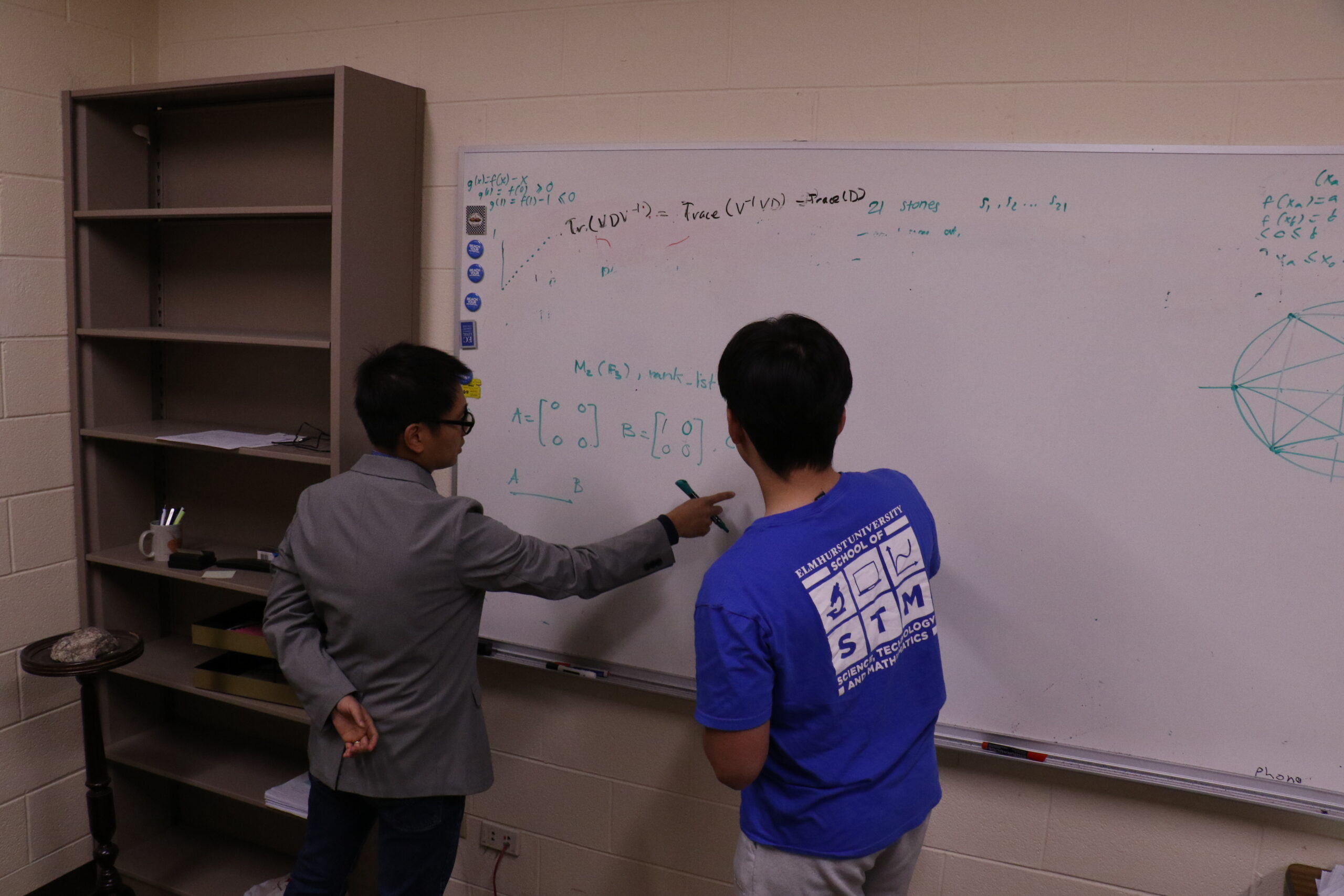
Assistant professor of mathematics Tung Nguyen and senior Dung Nguyen solve math on a whiteboard. || Photo by Star Herring
Dung Nguyen spent four months of his junior year at Elmhurst University staring down a single math problem.
The problem had no known solutions. There were no answers to be found in the back of a textbook or online. No professor at EU, or anywhere else, knew yet how to solve it.
It was a tangle of abstract algebra, which Dung Nguyen had studied the previous semester, and graph theory, a special interest of his. But after those four months, Dung Nguyen emerged with 13 new proofs, which were selected to be published in a future issue of the peer-reviewed mathematics journal Involve.
“I’ve been pretty happy about it,” Dung Nguyen said. “Conventionally, undergrads are not expected to have papers coming into grad school.”
Dung Nguyen’s problem concerns gcd-graphs, a special type of highly symmetric graph. Tung Nguyen, Ph.D., assistant professor of mathematics at EU, formulated the problem and had already published a series of papers on gcd-graphs that introduced new notions to an area of research that is considered pure mathematics.
“He’s a good student,” Professor Nguyen said about Dung Nguyen’s solution. “He got some easy results quickly, but some harder result was longer. I’m very happy, not because of the result, but because he found it himself.”
Pure mathematics, sometimes called abstract math, is the study of mathematics in its own right — focused only on the math, separate from immediate real-world applications. Advances in abstract math may take years or centuries to find a practical use.
But Professor Nguyen isn’t interested in number theory and graph theory because of possible applications. He enjoys doing math for the sake of doing math.
“I think about math as like a hobby, like painting,” Professor Nguyen said. “You paint a picture to express a feeling. To see how you understand the world. You may not have applications. You just do it for artistic reasons.”
Neuroscientists in the United Kingdom found in 2014 that when mathematicians looked at math they regarded as beautiful, the same part of the brain that is activated by art and music lit up on imaging scans.
Dung Nguyen said he finds math to be a creative process, similar to painting and music. Professor Nguyen said that because he has a background in pure mathematics, when something works, he wants to understand rigorously why — that he does math out of curiosity and the urge to understand the universe — and it’s a beauty he tries to teach his students.
Professor Nguyen described tackling an abstract math problem like entering a dark room. At the beginning, you walk around, and you may bump into something — a piece of furniture, a desk or a table. Then, you keep walking, and you bump into something else — a bookshelf. You don’t yet know the whole room, but your eyes start to adjust to the darkness, until finally you see a switch. You turn it on, and everything becomes clear.
Dung Nguyen and Professor Nguyen’s work with gcd-graphs offers promising practical applications in fields like quantum computing, computers that use the rules of quantum mechanics to solve complex problems faster than traditional computers.
Professor Nguyen’s formulas can be applied to perfect state transfer, a process where quantum information moves from one point in a network in a quantum computer to another with perfect accuracy.
Gcd-graphs can serve as ideal test objects to determine paths for quantum data to travel because of their strong symmetries. Scientists study these shapes to design pathways for networks, which could eventually help engineers build physical computer chips that transfer data seamlessly.
Professor Nguyen discovered that two points in his gcd-graph, even if separated by vast distances, can connect relatively quickly, because of inherent, underlying symmetrical structures in the graphs.
“The bigger the distance the better, because you want to send information as far away as possible,” said Hermie Monterde, a postdoctoral researcher at the University of Regina specializing in quantum walks and perfect state transfer.
Professor Nguyen also helped figure out the guaranteed lowest success rate for perfectly sending data across a network. Because moving data perfectly across a network is incredibly difficult, calculating these lower success rates gives scientists a more reliable probability of success when perfect transfer isn’t possible. Monterde said if calculating the highest chance for a perfect state transfer isn’t possible, finding this guaranteed minimum is the next best step, so that researchers have a reliable outlook of how data moves across a network.
“Tung’s expertise on abstract algebra and algebraic number theory really put him in such an advantageous position in understanding gcd-graphs,” Monterde said.
Ankush Moolky, who is completing his senior capstone with Professor Nguyen, said Professor Nguyen’s love for math and passion for teaching is obvious to his students.
Math is “a very polarizing subject,” Moolky said. “People either really like it or really hate it. I do wish that math was taught less in a robotic way and more in an engaging way, so that people could at least appreciate it more.”
To the untrained eye, these complicated gcd-graphs might resemble a spirograph.
Gcd-graphs are a topic that bridges multiple areas of mathematics including graph theory, number theory, discrete analysis, and algebra. They help mathematicians visualize relationships between numbers.
Mathematicians study graphs, which are collections of points (called vertices) and lines (called edges), because they offer insights into concepts that are otherwise hard to visualize.
But a graph needs certain rules so that mathematicians can find symmetrical patterns that might apply to real-life phenomena. Traditionally, each point on gcd-graphs is a number — a normal integer — but because integers can go up to infinity, mathematicians loop the numbers back in on themselves so that everything is finite and contained. It’s like a clock: The hours start at 12, progress through the rest of the day, and eventually you end back at 12.
Next, mathematicians apply rules. If, for example, you decide that you can only add one at a time, any calculation you make is guaranteed to land you on a number already on the clock face. This rule creates what is known as a Cayley graph.
Mathematicians often think of these graphs as descriptions of movement. Take a small Cayley graph with zero, one, two, and three as the only visible numbers on the face. If you start at three and take two steps forward, you end up at one. Five does not exist on this graph; five is effectively the same as one. Movements like these describe the connections between the numbers on our graph.
But not every point on the graph is connected — you can only connect two points by following a rule. So here are the pairs for our small Cayley graph:
0 + 1 = 1
1 + 1 = 2
2 + 1 = 3
3 + 1 = 0
Those rules turn our circle into a perfect square. Every single point is balanced.
Mathematicians usually look at Caley graphs with multiple different rules of movement happening at once.
Professor Nguyen scaled this simple graph up to a ring with many more numbers, which would potentially create a tangled mess of rules. To find an intricate, geometric web among this chaos, Professor Nguyen works with more specific rules and a specialized variation of a Caley graph known as gcd-graphs.
In these graphs, mathematicians connect only the points that share specifically allowed common divisors. With this rule, a line is drawn only if the greatest common divisor of the difference between two numbers and the total size of the system matches an allowed value.
Previous to Professor Nguyen’s work, mathematicians studied gcd-graphs primarily through integers. But Professor Nguyen and his collaborators sought to expand this limited approach to a more universal one, so they used finite rings as points on their graphs instead of integers.
A finite ring is a limited set of numbers (think of the clock). By using these rings, each dot on the graph transformed from a single number into clusters of values. While integers exist on a 1D plane and can only move backwards or forwards along the number line, finite rings can curve, bend, and factor.
“For me, the best takeaway is to keep thinking, try to study some universal mathematics, not just special game, but can you put this one in a framework that allows research and expand it to other directions?” Professor Nguyen said.
In a separate paper expanding upon his work with finite rings, Professor Nguyen simulated more gcd-graphs on a computer. For decades, math theories based on integers assumed these networks were unique, and if you changed the dots, then the overall graphs would look different. Professor Nguyen found something different: Entirely separate polynomial rings could ultimately converge into the same graph.
“It takes a few years to learn experience,” Professor Nguyen said. “You bump into the table. You know this table, you know that’s the bookshelf, but you don’t know the whole room.”
In his more recent published work with Dung Nguyen, the two pushed the points that make up these gcd-graphs from finite rings to matrices. This meant each individual point on the graph now contained an entire grid of numbers called a matrix.
Professor Nguyen and Dung Nguyen also established a formula for the maximum distance between two points on their gcd-graph, where even in a graph of 1 million nodes, for instance, any two points are only a short distance away. Their discovery demonstrated how closely knit these algebraic graphs are, and why they provide a blueprint for how information can efficiently travel through a system.
To determine this distance, Dung Nguyen found a way to characterize the sum when combining two matrices.
“I had a lot of hypotheses,” Dung Nguyen said. “I think that was the part that took the longest in our research, making predictions and testing predictions over, over again, and then eventually it worked out the way we wanted it. “
Dung and Professor Nguyen connected two points on the graph if they met specific mathematical rules, which generated predictable patterns just like using integers and finite rings. The fundamental lesson: As the math grows increasingly complicated, there are still patterns to investigate.
Professor Nguyen said his work with gcd-graphs is ever evolving, and there is much still to understand as he continues to collaborate with researchers in the field.
“I need to work on something, because every time I solve a problem, I hope to find two or three more,” Professor Nguyen said.