Violating Social Norms Around Campus
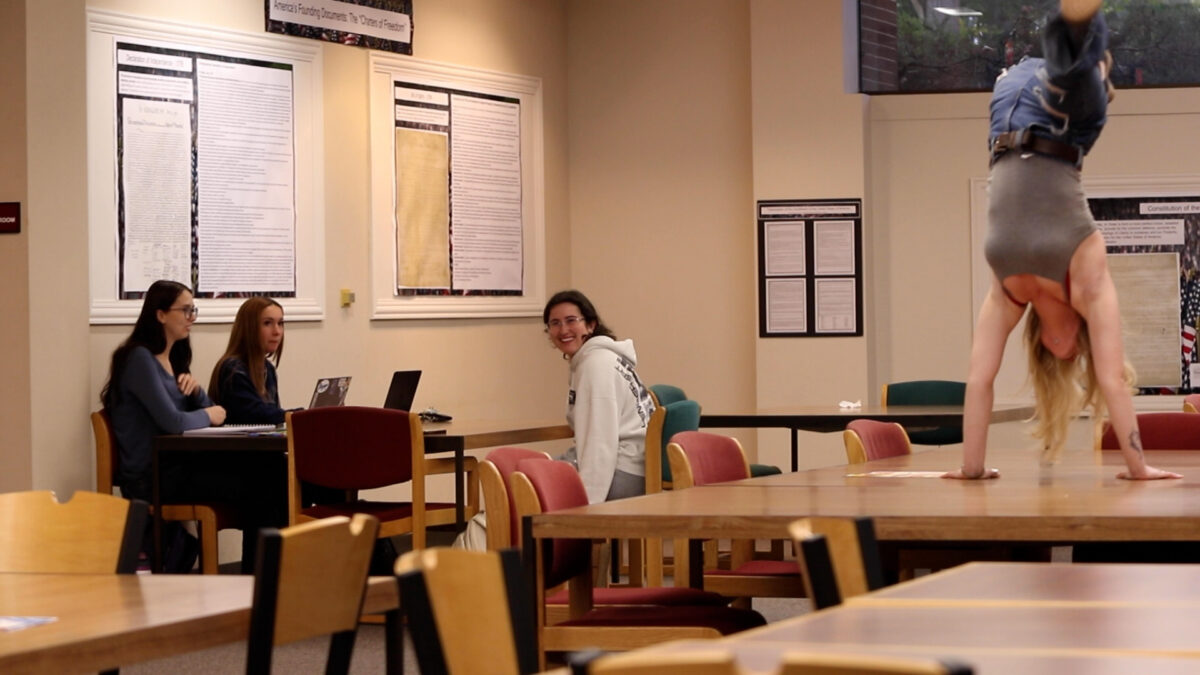
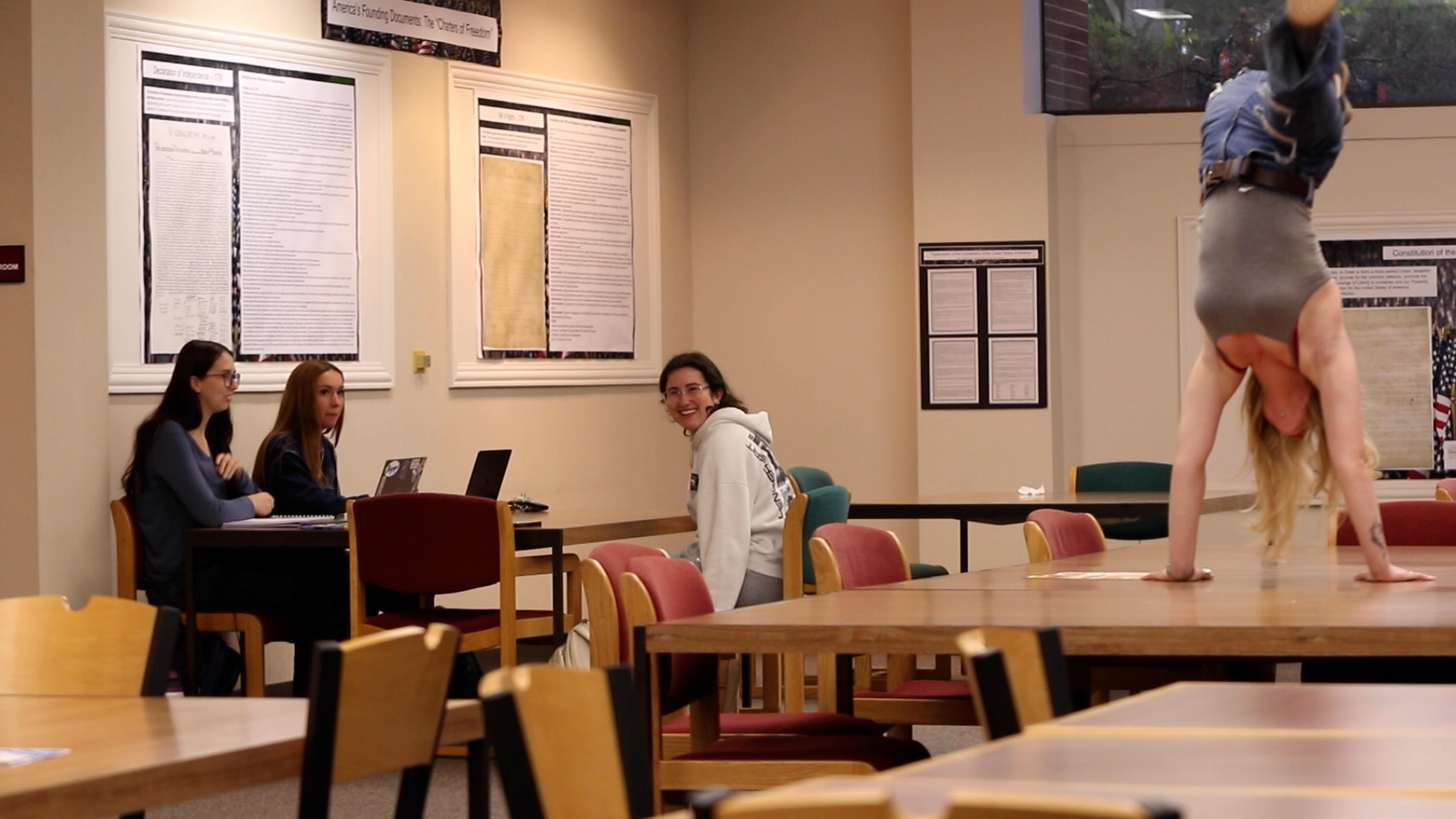
Staff Writer Grace Kelly performs a handstand in the A.C. Buehler Library near students. // Photo by Luke Hernandez
This isn’t exactly something college students expect from a stranger: “Hey, you look like someone I’d like to be friends with, can I sit here?” In a society where strangers often avoid eye contact and keep to their own inner circles, talking to a complete stranger can feel out of the ordinary.
To see what would happen, I randomly approached students, and their reactions varied from confusion and awkward pauses that transitioned to genuine excitement to enthusiasm from the start. What originally started as an experiment in breaking social norms quickly revealed how different people respond when a stranger makes the first move — and how a few unexpected words could be the start of new connections.
Studies show there are theories surrounding norm violations and how they demonstrate that behavior is a choice and as a society we can behave as we wish to.
According to the National Library of Medicine, social norms are “implicit or explicit rules or principles that are understood by members of a group and that guide and/or constrain behavior [to] create a shared understanding of what is acceptable within a given context and thereby contribute to the functioning of social collectives.”
I talked with 12 students, starting with the initial icebreaker question, “Hey, you look like someone I’d like to be friends with, can I sit here?” Four groups of students made up of 2-3 people, not including myself, consented to being a part of this experiment after the fact, while the two samples of solo interactions I had both denied consent in participating.
At first, interacting with other college students whom I don’t know felt just as awkward as it might sound. All of the college students seemed indulged in their own conversations or assignments.
Walking up to someone without a mutual connection or specific reason to talk went against the usual routine of campus life — searching for individuals they already know, and using their free time to get work done. This was exactly the point — to see what would happen when I stepped outside the boundaries of typical social interactions.
Individuals hesitate to approach people they don’t know, said Thomas Salek, Ph.D., an associate professor of communications at EU who connects many theories to the structure of social norms.
“Part of it is the idea of politeness, and politeness theory, and so with it, it’s the notion that you don’t want to put somebody in an uncomfortable or an awkward position,” Salek said. “And so with it, we divert to scripts of, oh, we live in a city, people are busy, they want to go and get to class and get home or they’re on their way to work.”
Students’ initial reactions, conversation topics, and responses to various questions all played a role in these interactions. The point was to see what would happen when stepping outside the boundaries of a typical social interaction.
Deirdre Zerilli, a senior lecturer in the Department of Communication and Media at EU, said that nonverbal communication is a key factor when approaching new people and beginning conversations.
“Nonverbal communication is continuous; we’re always sending that information, whether or not we’re intending to do so,” Zerilli said. “Depending on who you ask, it’s anywhere from around 50% to upwards of 90% of anything that we understand in an interaction is from the nonverbal communication.”
Some students seemed caught off guard: confused looks or pausing before answering the initial question. Others appeared more open to the interaction and showed excitement and engagement within the conversation.
I walked up to multiple groups of students who all had different initial reactions, but there was a trend of increased engagement as the conversations continued. For some students, the unexpected interaction seemed to create an opportunity rather than an inconvenience.
“I love new connections and new people and then learning also about their major, what year they are. So I didn’t find it weird at all, I actually found it really nice and welcoming,” said Leena Nawaz, a senior at EU.
Based on my findings, some of the students’ initial reactions portrayed confused looks and hesitating tones, while others appeared more open to the interaction, smiling and engaging in conversation.
Zerilli said that nonverbal communication plays a massive role in breaking social norms as well as interacting with new people. Individuals tend to rely on first impressions and similarities due to their predictability.
“We’re looking for people that are like us, and one of the reasons why we like similarity is that we can predict people who are similar to us a little bit better than we can predict people who are dissimilar to us,” Zerilli said.
Khadija Najjar, a senior at EU, appeared quiet at first and even later expressed that she tends to be shy. Over time, the interaction naturally flowed and Najjar became noticeably more engaged.
“I feel like this was so nice because people stay in their groups sometimes and they don’t mix and mingle or are just scared to go up to people,” Najjar said.
There are studied theories to explain these surprising behaviors of violating social norms. These unwritten rules are almost engraved into society and help guide human day-to-day lives.
“In terms of communication theory, one thing that we talk about is the theory called expectation violation theory, which is that interpersonally, we always have certain societal expectations about how people are supposed to behave in a given situation,” Salek said. “If we violate that, it can cause people to question, like, is this person rude?”
Jack Fletcher, a freshman at EU, was the first in one of the samples to engage once asked the question within his group. Fletcher explained his experience at EU socially and how it felt similar to other social interactions he’s had while beginning college.
“Random, but I’ve had people talk to me out of the blue often since I’ve been here. It’s random at times but I don’t feel some type of way,” said Fletcher.
According to Frontiers Media, a news source that reviews science, health, technology, and the environment, a research experiment was conducted about social effects when someone publicly violates a social norm: “Compliance with a norm that involved changing one’s sense of social reality or hurting another person against one’s will became the focus of these norm investigations, at the cost of furthering inquiry on deviation and dissent.”
There were some students who appeared to be enthusiastic and engaged with the opportunity to interact with someone new. In the interactions where the other students appeared to be eager about the encounter, the conversation flowed more naturally and connections began to form.
I engaged with a group of three students who were actively in an extensive conversation, and once I interacted with them, they filled me in on what was being discussed and included me almost immediately. Students responded to my initial icebreaker question with passion and eagerness as well as complemented me within their opening response.
Breaking social norms tends to take away this ideal of mystery and control over the perception others have toward a person.
“Where we’re communicating real time, we have less control, and then as a result, the perceptions that other people develop of us, we don’t have as much input on what that might be. It’s a little bit more mysterious to us in synchronous communication,” said Zerilli.
Once I asked to sit down with one of the sample groups, Maddie Miller, a senior at EU, appeared to be the most intrigued by the interaction, nearly interrupting the icebreaker question with what seemed to be excitement.
“Yes, please,” said Miller.
This experiment highlighted how much unspoken rules shape everyday communication. Although not every conversation led to a connection, the different responses showed that breaking a social norm does not have to result in an uncomfortable experience. Although these interactions may have come off as awkward for some students, they still found a way to find a positive in it.
Caden Whiddon, a freshman at EU, appeared to be thrown off by the interaction and didn’t portray genuine interest. After the fact, Whiddon expressed that it was a good way to make friends while mentioning how surprising it was.
Various students expressed their enthusiasm after finding out about the experiment due to them enjoying the interactions and new connections that come with it.
“I’m normally open to meeting new people and starting conversations,” said Elizabeth Acevedo, a senior at EU. “I love just meeting people.”
Salek highlighted that meaningful connections can be made through a social norm violation, but questions and hesitations will occur; it’s all about context.
“When we have somebody that actually tries to make that meaningful connection, it causes people to think twice about, like, am I doing the right thing? Or, is this the expectation of what’s bad for you?” said Salek.
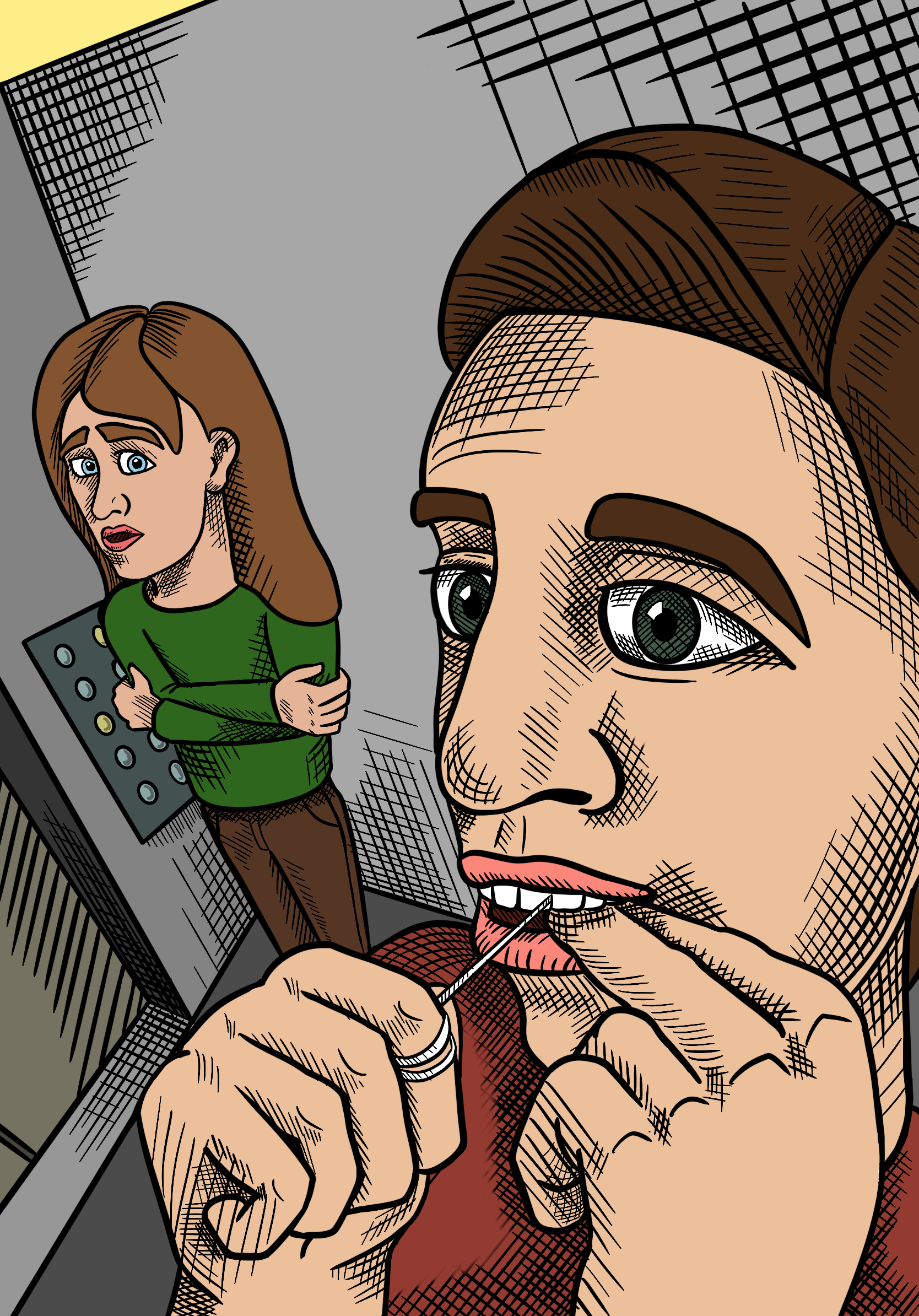
Illustration by Serhii Mahula
One of the interactions was with a group of two students, including Beatriz Damgl Lira, a student at EU I’m in a class with, although we had never previously interacted with each other. This was a different type of interaction because we had a few comments regarding the class we’re in as well as a brief mention about the professor. She originally appeared confused, yet smiled as the conversation continued.
Damgl Lira and her classmate, Viktoria Tacheva, another EU student, were heading out of the dining hall when I approached them and decided to stay five minutes longer to talk with a stranger.
Tacheva appeared to be very enthusiastic as the conversation continued, and once they became aware of the experiment, she came off excited and supportive of the breaking of social norms.
“I was like, okay girl,” Tacheva said.
There were other students who said similar responses about their opening reactions, although they had different thoughts as to the purpose behind the interaction, up until the reveal was expressed that this was an experiment on the violation of social norms.
“Does she need help, or is she hiding from someone who’s in the Roost right now?” said Miller. “We got your back, girl.”
Lily Galarza, a third-year transfer student, said that she’s more outgoing with people whom she knows, while with others she tends to not engage first.
“I originally was like woah what is this? Which is kind of why the signs of panic in my head because I don’t experience this often but then I was like wait, she’s a friend,” said Galarza.
Things such as facial expressions, body language, and tone of voice play a role in the approachability of breaking these specific social norms and having a conversation with a stranger.
“Nonverbal communication isn’t always intentional. And for that reason, we see that miscommunication is more likely to occur with nonverbal communication,” Zerilli said. “Nonverbal communication is inherently ambiguous. There are multiple correct ways to interpret any one gesture or any one behavior.”