Why Did the Campus Mall Smell Like Shit?
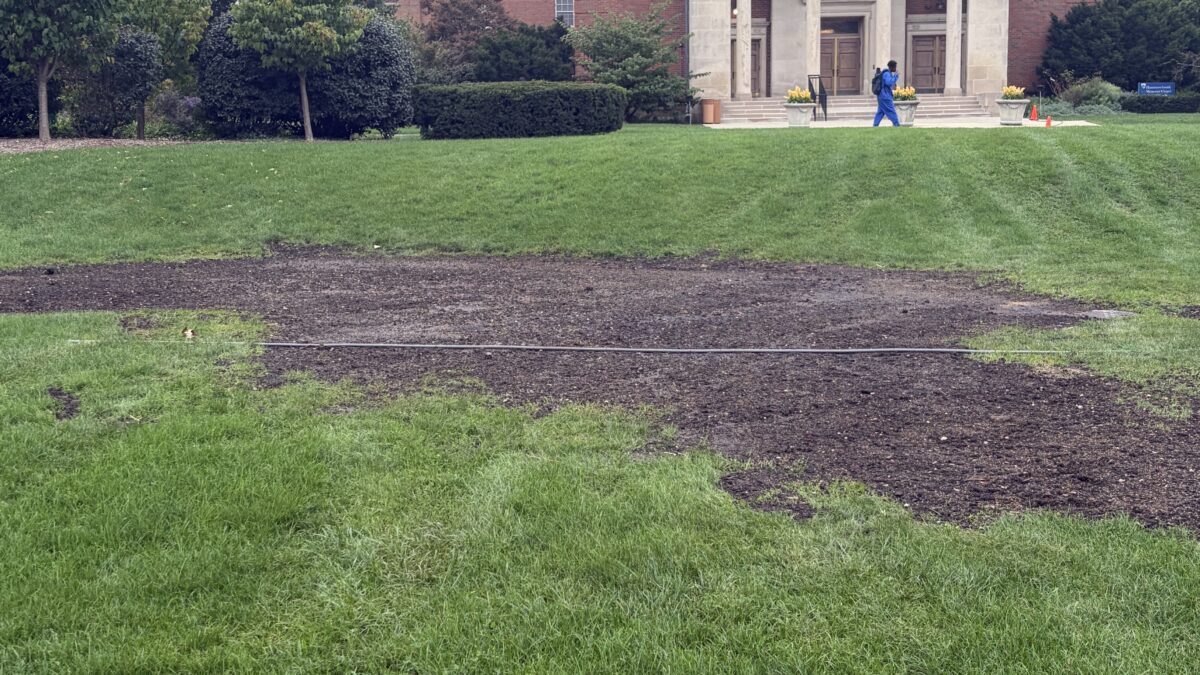
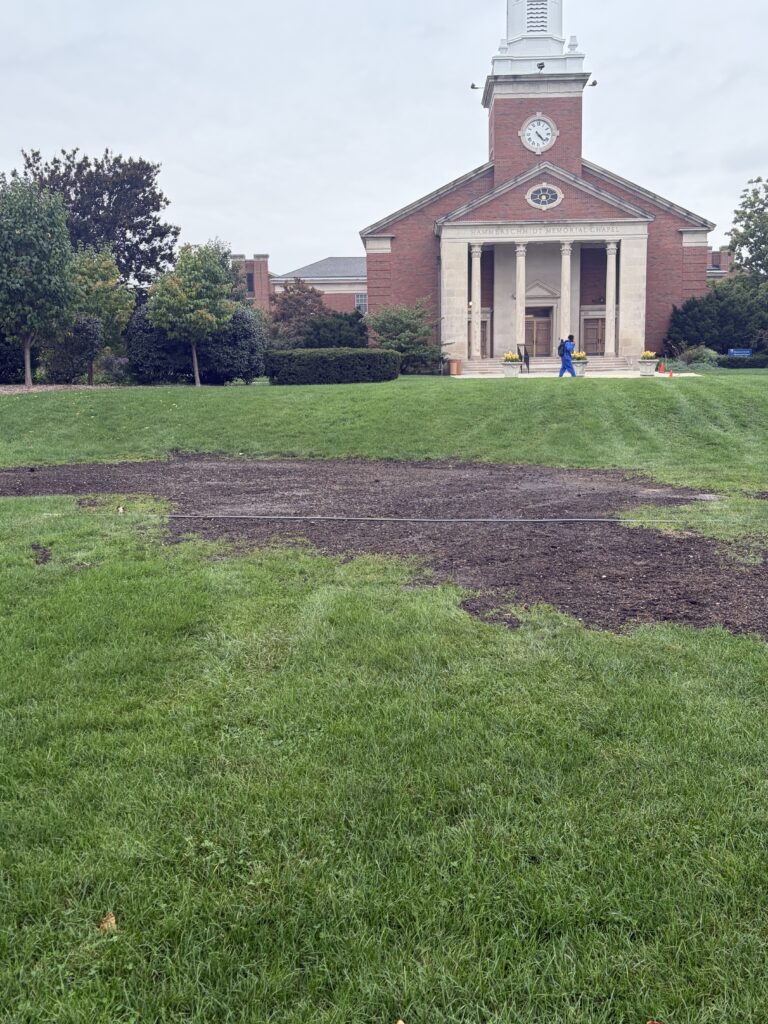
A student walks past compost spread near Hammerschmidt Memorial Chapel. // Photo by Ashley Vanderhoff
After a flurry of homecoming activities, campus settles into a post-celebration lull. Cool breezes and falling leaves create a familiar scene in our campus arboretum, but this year, the air carried a surprising aroma — one that smelled suspiciously like manure.
“It’s as if you went to Brookfield Zoo,” said freshman Jordan Diaz. “It wasn’t pleasant.”
Two posts mentioning the manure-like smell emanating from the University Mall received about 150 upvotes on Yik Yak, an anonymous social media application used to discuss campus life. One post questioned what first-year students would think of the smell. But the odor, which faded within a week, is an indicator of shifting biology and a healing lawn.
Grounds Supervisor Joe Nicoli said the treatment applied to the University Mall was a mix of compost, topsoil, and sand. The compost, which is the most likely culprit of the smell, is a blend of organic matter, including vegetable cutoffs and yard wastes such as leaves and sticks, and is used across campus.
While synthetic fertilizer is a quick and less odorous alternative, it’s not environmentally friendly. These fertilizers can result in poor plant health or water contamination. Compost, on the other hand, feeds the soil and promotes a healthier lawn for longer.
“The true benefit of using compost on campus is to avoid synthetic fertilizers as much as possible. Organic fertilizers feed the soil; synthetic fertilizers feed the plant,” Nicoli said.
Compost is a biological community made up of bacteria, fungi, microbes, mites, worms, and insects in incredibly high densities, associate professor of biological sciences Kyle Bennett, Ph.D., said. With billions of living organisms in just one tablespoon of compost, these bacteria and fungi are highly effective at colonizing the rotting vegetation matter, secreting digestive juices externally and breaking down the dead leaves and twigs.
Despite the notable odor shortly after homecoming celebrations, compost is not normally smelly.
When compost is deprived of oxygen, it enters into an anaerobic process, meaning bacteria that don’t require oxygen to break down the compost take over. These bacteria tend to emit a foul odor that smells like rot or manure. This rotten-egg stench comes from reduced compounds like hydrogen sulfide, a common byproduct of anaerobic activity.
Compost is typically deprived of oxygen when it sits in large mounds and the center of the pile can’t breathe. Once it’s exposed to air and spread out — in this case, across the Mall — the smell typically lingers for a day to a week as the compost reoxygenates and a different set of bacteria takes over, allowing the smell to fade back to a pleasant, earthy scent.
“It’s not just that the smell dissipates. It’s that the biology shifts,” Bennett said.
No one is intentionally trying to make a stinky pile, Kelly Mikenas, Ph.D., associate professor of biological sciences, said. Still, space constraints and factors like rain can compact the compost, depriving it of oxygen. She said that typically, the pile is left to air out for a day or two and then it stops smelling.
Environmental studies major Breanne Long said the compost was worth it despite the smell. Compost can add organic matter to the soil and help prevent greenhouse gas emissions; it can divert organic waste from ending up in landfills and even mitigate climate change by locking carbon into the soil, she said.
Students said they thought the smell lasted about a week. Most, when explained what the compost was used for, agreed the unpleasant odor was worth it.
“The smell wasn’t too exhausting; it was manageable,” freshman Diana Elhrisse said. “After they took out the tent for orientation, the grass was a little bit yellow, so I think it was worth it. The Mall is the heart of the campus, so keeping it healthy and green is really nice, and it looks really pretty now.”
Diaz said if it’s an annual treatment, the smell could be bothersome as it’s obvious even indoors at times in the Frick Center, but she thinks it’s worth it because of the benefits.
Bennett said that compost is by far the best way to improve plant health as it feeds the grass with nutrients while cultivating deep, resilient roots. While grass absorbs the nutrients from fertilizers quickly, those nutrients stay near the surface, leading to shallow root systems that are susceptible to dry periods. Nutrients from fertilizers can also be easily washed away by rain.
Compost, on the other hand, releases nutrients for a longer period of time at slower rates. Bacteria and fungi continually break down the organic matter, restoring the turf layer and forcing the grass to grow deeper roots. The compost will also sit in the grass all winter, allowing microbes to grow and release nutrients in the spring when the sunlight returns and the lawn thaws.
Among the benefits of compost is that it outcompetes other weeds, allowing for fewer applications of herbicides down the line. Bennett said in his 16 years at Elmhurst University, this is the first time he’s seen compost used.
Mikenas said compost, which uses fewer resources to make, is often preferable even to organic fertilizers, which are usually made in factories and shipped across distances.
“Having a beautiful campus that supports biodiversity and wildlife is a really positive thing that the university does, and with that comes a smelly day here and there,” Mikenas said. “Hopefully, it’s worth it to enjoy the beauty of the campus for the other 363 days.”