Policy Shifts Restrict Internships and Work for International Students
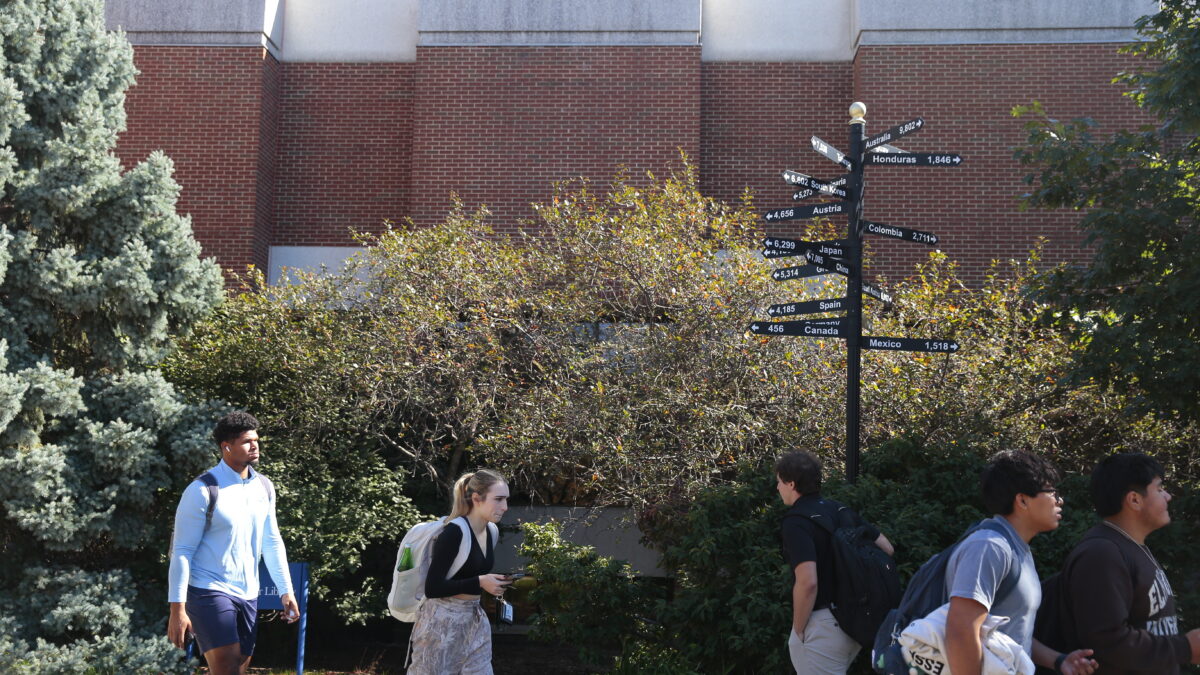
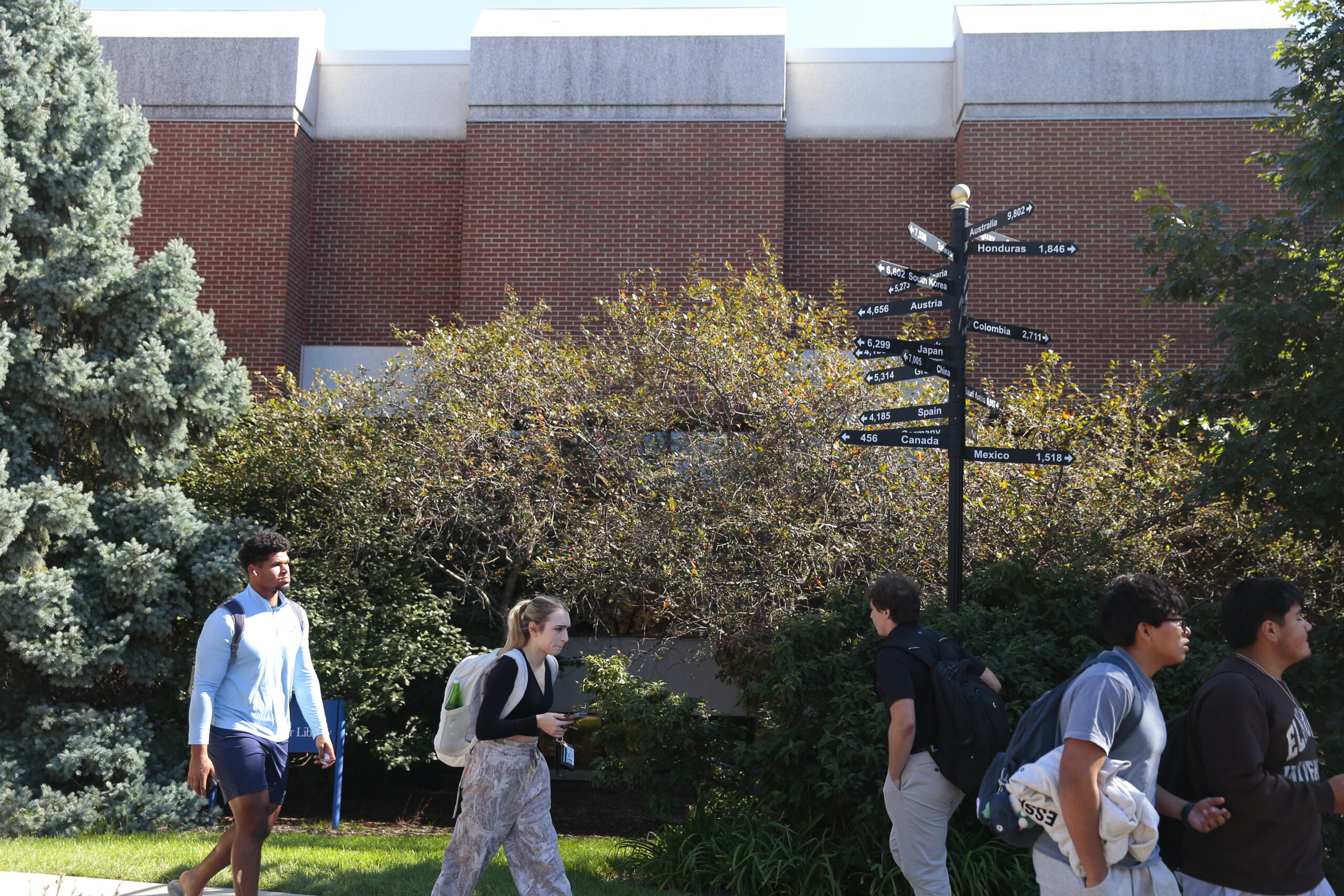
Students walk past a sign pointing to countries around the world.
Eshateer Razia, a biology major on the pre-med track, planned to complete clinical work during her undergraduate years to strengthen her resume for medical school — but new federal guidelines have eliminated her pathway to get that experience.
As an international student from Bangladesh, Razia would have needed to complete clinical work or internships through Curricular Practical Training (CPT), a temporary work authorization for F-1 visa holders. F-1 visa holders are non-immigrant United States visas that allow international students to enter the U.S. to pursue full time academic studies.
But universities across the country are now declining CPT applications following two broadcast memos from the Student and Exchange Visitor Program (SEVP), part of the U.S. Department of Homeland Security.
The memos informed universities that SEVP observed a rise in CPT authorizations that violate requirements. Under those regulations, CPT should only be approved when the training is required for all students in a major program to graduate. Underlying regulations for CPT have not changed — the SEVP is just enforcing them more strictly, according to the memo.
“If you want to stand out, you have to have something apart from your studies,” Razia, who plans to apply to med school in the U.S., said. “And clinical hours are a very strong factor that makes your overall application strong. So I was really looking forward to getting some clinical hours in, but now CPT has stopped.”
The updated guidelines prevent international students across majors from pursuing CPT. EU can continue to authorize CPT for programs that require curricular training like clinicals for the nursing programs or student teaching for education programs, according to Assistant Director of International Student Services, Lucy Bruno.
Elmhurst University enrolls about 180 international students, split evenly between undergraduate and graduate programs. Bruno works with about 435 international students overall, including alumni.
EU updated its CPT website to reflect the new policy, writing that, “CPT must be integral to the academic curriculum for a program, and therefore can only be authorized for programs which require off-campus practical training for all students for degree completion.”
“I know that there’s a lot of changing policies right now that makes it really confusing for the students, and I’m here to support and guide them and help them navigate all of those changing, confusing things,” Bruno said.
Razia said she was about to start the CPT process and was discussing the procedure with Bruno when the first broadcast messages rolled out. She was offered a remote job for customer service that she had hoped to convert into CPT.
“CPT and Optical Practical Training (OPT), these are the things that actually attract international students,” Razia said. “Even working on-campus, getting those little experiences, it’s not as common back home — it’s only studies, that’s it. So getting the exposure to the real world, before you actually join a workplace and learn those skills.”
One remaining pathway for international students wanting to gain off-campus experiences during their undergraduate degree is OPT. OPT can be used for one year, and STEM students who request for an extended period of time can gain access to two additional years.
International students typically use OPT after graduation. OPT exhausts after either 24 months of part time work or one year of full time work. Prior to the new regulations, students typically used CPT during their undergraduate because only OPT could be used after graduation. Now students are starting using their OPT early to allow them to continue off-campus work and internships.
One international student, who asked to remain anonymous, said they are using their OPT early to keep an internship they felt teaches how to navigate corporate environments, peer competition, and improve self-branding. They said they had to pay upwards of $2300 to expedite the process and keep their position.
Razia said using pre-OPT is not appealing to her as a pre-med student. She said she worries about the competitiveness of med school, and wants to ensure she has a full year of OPT available to her after graduation in case she doesn’t get accepted right away, because otherwise, she would have to leave the country.
The memos are the latest move from the Trump administration to limit how international students can study and work in the United States.
In recent years, international enrollment at EU has dropped from about 115 new F-1 students in 2024, to 45 new F-1 students in 2026, according to Bruno.
Razia said international students already struggle with adapting to life in the U.S., and protecting their mental health. She also said that international students pay higher rates than most domestic students.
“So ideally, any student, when they’re putting in so much work, would definitely want to get something back in return, so CPT was a really good option,” Razia said.
Freshman Ayaan Anand hoped he’d have more opportunities to work and earn money during his undergraduate degree. He said he feels bad asking his family for money, especially with the steep exchange rate, and that on-campus jobs are limited for international students who can’t participate in the federal-work study positions
“I didn’t know how severe it was out here,” Anand, who is an international student from India said. “I knew I couldn’t do off-campus jobs, but the thing is, people do jobs for just general cash too.”
International students make up 80% of the full-time graduate students in computer and information sciences at U.S. universities, according to Forbes.
“These new regulations have everyone scrambling, it was very much a curve ball that not many could say they saw coming,” said David Brown in an email to The Leader, chair of the computer science and information systems.
Hamza Javed, a data science graduate student, found out he no longer qualified for CPT three days before the fall semester started. He expected the semester to be busy — he had secured an internship to start that week.
When Bruno’s email detailing the regulations arrived, he sat at his computer for four hours, researching his options and learning other international students’ experiences.
“It limits our career advancement opportunities,” Javed, who is from Pakistan, said. “Secondly, it limits our exposure to American culture. It also negatively impacts our ability to negotiate better pay going forward.”
Javed converted part of his internship to on-campus work as a psychology department research assistant. His role will support the creation of an undergraduate psychology course at EU.
Javed said everyone wants stability in their life, and with all the changing regulations, studying in the U.S. is becoming too much of a risk for international students.
“If you give me the option of having really hostile regulations, but clarity on those regulations, I would take that over this vagueness — this uncertainty, because we as international students don’t know how to plan,” Javed said.
The U.S. Department of Homeland Security also announced this summer that they plan to implement a rule that would limit international students’ visas to four years. The rule would change the longtime system of “Duration of Status” with a strict “Admit Until Date.”
The rule, which was supposed to go into effect on Sept. 15, is temporarily blocked by a federal judge, meaning existing duration of status regulations are currently still in effect.
Razia attends EU on a five-year F-1 visa. Because she applied for her visa prior to these proposed changes, she expects to remain under the Duration of Status system. But, if the policy takes effect and she decides to visit her home country, she said she would fall under the new system when she steps back inside the U.S. — shortening her period of admission and her post-graduation grace period.
“It’s getting overwhelming to you mentally where you want to see your loved ones,” Razia said. “It’s been more than a year. So I feel like I’m at the point where I’m willing to take that risk, because it’s draining mentally.”