
Chicago Mayor Johnson Is Leading the Fight Against Data Centers. We Must Join Him
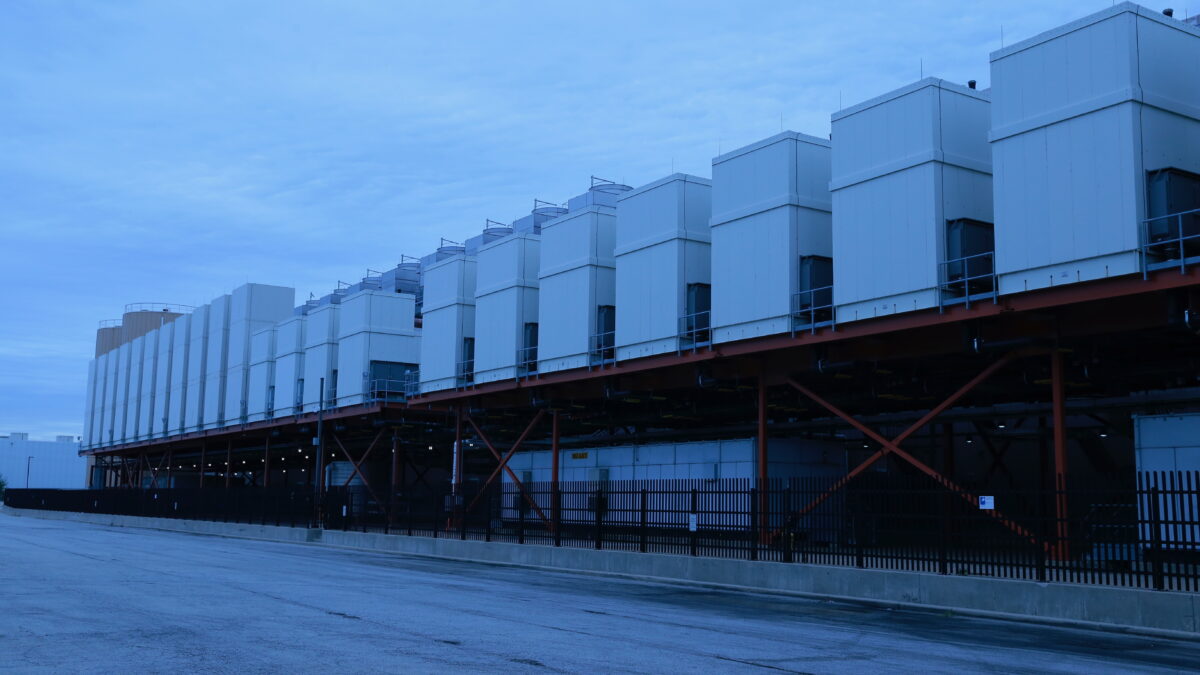
The exterior of Microsoft’s massive over 700,000-square-foot data center in Northlake, Illinois. || Photo by Star Herring
The most poorly kept secret in American history is our current cost of living crisis. Since the end of World War II, the United States has enjoyed its undisputed spot as the pinnacle of the world. Opportunity, wealth, status — it seemed as if everything could be achieved in the United States. And perhaps, for a time, that fantasy was true.
Now, every single one of us sits at an uneasy precipice of insecurity. Political deadlock, crushing inflation, ecological collapse, the improbability of any of us ever owning a home of our own, all of which seems as if it was ripped out of a sci-fi dystopia.
This dystopia takes the form of a hydra dreadfully looming its long necks over the American populace; however, there is hope of carrying ourselves and our communities out from this bleak futuristic epidemic.
Last month, Chicago Mayor Brandon Johnson signed an executive order. The goal is to establish strict guidelines and regulations pertaining to energy costs, water consumption, and the construction of data centers in the city. In addition, he attempted to garner the support from the city council to enact a moratorium on the construction of new data centers.
This is paramount leadership in a time where large tech corporations are aggressively choking out what little resources are available to us. The Chicagoland area (which includes Elmhurst) has some of the highest concentrations of data centers established, in the works, and proposed in the country. In the nearby city of Northlake, there are several operational data centers, the largest of which is the Azure data center, operated by Microsoft. According to the US Data Center Map, an interactive resource that details the locations, power usage, and more information about every data center in the country, Azure’s building is nearly 710,000 square feet.
Depending on where you live in Illinois, you might rely on Lake Michigan, Fox Lake, or any number of our water systems for means of irrigation or recreation. We are incredibly lucky to live on one of the largest reserves of fresh water in the world. On a planet whose natural disasters are increasing in both frequency and intensity, we are already racing against the clock to ensure that our water isn’t drying up.
Building data center infrastructure poses a direct threat to that resource. The University of Georgia College of Agricultural and Environmental Sciences warns that the water used by these data centers runs an increased risk of availability especially during droughts, promotes algal blooms, and causes long-term changes to ecosystems.
The Great Lakes account for 21% of the entire world’s fresh surface water. It is easily accessible and used to support communities along the region, across the United States, and abroad. At a time where our freshwater sources are quickly drying up, it is imperative that we do what we can to protect our lakes.
This includes banding together and supporting YOUR local lawmakers when they make legislation ensuring the protection of our towns, cities, and villages by not allowing data centers to be propped up. I understand in the abstract, this may seem like a nonissue, especially if there isn’t one being built in your community.
I am pounding the alarm because there is one proposed to be built in mine.
I live in Batavia, a respectable-sized town north of Aurora and bisected by the Fox River. I grew up there, performed in plays, and blasted my mellophone in its high school’s marching band. I frequent the cafes and boutiques in its downtown, and I even walk across its signature Peace on Earth Bridge.
Batavia has always been an industrious town. Its spirit is reflected by the many windmills and factories that reside here. The city has a rustic charm to it that I’ve grown to appreciate in my time living here. Those positive qualities are threatened by this proposal.
The data center is being built by a Miami-based tech company called Hut 8. Hut 8 develops power infrastructure for various energy systems across the United States and Canada. However, before it became an energy powerhouse, it became one of the first publicly traded Bitcoin mining services back in 2018. Now, following a 2023 merge with US Bitcoin Corp, Hut 8 exists at this uneasy crossroads between genuine energy management and crypto mining.
I am not comfortable separating the good from the bad in this instance, especially given how closely tied technology infrastructure is to the profiteering of crypto, and the incessant gambling and untraceable economic trails it proliferates. It opens up a Pandora’s box of unchecked, unregulated political and economic corruption.
From my point of view, this is a direct attack perpetuated by corporate tech oligarchs onto my historic home.
My city has outlined a list of parameters that Hut 8’s data center must abide by. It includes and is not limited to noise ordinances such as not exceeding 65 decibels in volume, not exceeding more than 50 megawatts without city approval, metered wastewater, and the promise of using transported water rather than relying on Batavia’s water systems. It is estimated to bring about $2.3 million in revenue, upwards of $5.5 million if it operates at its maximum capacity.
That is, without a doubt, a lot of potential revenue. It is also opening the floodgates for more and more data centers to be set up in and outside of Batavia. The Fox River supports over a hundred endangered species, ranging from aquatic to terrestrial to avian. I am not okay with threatening our at-risk biodiversity for the sake of profit.
It isn’t just the health of our critters that we must look out for, but also the health of our family, our friends, and our communities.
I doubt that Hut 8 will employ Batavians. I am skeptical of the benefits the data center will have in my community. I am angry that a Miami-based company is using our land and our resources for their growth.
Please, for the health of Chicago and our communities, stop building data centers in our towns.