
Kevin’s Journal: No Cap We Really Need an Age Cap for Politicians

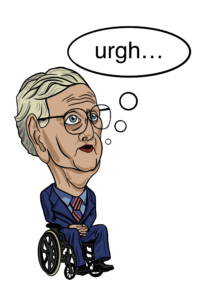
Illustration by Serhii Mahula
Looking at our Congress, you can tell that not a lot of them are interested in the values of the younger voter, let alone obtaining their vote. The age of politicians in this country has been hotly contested for years, including a discussion of an age cap for politicians. During this midterm, there has been a new crop of young leaders who are looking to change the disposition of the chambers as a whole.
After a three-month hiatus, former Majority Leader of the Senate Mitch McConnell (R), 84, who has been serving for 41 years in the Senate, came back to the chambers and looked sickly and nearly catatonic. He was admitted to George Washington University Hospital on June 14 after a fall. While in the hospital, he contracted pneumonia before being transferred to an undisclosed rehabilitation facility in July. His term ends in January 2027, and he is not planning to run for re-election.
A video recently showed McConnell seemingly confused during a vote on a farm bill on Sept 29. While he initially seemed to vote nay, Committee Chairman John Boozman (R) seemed to then prompt him to vote aye, which allowed the vote to advance along party lines.
When politicians need support to tell them how to vote, this creates a very tricky ethical situation where politicians are not thinking for themselves — rather they are doing what they are told. Politicians are elected to support their constituents, not take orders from other politicians or big corporations.
Even if they do receive assistance in deciding their votes, they should at the very least make the final decision by their own volition. When it comes to the older politicians in their 60s there should be a mental test they have to go through before every election to ensure they are even electable. They should go through these tests during regular doctor visits, and we should rely on these tests to ensure they are able to govern effectively.
“The public should not be forced to reckon with whether candidates are physically capable of completing their terms. Encouraging voters to look past the big-name incumbents is not enough; ending American gerontocracy requires systemic change,” the Harvard Political Review said in an article. “An upper age limit is the correct solution to restore voters’ confidence in the fitness of their elected officials.”
A cap on the age of politicians will help ensure they are serving in the best interests of their constituents and not their own interests. In your average 9-to-5 job, people retire at the age of 65 or 66, often to receive Social Security benefits.
Our politics today is changing and Congress needs to change to represent those shifts.
About 80% of young people and older adults hold different moral values and work ethics, while about 78% differ in how they show respect to others, according to a Pew Research Center report.
“Moreover, majorities say the generations are “very different” on each of these three core values,” the Pew Research Center report said.
A majority of people see gaps in other areas: 74% cite differences in political beliefs, 70% noted racial and social tolerance, and 68% pointed to differing religious beliefs, the report said.
The general public wants and needs younger representatives to ensure younger values are being represented, including expanding healthcare and voting rights, ending forever wars, and ensuring our government leaders are being held accountable.
There is definitely a difference in values between generations, and with these differences in values there needs to be a difference in the politicians we elect. Of course having politicians who have been in power for more than 20 years gives them the benefit of experience and power, but we need to ask how this power benefits us.