
Guys, Artemis II (and the Moon Landing) Really Did Happen
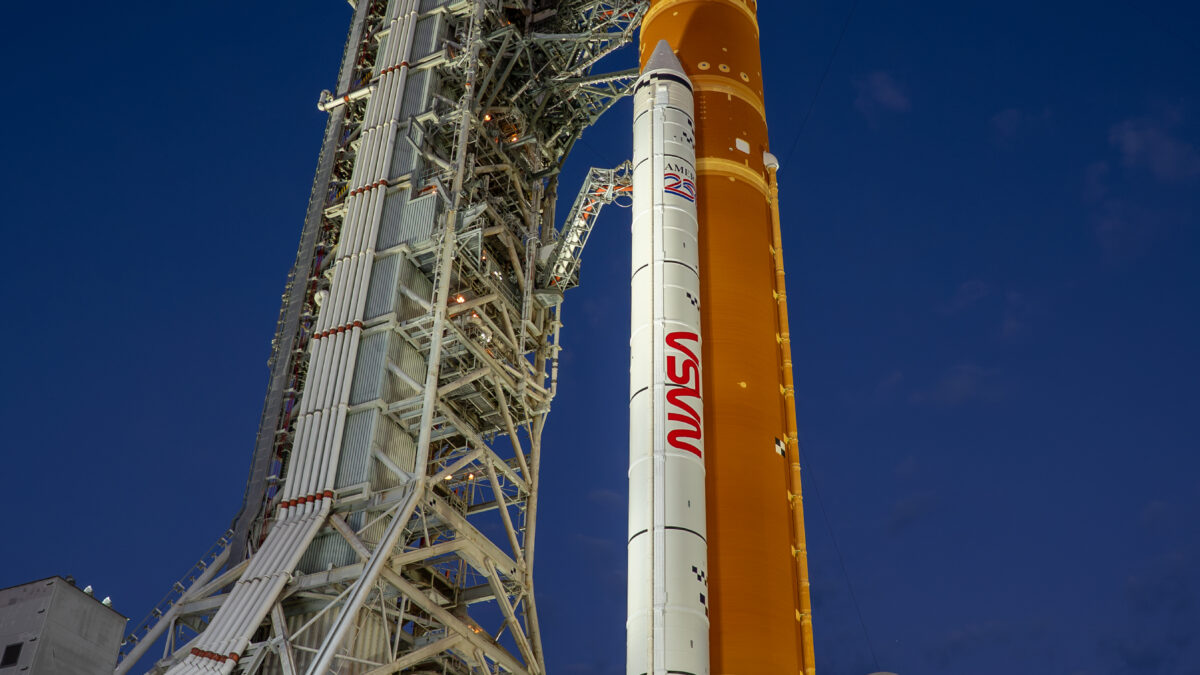
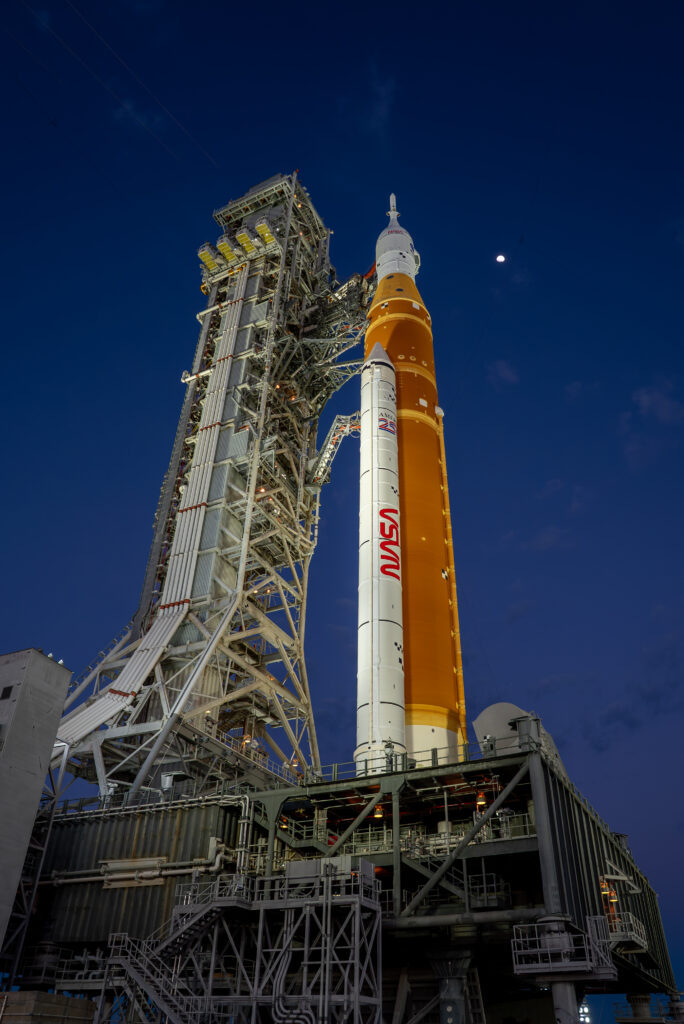
Artemis II and the Orion capsule “Integrity” on top of a NASA Space Launch System (SLS) rocket at launch pad 39B at the Kennedy Space Center. (NASA)
With Artemis II’s successful return, NASA and humanity have made the first crewed trip around the moon since the Apollo era, and have travelled further away from earth than any other human in history. Though the Artemis missions have provided groundbreaking advancements in science and technology, including a 24/7 live broadcast from multiple cameras attached to the inside and outside of the Integrity spacecraft, skeptics online continue more than a half-century of space-race denialism.
On the social media app TikTok, one user commented on a video of mission footage, “how funny [is it that] they’re trying very hard to prove it’s real.”
Another user commented on the same video, “At this point, I don’t believe anything.”
This skepticism is not new regarding space exploration. According to a 1999 poll from Gallup, roughly 11% of Americans did not believe the Apollo 11 mission successfully landed on the moon. In a 2021 POLES survey, roughly 12% of participants said the same.
Buzz Aldrin famously punched a moon landing denier in 2002, fed up with repeatedly hearing theories invalidating his lived experiences.
1 in 10 doesn’t seem high, but it is. According to the last US census, that’s around 30 million people.
Elmhurst University Astronomy Professor Kevin Murphy understands how people come to this conclusion, though doesn’t condone it.
“In terms of conspiracy theories, it’s just simply easier to believe something than to understand it,” said Murphy.
“Because it takes hard work,” said Murphy. “So, if you went through a graduate course in orbital dynamics like me, then you understand how the whole process is done.”
With the background knowledge and understanding of how these processes are carried out, Murphy simply watches the events with enjoyment and awe. While more comments are posted saying, “the studio hatch,” or simply, “fake.”
These comments aren’t necessarily based in any strict reality. More often than not, there’s no logical backing to any statement that references a “studio” or a “firmament” or the glass dome over our planet. They’re people who are generations removed from the cultural phenomenon that was the Apollo, or even Space Shuttle era.
“In terms of the old Apollo missions,” Murphy continued, “I don’t think there is anyone over 60 who thinks it’s a conspiracy. Because, if you lived through that era, it was everything. I mean, you could ask any 10-year-old [at the time], and they would know the names of all the astronauts on board.”
NASA currently directly employs approximately 18,000 civil servants. At Apollo’s peak and including contractors, NASA had approximately 400,000 individuals involved with the association. This monumental staff reinforces the existence of the moon landing, how do you keep a secret among thousands of employees?
“5 people can’t keep a secret, how are you going to get 200,000 people to keep a secret?” said Murphy. “Plus, they sent the lunar reconnaissance orbiter to map out the surface of the moon. So, on the next Artemis mission, they know where to land. In the photos they captured, you can see the stuff we left on the moon. You can see the little rover tracks and everything.”
Ultimately, who knows how many people actually think NASA is a bunch of film majors in a multi-billion-dollar movie studio. If the Dead Internet Theory has any place to be evident, it’s in bad actors taking human-first government achievements and sewing distrust, or bots filling the comment boxes of popular videos with accounts designed to generate activity, and therefore revenue.
Sometimes though, according to Murphy, “People are just willfully ignorant.”