How a China Rabbit can Change Your Perspective

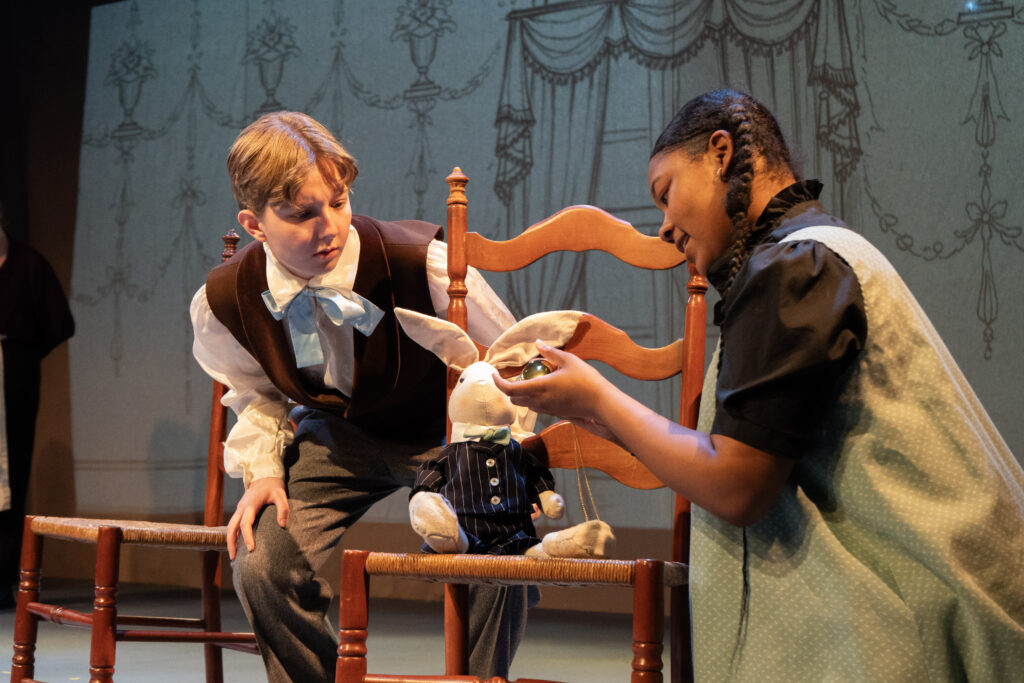
Edward Tulane (Delaney Murphy) watches Abeline (Trinity Reid) during “The Miraculous Journey of Edward Tulane” on March 11. (Ian Murphy and Delaney Murphy)
Edward Tulane (Delaney Murphy), is a china rabbit who goes on a 20-year adventure being loved, lost and talked to, though he isn’t able to communicate his own thoughts back. The Mill Theatre’s latest play, “The Miraculous Journey of Edward Tulane” executes a simple story in profound ways, highlighting what it means to truly be loved.
Edward meets a little girl named Abilene (Trinity Reid) who is his first owner, and treats him as her own child, even finding him clothes and dressing him every day. Reid brings a level of joy that is rare to find outside of childhood, and demonstrates how to bring in child-like charm and attitude while also being able to give Edward an experience he will remember throughout his journey. Even when he is hundreds of miles away from Abilene, Edward still fights to get back to her and help her along in her life and ensure her safety.
A lot of people will ask, “Why are we telling a ‘children’s’ story at the college level?” I know I did. I think that is the whole reason this was shown: to demonstrate to young adults that we all can change our situations; even if we feel old or worn, like Edward, there will always be opportunities to fix our attitude towards life, and to begin to see humanity even in the dark places.
Pellegrina (Elizabeth Jarrett), who was Abilene’s grandmother, brings Edward from France and gifts him to her granddaughter. Pellegrina tells Abilene and Edward a story almost every night before bed. After one of the stories, it seems like Pellegrina can read Edward’s mind, and she begins to guide her stories into lessons for him. One story is particularly important to Edward, and it begins his process of having a different outlook on life. Jarrett acts in a way that makes us suspicious of Pellegrina and wonder if she has certain powers that seem to be affecting Edward’s life.
In today’s world, it is so hard not to see our attitudes turn sour, affecting how we react to others and possibly lose the people closest to us.
Throughout the show, the audience learns that if you did not go in with an open mind, you could miss the messages within the show, and you might have thought the show was meant for children.
I believe this is another theme throughout the show: the importance of creating a community. To pull himself out of his dark places, Edward needed to find people to go on his adventures with. This represents the fact that when you are far away from home, having people who you relate to and care about are important to your journey and can make or break your experience.
This theme seems to be especially true for our international students and students far from home. It is hard to make this college journey on your own, and when you find people to surround yourself with, who will care for you and support you, you have truly won in college, and you should go on as many adventures as you can. Murphy’s performance takes us down the road of someone who is mentally lost before they are physically lost and shows how it feels to be angry at the world.
Everyone goes through a point in their life when they feel as though people in the world are against them and they begin to get mad at certain people or situations, even if they had nothing to do with the situation they are dealing with now. This story shows that changing your view on the world can help build a better mentality for yourself and better support yourself throughout life.
When you go to a show at the Mill, you do not always need to think this deeply, but you should always keep your mind open because you never know what you can walk out with. Of course, I am not suggesting that one show should change your whole view, but a new perspective can be brought into your life and allow you to think differently.
“The Miraculous Journey of Edward Tulane” performed for two weeks, March 12-15 and March 19-21.