Billy Huff Examines Sex and Gender in the Johnson Lecture
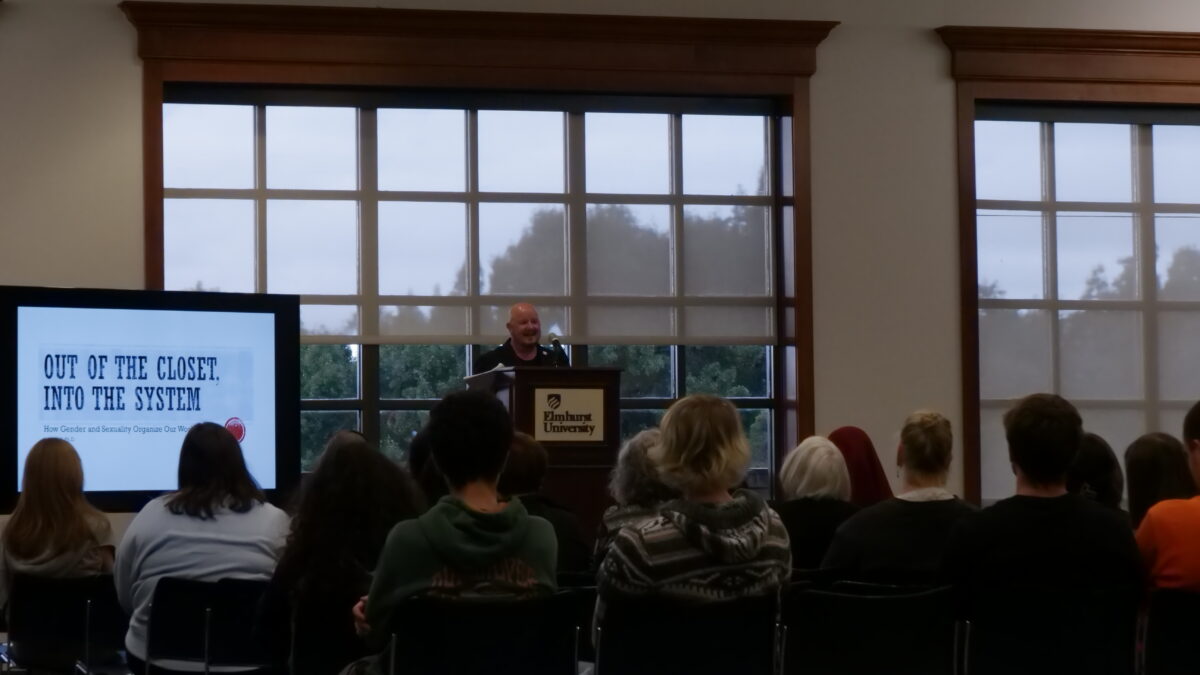
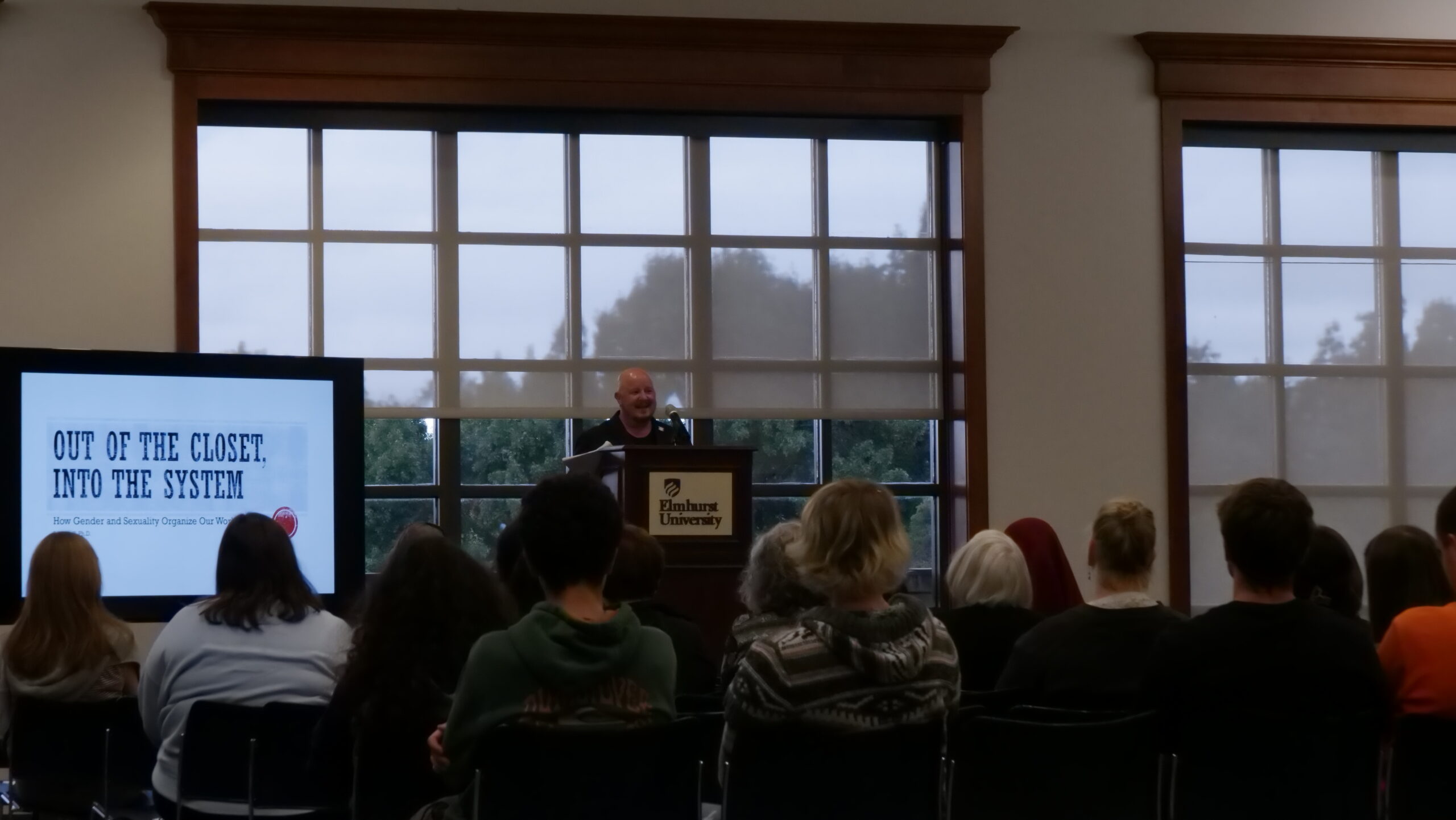
Billy Huff, Ph.D., delivers his version of the Johnson Intecultural Lecture in the Founders Lounge on Oct. 14. // Photo by Star Herring
Billy Huff, Ph.D., a communication scholar who serves as the director of the Gender and Sexuality Center at the University of Illinois Chicago, explored the complex histories of sex and gender throughout the William R. Johnson Intercultural Lecture, held in the Frick Center Founders Lounge on Wednesday, Oct. 14.
The second of Elmhurst University’s four annual intercultural lecture series, the Johnson Lecture is held every October to overlap with not only LGBTQ+ History Month, but National Coming Out Day, which commemorates members of the LGBTQ+ community “coming out of the closet.”
The lecture series is named for the Rev. William R. Johnson, Ph.D., a Class of 1968 then-Elmhurst College graduate who went on to become the first openly gay person ordained in the United Church of Christ, as well as in the history of Christianity as a whole, although he was subjected to intense discrimination beforehand due to his sexual orientation.
The latest installment in this lecture series, titled “Out of the Closet, Into the System: How Gender and Sexuality Organize Our World,” was introduced by Josh VanArsdall, Ph.D., associate professor and chair of EU’s Department of Psychology.
“Psychology has a long history of measuring, categorizing, and sometimes pathologizing gender and sexuality,” VanArsdall explained to lecture attendees, adding that homosexuality was officially classified as a mental disorder until 1973. “Even today, gender expression and identity are often the subject of psychological scrutiny.”
“When I teach this material, I want students to see that the science of sexuality doesn’t just describe people, its definitions and norms have also shaped how institutions treat them, and how they think of themselves as well,” continued VanArsdall. “Dr. Huff’s work pushes scholars like me as well as folks like you to keep asking whose experiences our categories capture, and whose they leave out.”
Huff, a transgender man with a Ph.D. in rhetoric from Georgia State University, then commenced his lecture, which outlined the ways in which social, political, and economic systems have shaped gender as well as sexuality and vice versa. Huff encouraged attendees to view gender and sexuality as “two of the most fundamental tools that have been used to structure the modern world,” as opposed to focusing on individual sexuality.
Huff noted the particular importance of protecting the LGBTQ+ community in the current political context, as the American Civil Liberties Union (ACLU) has tracked more than 500 anti-LGBTQ+ bills in U.S. state legislatures, including 23 in the Illinois 2026 legislative session alone. Despite this, the ACLU classifies Illinois as a state with strong legal protections and supportive policies for LGBTQ+ individuals.
“I’m very grateful to be in Illinois now,” Huff told attendees. “I coincidentally moved here from Florida, like, eight years ago, so I got out of there right in the nick of time.”
Huff referred to trans studies scholar Loretta LeMaster’s interpretation of gender as a dual-sided framework with a “light side” and a “dark side.” Although White women on the “light side” were still deemed to be subordinate to men, they still “held vast racial privileges,” whereas non-White women on the “dark side” were exploited for labor and sex. Huff further noted that although women formally achieved voting rights in 1920 via the 19th Amendment, Black women continued to endure racial discrimination at the ballot box.
Huff also referred to the Lavender Scare, a moral panic about homosexual workers in the United States government that caused the forced resignations of an estimated 10,000 gay and lesbian civil servants, who were portrayed as “inherent national security risks.”
Huff noted that transgender individuals continue to experience discrimination and persecution in the so-called “land of the free,” with a January 2025 federal executive order directing federal agencies to withhold funding from any medical institutions providing gender-affirming care, including puberty blockers and hormone therapy, to individuals under the age of 19.
In a private interview with The Leader conducted prior to the lecture, Huff described additional challenges for LGBTQ+ individuals under the current Trump administration, including attacks in the forms of misinformation and erasure, as well as institutions such as universities attempting to fly under the radar of the Trump administration and protect funding by downplaying support for LGBTQ+ populations.
Huff also discussed the heavily anticipated midterm elections.
“It’s important to hold onto the hope. And don’t forget about joy,” said Huff. “We need to make new friends with differently oppressed people, and stand in solidarity together.”
EU’s next intercultural lecture is the Martin Luther King Jr. Lecture, which is traditionally held in February to align with Black History Month, though the date and speaker for the lecture series’ 2027 installment have not yet been disclosed.