EU’s New Curriculum: “Your Education Is Much Larger Than Your Major”
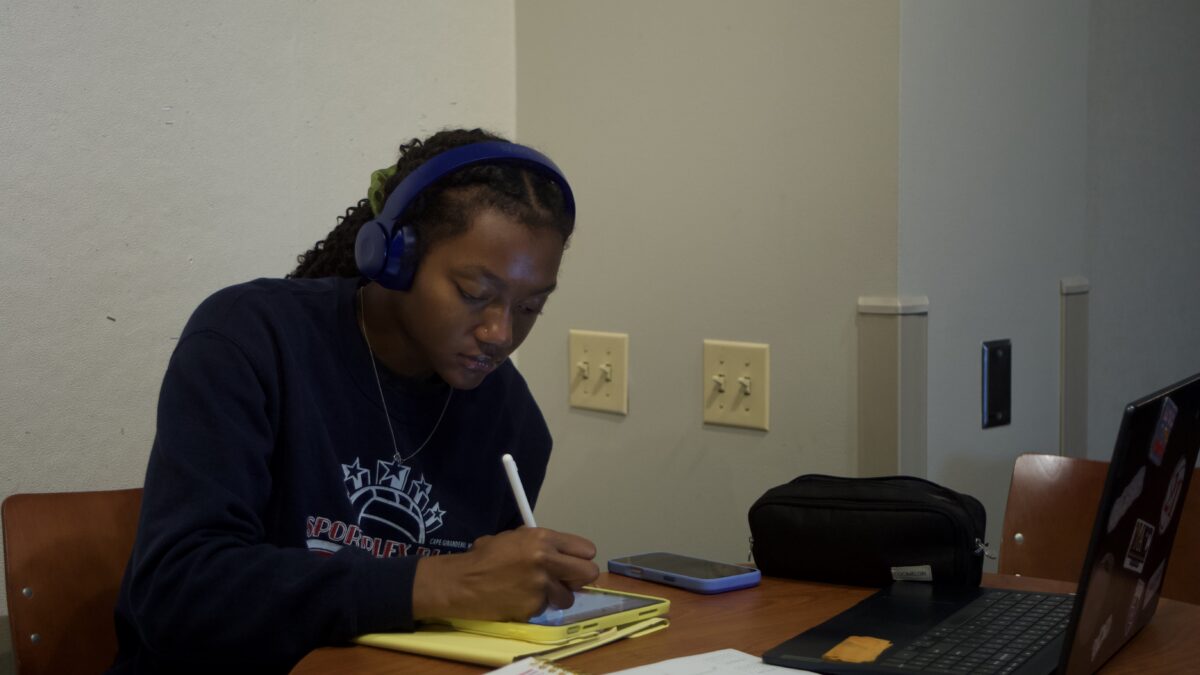

A student sits in the Frick Center while working on homework. || Photo by Star Herring
Elmhurst is launching a new integrated core curriculum, the Bluejay Core, in Fall 2027. Talks of launching a new core curriculum began around 10 years ago. The requirements for the curriculum were decided between two working groups composed of faculty members and admin.
In the first working group, faculty, students, and student leaders around campus were surveyed to get a sense of how people were experiencing the current curriculum, according to Karen Benjamin, the chair of the working groups.
The general education requirements are changing and the goal is that students are not just taking classes that target their majors but all different types of classes to get the liberal arts experience. Benjamin also said that she hopes students can get additional opportunities to help build their resumes.
“We’re trying to move students away from thinking about their education as their major,” Benjamin said. “Your education is much larger than your major, and being intentional about how requirements might give you an opportunity to take a class that you’re not required to for your major will really help you when you’re out on the job market.”
Along with the general education requirements being redesigned, the first-year seminar (FYS) program is also undergoing changes. Benjamin is the current director of FYS, but at the time of the proposal it was Tyler Fagan, assistant professor of philosophy.
The redesign has students focused on engaged and active reading as well as building quantitative and writing skills right away. The university is also applying for a Teagle Grant, which brings the humanities and liberal arts back to the center of education.
Being added to the new curriculum will be more professional internships, volunteer opportunities, and independent research opportunities. A new aspect of the curriculum will be that these types of opportunities can qualify as students’ experiential learning credit. Now there are more ways to fill the requirement, including research through the Creative and Scholarly Endeavors (CASE) program and study abroad internships.
“We think it’s so important that our message isn’t just do one and check the box,” Benjamin said. “We want you to do as many as you can. Do the independent research, volunteer; we’ll build your network. You want to meet as many people as you can.”
Fagan was a part of the working groups to help determine how freshmen would fit into the overall general education structure. He said that the program has been around for long enough where it was time to see what wasn’t working and what needed to be improved.
Fagan hopes that the new FYS program can give first-years more time to learn about the people, the places, and the support networks the university offers. He also said that he wants FYS to continue to be a community of students, and that students can use faculty as a resource.
“I think students, and for that matter, faculty and advisers are going to have an easier time navigating a more streamlined or less complicated set of requirements,” Fagan said.
Benjamin said around 85% of faculty voted yes for the first working group to elect a second working group to start designing models for the integrated curriculum. On April 10 of the last spring semester, 170 paid faculty members voted to pass the curriculum and 90% voted to make a change.
Benjamin said that if current students like the curriculum better they have the opportunity to switch their catalog year during Fall 2027, but they don’t have to if they don’t want to.
“I want to make it clear to existing students this is not necessarily going to have any impact on them at all,” Benjamin said.
Dean Jensen, associate professor of computer science and information systems, was chosen by faculty as an at-large member to represent faculty for the proposal of the new curriculum. He wants students to be better well rounded and believes the new curriculum will help students leave Elmhurst feeling more educated.
Jensen said that the new curriculum will allow students to engage with students and faculty they may not normally run into, as there are more varied types of classes. Under the new curriculum, students will be required to complete coursework across several designated areas of study. These areas will be called the Liberal Arts Core, Responsible Engagement: Advancing the Common Good, Experiential Learning, and Requirements for the Major.
“It’s really to give them that opportunity to not just be checking a box, but to get something out of that requirement and get some knowledge,” Jensen said. “To be like, ‘I’m doing that to become a better, more well-rounded, more educated person.’”