Commuters Feel the Impact of Rising Gas Prices

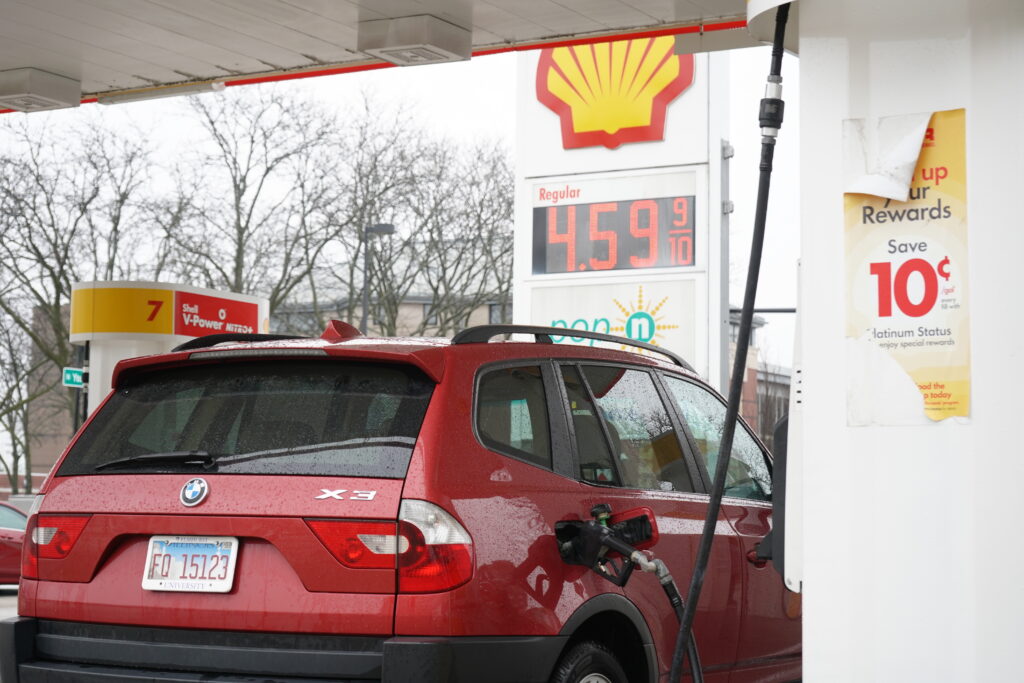
A car fills with gas at the Elmhurst Shell on York St as prices approach $5 per gallon on April 4. (Ian Murphy)
Rising prices tied to the Iran conflict are causing Elmhurst University students like Alex Knapik to rethink daily budgets. He’s paying more for travel to school and work while cutting back on leisure amid uncertainty about future prices.
“It’s a lot harder now to justify going out and doing something — or even driving a little further,” Knapik said. “Right now, it’s just not making sense to go out and enjoy oneself.”
Since the start of the United States-Israel strikes on Iran last month, gas prices have risen to an average of $4.28 per gallon in Illinois, up from about $3.06, according to the American Automobile Association.
While military conflicts often drive up prices for a variety of reasons, Iran’s strategy relies heavily on targeting energy markets — limiting the supply of oil and making the conflict difficult for the United States to justify economically.
Iran’s closure of the Strait of Hormuz due to escalating military threats posed a risk to shipping. Tankers are currently facing difficulties in securing insurance coverage, slowing oil transportation, and contributing to global supply chain disruptions.
What are the economic implications of rising oil prices?
Adjunct economics professor Frederic Peronto says the concern with rising gas prices is less about the current amount and more about how quickly they’ve increased. While the U.S. has experienced $4-per-gallon gas before — and not that long ago with the Russo-Ukrainian conflict — it’s the sudden, short-term spike that is striking. Oil is now approximately $110 a barrel.
“If it gets to $150 or $200 something, people are saying you could see $6, $6.50 gas,” said Peronto.
Gas prices are often based on the futures market, where businesses and economists make projections about what gas will cost at a future date. If the market anticipates higher prices, it can drive up future prices, prompting sellers to raise gas prices in advance.
But rising oil costs don’t just impact gas; it also affects the broader economy. As gas goes up, transportation costs rise for any goods purchased in the U.S., and those higher costs are eventually felt by consumers.
“I’ve noticed groceries have been pretty consistently on the rise as well,” said Knapik. “The cost of living just continues to increase, and I feel like we’re focusing as a country on the wrong areas to remedy some of the hardships we’re facing right now. I hope we prioritize what we’re doing.”
Uncertainty can make it difficult for businesses to plan ahead, which also impacts the economy, Peronto said.
Graduating seniors could be particularly vulnerable to the uncertainty created by the Strait of Hormuz closure. With unpredictable gas prices and potential inflation, job markets and business expansions may slow, making it harder for students to plan financially and professionally after graduation.
“It’s the uncertainty overall that is kind of having a stranglehold on businesses,” said Peronto. “People who potentially were thinking about expanding or increasing their workforce are probably going to put that on hold right now until they have more certainty.”
“If I were a senior at Elmhurst University looking for a job, the thing I would most want is certainty right now,” Peronto added.
President Donald Trump has relayed mixed messages on whether the war will be short-term or long-term. On Wednesday, Trump, in his first national address since the conflict began, said: “core strategic objectives are nearing completion.” He offered no end date for the war, and some observers suggest that the Pentagon’s request of $200 billion in additional funds from Congress points to a longer conflict.
Even if the Strait of Hormuz were to open up relatively soon, markets would not rebound instantly. Transportation of oil could resume, but many production facilities in the Middle East have been destroyed and will take years to rebuild, keeping oil scarcer than before the conflict.
“Anytime there’s scarcity of anything in the world, the price is going to go up,” said Peronto.
Why is the U.S. still reliant on Middle Eastern oil?
The U.S. is the world’s largest exporter of oil and is less dependent on Middle Eastern oil than decades ago, but global market disruptions still affect prices at home. Even if the oil and goods go to Asia, the interconnected nature of supply chains and energy markets means the U.S. economy remains tied to the region.
“If all of a sudden helium gets strangled and can’t get out of the Strait, now in Taiwan, the companies that are making microprocessors can’t, which means refrigerators and many other goods can’t be made,” said Peronto. “So there’s that ripple effect that is going to affect us.”
Assistant professor of political science Timothy Hazen noted no one person, party, or institution is to blame — it’s the result of a democratic society. Conservative-leaning interests tend to reinforce the role of petroleum in U.S. society. But some observers argue that left-leaning interest groups have pushed for limiting how much oil American companies drill, which contributes to the lower supply.
Additionally, Hazen explained how over the past 50 years, U.S. policy toward Iran has often oversimplified the country, treating it as a monolithic “enemy” without fully considering the complexity and nuance of Iranian society. Even when the U.S. seeks regime change, its involvement can complicate legitimacy and make the situation more difficult to influence than policymakers often assume.
“One of the criticisms that one could have towards American policy towards Iran in the last six weeks is a superficial understanding of Iran and not fully understanding the complexity and the nuance of Iranian society,” said Hazen. “Iran, with American presidents, both Republican and Democrat in the past, has been labeled as bad, evil, the enemy.”
How else are students affected by the Iran conflict?
Knapik worries that with any issue as complex and multifaceted as this one, elements of racism and antisemitism have the potential for impact if conflict were to arise in the U.S.
“I feel like now in 2026, we’re more divisive than ever. We use a lot of divisive diction, and it’s always us and them,” said Knapik. “I feel as though there’s a lot of internal remedies that we should work on rather than meddling in foreign affairs.”
International student Hamza Denguezli echoed similar concerns as someone who deeply values human life. He views such conflicts as unjust, often driven by misleading motives, and believes they create more suffering rather than real solutions.
“I feel the impact in my daily life as an international student commuting to Elmhurst,” said Denguezli. “Gas prices are going up, expenses are adding up, and it becomes more stressful just to keep up with school and responsibilities.
“That’s what makes it even more frustrating,” added Denguezli. “Real people are paying the price, both in human lives and everyday struggles, for something that doesn’t feel necessary or fair.”
Knapik echoed a similar sentiment.
“This one feels closer to home because I feel a more direct effect,” said Knapik.