As National College Safety Concerns Grow, EU Students Push for Change
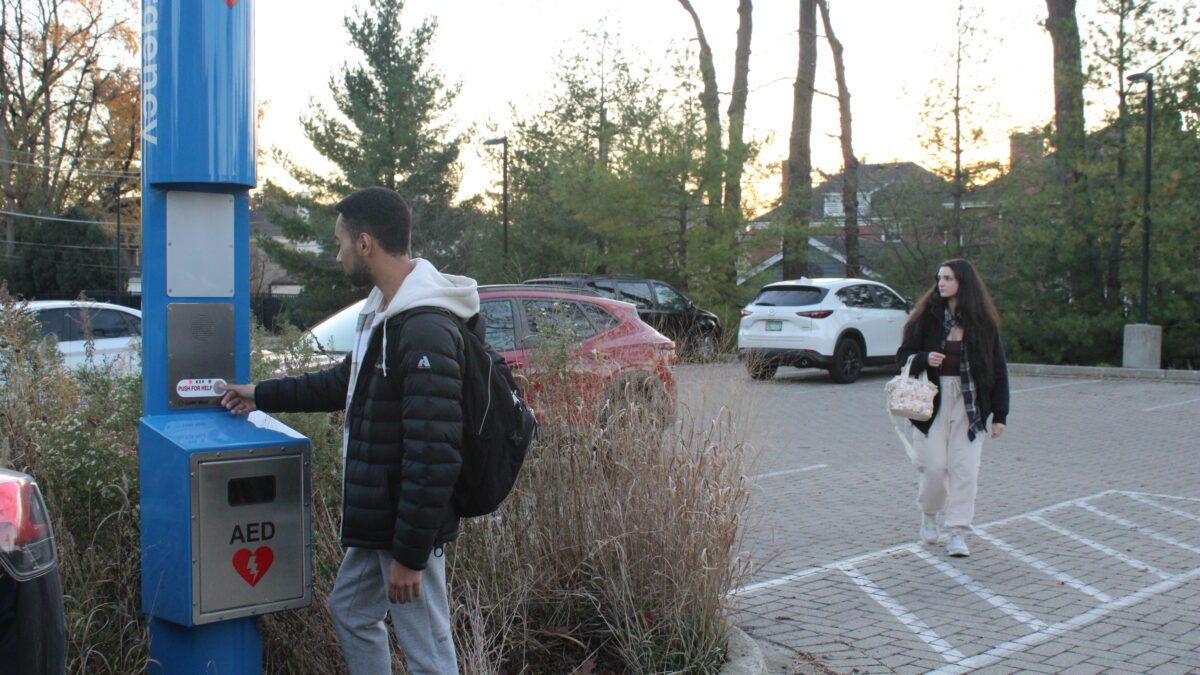
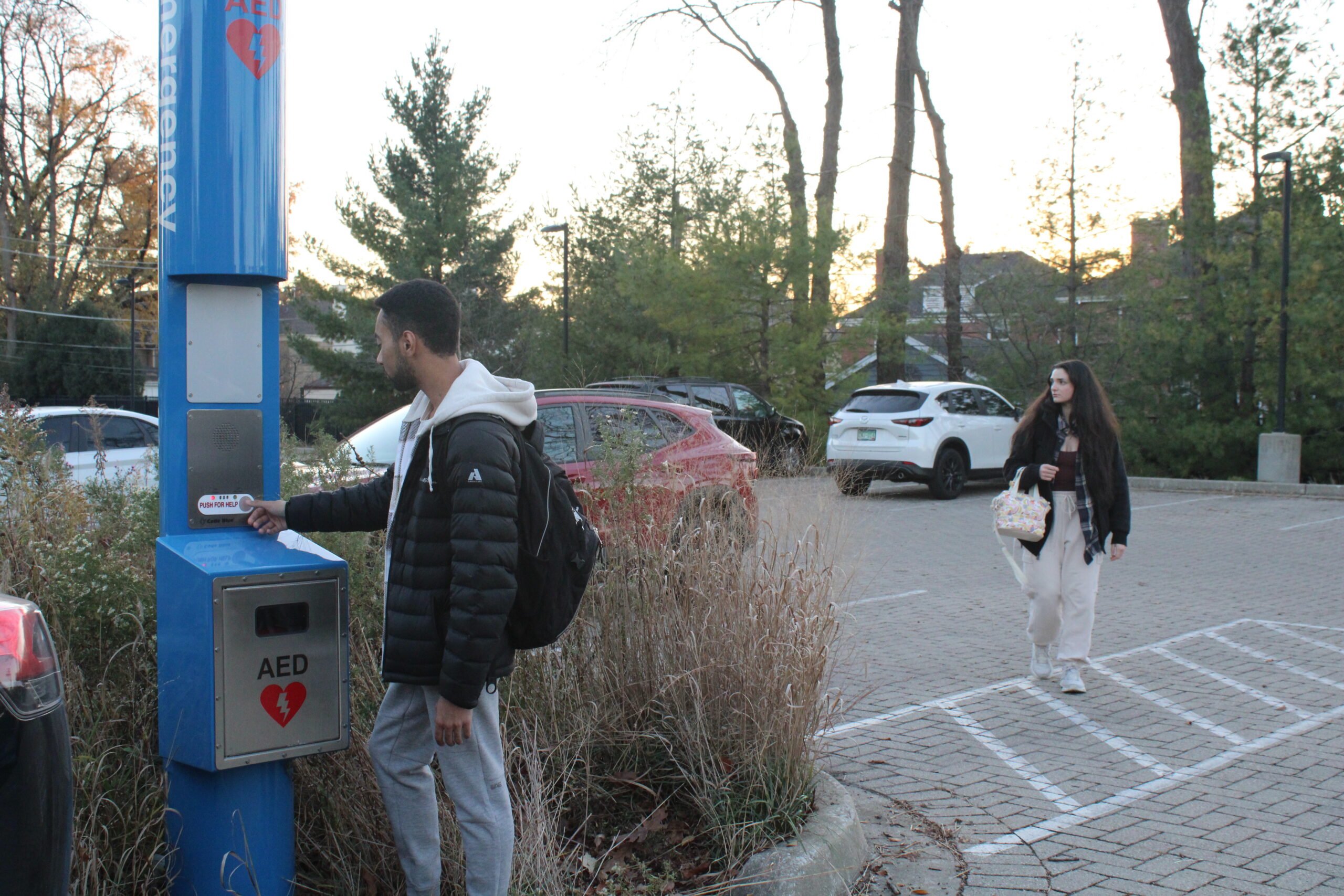
Senior Luke Hernandez presses a button on one of the emergency blue light phones in the West Hall parking lot. || Photo by Grace Kelly
To target poor lighting on campus, the Student Government Association (SGA) took a night walk on Nov. 5 to find where the lighting on Elmhurst University’s campus was down and students felt unsafe. Although it was rainy and cold, the event had a good turnout and SGA found West Hall, the Prospect Apartments parking lot, the side and rear areas of Faganel Hall, and portions of the University Mall walkways areas with poor lighting.
Patricia Perez, vice president of SGA, wanted to hold the night walk, along with other members of SGA, because as an evening student herself, she wanted to make sure students felt safe on campus. The walk also included Public Safety.
“They were pointing out to us that in the areas that were unlit, there’s cameras, but the thing is, we want something to be done before,” Perez said. “Like to be proactive, we don’t want something to happen God forbid.”
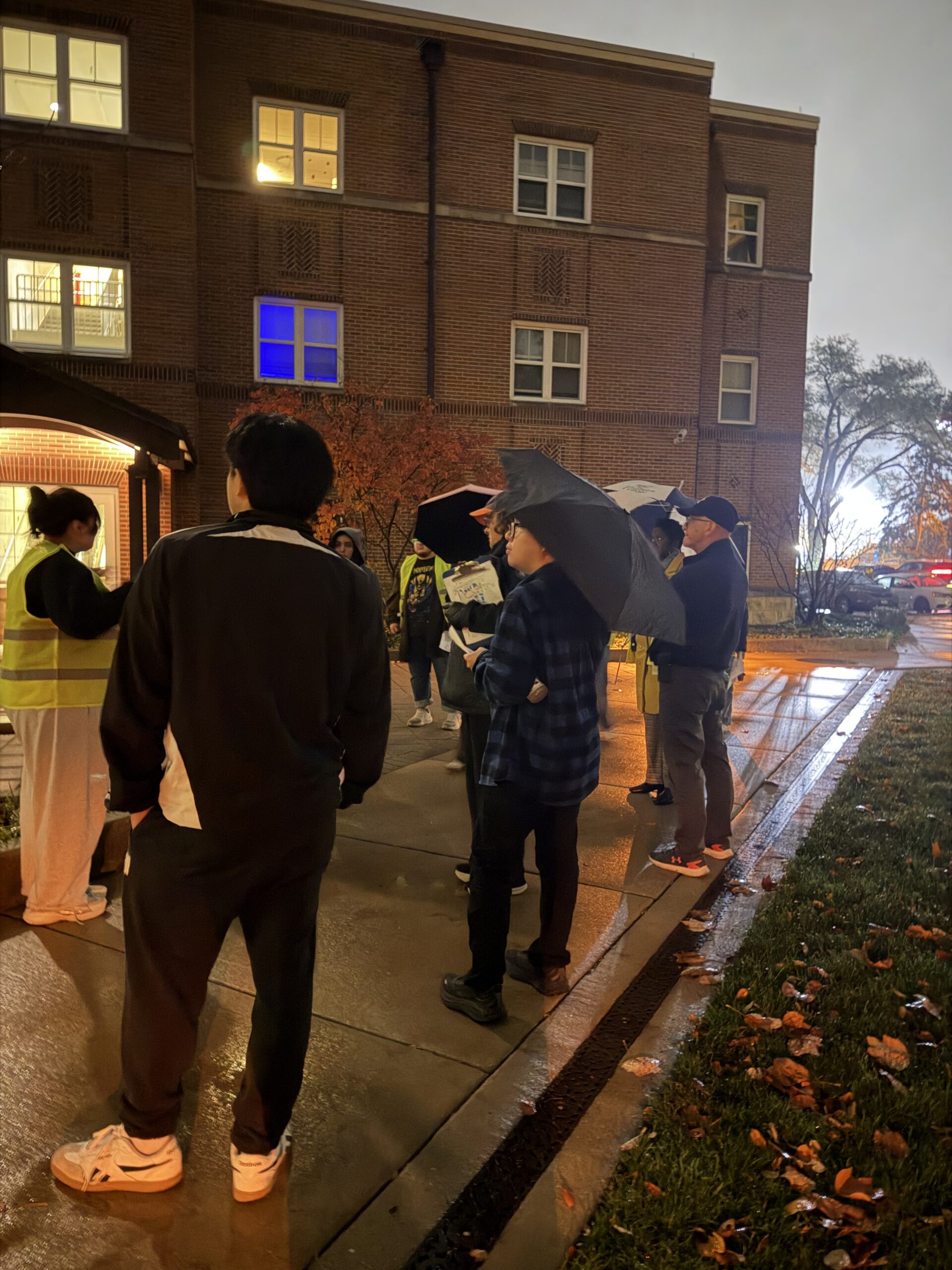
Students gather for the Student Government Association’s safety walk on Nov. 5. || Photo courtesy of Patricia Perez
Mario Ronces Ocampo allegedly sexually assaulted a 31-year-old woman on Aug. 20 on the Prairie Path that runs through Elmhurst. On Aug. 26, Ronces Ocampo was charged with one count of aggravated battery in a public place and one count of criminal sexual abuse.
“I think anything that hits close to home like that gets jarring, but I think they still feel safe,” Elmhurst Deputy Police Chief Brett Kaczorowski said, speaking about Elmhurst residents.
Student safety has been under scrutiny on college campuses around the country as a series of sexual assaults and attacks have taken place on campuses such as New York University, a fraternity near the University of Chicago, the University of Nebraska-Lincoln, and most famously, Cornell University.
There is currently an open investigation at Cornell University about a then-20-year-old student, known as Jane Doe, who was allegedly raped by seven men at a fraternity house in 2024. The lawsuit alleges she was pressured into doing drugs and drinking alcohol until incapacitated.
The case attracted massive attention across the country and raised questions about how university administrations handle reported sexual assault. Similarly, the effects of toxic fraternity culture were put under a deeper lens for more people to share their experience of sexual violence on college campuses.
As of Nov. 16, Cornell University announced it will launch a comprehensive review of its Greek life system as well as its ties to student housing. Cornell President Michael I. Kotlikoff wrote that this review will “consider the future of fraternities and sororities at Cornell.” There have also been many questions over who should run the reopened investigation.
On EU’s campus, multiple sororities and fraternities put up posts condemning the case and many provided resources for sexual assault awareness and support for survivors. The Alpha Sigma Phi (Asig) fraternity on campus recognizes the Rape, Abuse, and Incest National Network (RAINN) as one of their philanthropies.
Senior Jacob Bibik wrote the original Alpha Sigma Phi post condemning the Cornell case and said as a chapter they take sexual assault very seriously.
“One of our values in Asig is silence,” Bibik said. “I think when people first hear that value it’s a little alarming, but for us it means, it’s important to know when it’s your turn to talk and when it’s your turn to be quiet and to listen. I think when thinking about sexual assault and rape it’s our job to be someone that listens.”
Beyond individual fraternity efforts, the Interfraternity Council (IFC) also works to oversee fraternity chapters and address concerns involving their members.
The IFC president, junior Bryan Ramirez, said he regularly checks in with fraternity presidents to make sure chapters are operating appropriately and offers guidance when issues arise. Following the Cornell case, he said EU’s Greek organizations discussed ways to raise awareness beyond social media statements.
“One thing is to put out a statement and then another thing is to actually take action and create an event that brings an impact onto the community,” Ramirez said.
Ramirez also said EU could do more to make existing safety resources visible to students. Although he believes the university has helpful resources and staff members available, he said students do not always know where to find them. He suggested placing more flyers in accessible locations throughout campus so students know who to contact if they experience or witness misconduct.
Ramirez said collaborating with other chapters to host awareness events and sharing resources are ways Greek organizations can show support for survivors and encourage conversations about sexual assault.
Elmhurst University reported two cases of domestic violence last year, along with six cases of forcible fondling, according to data the university published in accordance with the Clery Act.
The Clery Act is a federal law requiring colleges and universities that participate in federal student financial aid programs to disclose campus crime statistics and safety policies. EU releases their Clery Act data every fall. The data this year is from 2023, 2024, and 2025.
John Escalante, executive director of public safety, said there is not really a rhyme or reason for most of the fluctuation in data each year. He did say for the liquor law violations that there were two parties that resulted in a rise in liquor law violations. Those can include underage drinking, or someone of age providing alcohol to someone under 21.
“I also think students need to be careful no matter where you’re at,” Escalante said. “I think this a safe campus and safe community, but you still need to be aware of your surroundings and you need to take precautions.”
Escalante said one of the safety aspects of campus he is very impressed with is the extensive security camera network. He said all the residence halls, entrances, floor lobbies, and (depending on the building) the hallways are all covered by camera. He said that Public Safety has a state-of-the-art access control system that was upgraded in 2025.
Students tell The Leader they generally feel safe on campus but feel the university can still do better in ensuring students feel protected. Sophomore Tasiya Simmons said the university could do a better job paying attention to lightbulbs that are out.
“Anything could happen,” Simmons said. “And if you don’t get to that safety light in time… One second is a little bit too late.”
Sophomore Alana Newsom said she always walks with a friend and carries mace. Newsom and Simmons both agreed there is poor lighting by Schick Hall and the Schaible Science Center.
Sophomore Rashard Wraggs also feels it is very dark on campus when he walks around at night. He does not personally take safety precautions but knows a lot of his friends carry alarms on their keys. He said the safety walk could be helpful but feels the university telling students to take safety precautions may be more helpful.
Wraggs said that Greek life on campus is fairly safe as he has talked to a lot of the members in the sororities and fraternities and found them to be understanding.
“What I saw with those sororities and fraternities is that they are equipped to notice when that happens,” Wraggs said.
Escalante stresses to students at orientations to put Public Safety’s numbers in their phone as they are available 24/7. He added that Public Safety always has one dispatcher and two officers scheduled. Public Safety patrols the campus 24/7 as well as have to do a check-in every time they hit a new building.
SGA plans to continue advocating for campus safety beyond the initial walk. The organization plans to revisit the areas identified before the end of the semester to determine whether lighting concerns have been addressed.
Perez said the organization will continue raising concerns with facilities if the identified areas remain unlit and plans to update students on its progress.SGA also hopes to increase awareness of campus safety resources, including emergency blue light phones, and connect with more students through campus pop-ups.
“I just want everyone to feel welcome, feel safe, feel included,” Perez said. “I do want to advocate for the students again, and I just want everyone to feel safe on campus.”