$950,000 for New Health Science Research Technology at EU
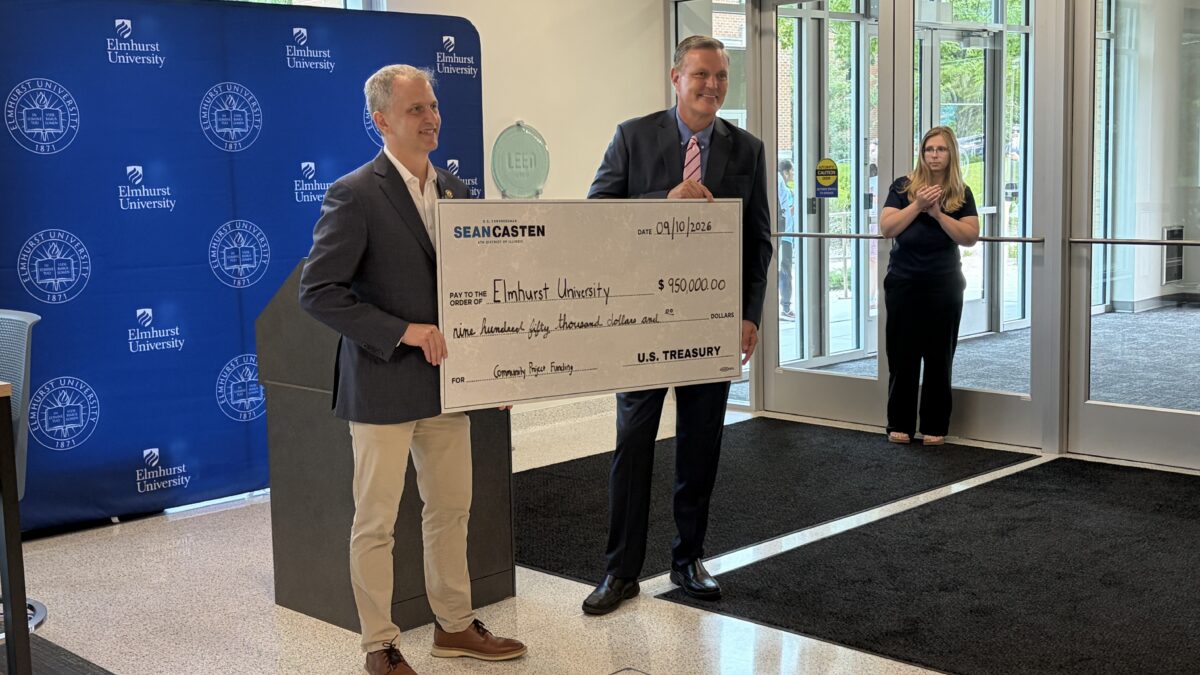
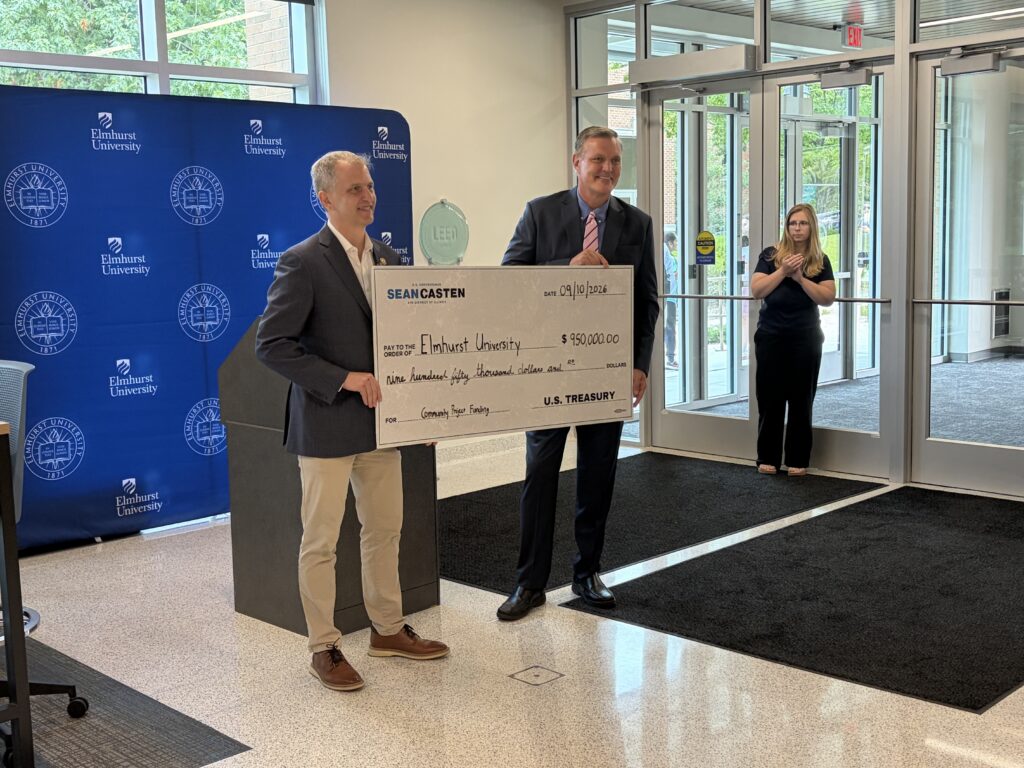
EU President Troy VanAken and U.S. Rep Sean Casten hold a $950,000 ceremonial check for the Health Sciences Building. Photo by Ashley Vanderhoff
Elmhurst University and U.S. Rep. Sean Casten, D-I.L., celebrated a $950,000 federal funding award Sept. 10 to purchase new instructional, simulation, and research equipment for the Health Sciences Building.
Dozens of staff gathered in the Health Sciences Building to commemorate the moment and hear opening remarks from Vice President for Academic Affairs and Dean of the Faculty Courtney Miller and President Troy VanAken. Elmhurst Mayor Scott Levin and Board of Trustees Chair Julius W. “Wes” Becton were among those in attendance.
The federal funding will help EU purchase two 3D anatomy tables, which provide high-resolution anatomical images of digitized cadavers; two new simulation mannequins, a man and a child; and a new simulation equipment package that will support maternal and newborn nursing educations. The federal funding will also help secure the latest version of video, audio, and learning tool systems, according to VanAken.
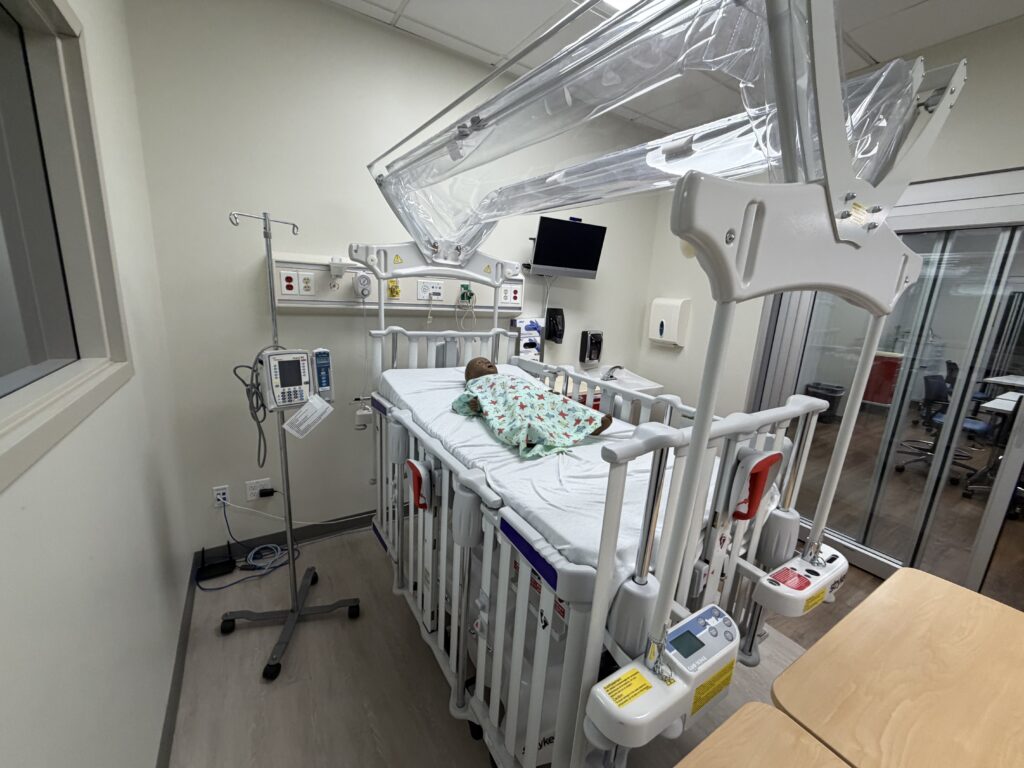
One of the various mannequins used by nursing students in the Health Sciences Building. Photo by Ashley Vanderhoff
“I’m very proud that Elmhurst University, with our new building and new opportunities that this grant creates, can play an important role in giving future healthcare professionals the kind of invaluable educational experience that will lead to better patient care, and a healthier world,” VanAken said.
In his speech, VanAken said he first met with Casten in April of 2024 to discuss the Health Sciences Building, in which Casten’s background in biochemistry and biochemical engineering helped facilitate the conversation. Casten helped advocate for the funding in Congress as part of his Community Project Funding sites for Fiscal Year 2026.
Speaking to The Leader, VanAken said he’s excited about the new simulation equipment, which will enhance student learning. “You know, in the old days, doctors and nurses had to learn things on human bodies, maybe you had a cadaver, but now you can do this rich simulation,” VanAken said. “Both my children are medical doctors, and the first time they do a procedure, they’ve done that hundreds if not thousands of times through simulations. That’s one of the big get-aheads that we’ll get here is this really high-tech, state of the art, industry leading simulation.”
Becton highlighted the Jans Family Military and Veterans Center, located in the first floor of the Health Sciences Building, where the event was held: “As a veteran it’s pretty cool that we have a place where veterans can gather in a location that trains the next generation of healthcare leaders. I think it’s pretty amazing. My mom was a nurse. If she was still alive and could see this facility, she’d just be like, ‘This is amazing.’”
The federal funding comes amid a surge of nursing and health sciences students at EU, according to the 2025-2026 Data Book. Enrollment in undergraduate and graduate programs jumped from 424 in 2021 to 703 in 2025.
EU nursing student and junior Jaedon Thompson said simulation work is essential to his education and comprises most of his program. He said he was excited to hear about the new 3D Anatomage table and that he enjoys using the current one.
“We do already have sims and labs but adding more, especially with the nursing program growing, will be so much nicer,” Thompson said. “It’ll be nice to split up into even smaller groups and get that one-on-one action too.”
Interim Director of Nursing Simulation and Doctor of Nursing Practice (DNP) student Marissa King said simulations, especially through mannequins, play a huge role in the education of nursing students by creating immersive scenarios where they can practice being the nurse. She said she’s excited about the two new high-fidelity mannequins EU will receive through the federal funding.
“Our high-fidelity mannequins have heart sounds and lung sounds; they talk back to us, they can throw up, they can sweat, they can bleed — they’re very advanced,” King said. “Our low-fidelity mannequins don’t do as much, but we treat them in the lab here as if they were patients. So, nursing students practice their skills by putting in IVs, fully catheters, wound care.”
The new simulation equipment will also support faculty in their research. King, a three-time Elmhurst alumna, is centering her DNP around orienting faculty to high fidelity and teaching them the Healthcare Simulation Standards of Best Practice.
“I want to mentor and educate the didactic faculty on what it’s like bringing simulation into the classroom,” King said. “Now that we’re all together in this new building… I would love for them to have access to these mannequins and supplies.”
King first heard that EU was awarded the federal funding about a week before the celebration from Laury Westbury, chair of the Department of Nursing and Public Health. She said it was an incredibly exciting day and that his grant will have a huge impact on student learning and engagement.
“I’m super passionate about student engagement and hands-on learning,” King said. “They’re the nurses, let them run the show. We’re here to guide and support them, and give them feedback.”