From Quantum Batteries to ICE Legitimacy, AI Hiring to 3D Printing: Students Complete Summer Research Through the CASE Program
As Elmhurst University’s campus settles into summer, some students will be at the beach or the pool, but some students will be in the lab, in museums, or with their AI model named Antoine.
Many students completed research alongside faculty mentors over the summer. Through the Creative and Scholarly Endeavors Program (CASE), students received a stipend for their research and attended weekly educational seminars.
Here are six students who completed summer research with faculty in topics from quantum batteries to ICE legitimacy, AI hiring to 3D printing.
Muhammad Khan: Organic Molecules’ Usefulness for Quantum Batteries
Muhammad Khan’s research combines computational organic chemistry with quantum physics. As a biochemistry major, he is working with assistant professor of chemistry Álvaro Castillo, Ph.D, and the two are exploring how a molecule’s structure helps it catch and store energy for quantum batteries — a next-generation technology still in early laboratory testing.
“We wanted to research kind of untouched subjects where there isn’t much information available,” Khan said. “Most of the time this research isn’t published publicly because it’s for a specific industry, and is kept confidential to grow that sector. But, if something is this important, then we should try and see what information and results we can get.”
Current batteries rely on chemical reactions, which degrade internal components over time, but a quantum battery could use organic molecules that absorb photons of light, exciting an electron to a temporarily higher state of higher energy. That extra energy can be used to perform work, and once the electron returns to its state of lower energy, the molecule is left chemically unchanged, enabling a theoretically indefinite cycling of the battery.
But, there’s a catch — when a molecule absorbs energy from light, its shape can change, either drastically or very little. For an organic molecule to work well in a quantum battery, it needs to do two things. It must hold the absorbed light energy long enough for us to use it, and minimize the loss of that absorbed energy. To minimize that energy loss, the molecule needs to stay stable enough so the energy is not lost as heat as the molecule’s structure changes. Khan aims to find exactly those molecules.
Working with organic molecules is particularly promising because they’re chemically modifiable, meaning researchers can customize them to learn what structure yields that mild shape change. Khan will simulate these molecules using a computer simulation, rather than synthesizing them in a wet lab.
Khan runs his simulations on a computer named Antione — an ode to French chemist Antoine Lavoisier — and his results take anywhere from fifteen minutes for smaller and less complicated molecules, to months of computational time for highly accurate, complex calculations.
His work isn’t a predetermined route, but a map he is developing as he goes: “It’s a running project, the more information we get, the better, more focused changes we’re able to make. But it all has to be built from the ground up. We didn’t even know if there’s good candidates out there, and that’s why we’re working on validating information.”
Over the course of his research, Khan analyzed 22 molecules and ran 440 jobs on his computer. He started with six molecules: phenoxide, benzene, phenol, aniline, pyridine, and nitrobenzene — working with aromatic carbon rings because they are stable enough while absorbing light but still customizable. He found that the first four molecules he tested experienced very small changes in shape, proving excellent candidates for quantum batteries. But other molecules like pyridine and nitrobenzene had much bigger changes in shape.
“There’s no gradual slope leading from aniline to nitrobenzene, it just kind of jumps,” Khan said. “And this result really piqued my curiosity.”
Khan discovered that this energy loss jumps dramatically when multiple nitrogen atoms are crowded close together in the molecule, forcing a much bigger and more violent shape change than when nitrogen is spread far apart.
To assist him in his research, Khan developed an AI model (also named Antione). Antione is connected to Rowan Labs — a computational chemistry program that models and simulates molecules. Antione uses this program to reconstruct the molecule, writes input files for Khan’s computer and submits them, monitors the job, suggests fixes in the case of errors, and extracts valid data he needs for Khan’s scientific analysis. Antione is safeguarded and always asks Khan for confirmation first.
“If this is something that could be commercially available on campus for the use of students and other computational chemists in our chemistry department, it makes the research a lot easier,” Khan said.
Khan hopes that if they find a molecule that would make a good candidate for quantum battery applications, another researcher could replicate his work in a wet lab.
Amiya Tongson: A Rhetorical Analysis of the Legitimacy of ICE
Last October, U.S. citizen Marimar Martinez called 911 after a Border Patrol agent shot her five times. Over the line, Martinez was heard crying, swearing, and speaking Spanish. That recording is one of many crisis calls that form a large dataset for sociology major Amiya Tongson. Through a rhetorical analysis of hundreds of 911 calls, Tongson is identifying how civilians and dispatchers use language to either legitimize or delegitimize immigrant enforcement authority, in emergency situations.
“We’re not exactly making a hypothesis and planning what we see,” Tongson said. “We are letting the data inform us of what patterns emerge and what we identify from the transcripts we are able to code.”
Tongson is focusing on major immigration enforcement operations, including Operation Midway Blitz, Operation Metro Surge, the 2025 National Guard deployment in Los Angeles to better understand how ICE is conceptualized in very intense situations like public shootings. She is also looking at the smaller, everyday encounters with ICE such as ICE sightings and protests.
To obtain the recordings, Tongson is filing Freedom of Information Acts (FOIA), however, these requests can take a long time to process, and in Illinois the standard wait time is five to 21 business days — if you hear back at all.
But Tongson is filing bulk requests in addition to her individual requests, and her faculty mentor, Emily Navarro, associate professor of sociology, Ph.D., has contacted reporters who already filed FOIA requests. One journalist in Minnesota received an approximately 40 page document of transcripts which Tongson has begun organizing into categories such as calls regarding informational reporting, detailing ICE behavior, or requesting police help.
During a July presentation to other CASE students, Tongson highlighted one caller’s characterization of ICE as, “They’re brutalizing our neighborhoods.” That word choice, Tongson said, suggests a concern for others. Specific words like brutalizing and neighborhoods reflect concern for the broader community rather than just individual experiences.
“It’s very exploratory research,” Tongson said. “When we transcribe, it is every sound a person makes. You want to make sure you are doing justice to the situation and what people are saying — being as objective as you can.”
Tongson is also interested in instances when ICE calls 911 themselves. In one of her recordings, ICE called police to remove people allegedly disrupting operations, but officers found only two individuals and deemed the call a waste of time.
That distance between police departments and ICE, Tongson said, is an important point of tension as, rhetorically, ICE is looking for the police to validate them with their own power.
Tongson will continue to transcribe and code 911 phone calls regarding ICE beyond the CASE program. This fall semester she plans to continue transcribing the calls so that in the spring she can code them. To code the transcripts, Tongson first highlights dialogue from both the caller and 911 operator. For example, if a caller says that they are a U.S. citizen, Tongson might code that as them reaffirming their own citizenship. Once Tongson has developed enough codes, she can analyze them rhetorically to understand how people are conceptualizing ICE legitimacy. She hopes to publish her research in an academic journal eventually.
“Anybody will be able to find this research, make their own interpretations, and that might influence people’s relationship to law enforcement,” Tongson said. “I think that people can definitely look at this and say, ‘What do we need to change in order for people to have a greater trust in authority?’”
Jack Helms: 3D Printing and the Organic Makeover
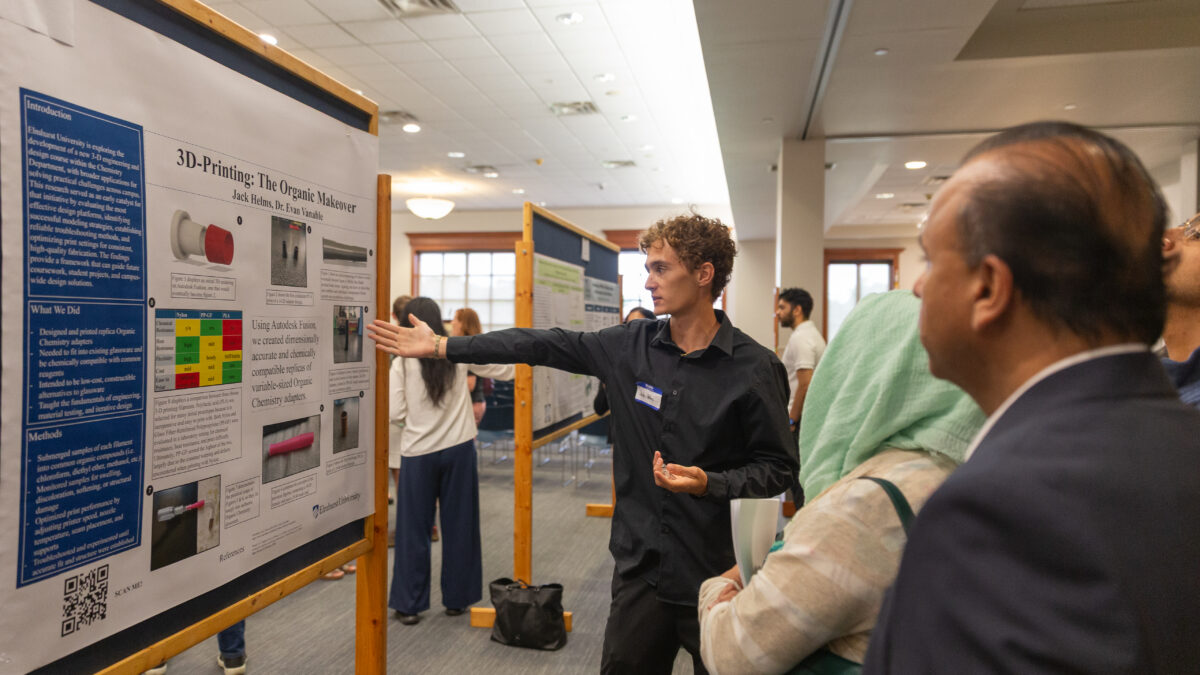
Jack Helms, a biochemistry and physics major, is learning to 3D print parts for organic chemistry labs. His research will allow him to document his work for future students and faculty at EU, and may even help pioneer a new class. He is working with associate professor of chemistry Evan Vanable, Ph.D.
3D printers have printed houses, pizza, and even organic tissue. Introduced in the early 1980s, 3D printing is now used in a myriad of fields, but organic chemistry is still relatively untouched, according to Helms.
“The [designs] I’m creating are completely from scratch,” Helms said. “I’m sure if I dug deep enough I could find something another scientist made, but there’s not readily available designs for organic chemistry parts out there like there are for a lot of other things.”
While typical manufacturing or sculpting requires removing material until an object’s shape is formed, a 3D printer does the opposite. The printer starts with nothing, and adds just enough material to create the desired object, wasting less material than traditional manufacturing processes.
While many 3D printers use filaments in the form plastic, you can also use metal, ceramics, glass or even biological tissue. For Helms research, he needs to use chemically resistant filaments that won’t deteriorate once his printed parts are used in a chemistry lab.
To start the 3D printing process, Helms is using Autodesk Fusion, a computer aided design program, to create a blueprint of a digital model. Once his design is complete, the computer looks at Helms’ model and slices it into layers, so that the printer prints the model layer by layer.
A hot extruder nozzle squeezes out hot filament that forms a shape. Helms is printing pieces he referred to as adapters, which can connect different sized glass pieces together in lab apparatuses.
He’ll be printing various sized adapters, and one process they can be used for is distillation. This is a method used to separate liquid mixtures by heating them to boiling temperature and then cooling the vapors back into liquids.
Helms will extend his research beyond the CASE program — designing and printing new pieces while Vanable is away on sabbatical. He feels that his research will contribute to his future studies, and he’s excited to continue printing.
Avaion Viverette: Job Applicants’ Reactions to AI Rejections
Avaion Viverette, a psychology and sociology major, is spending the summer researching job applicants’ openness to AI hiring. He is working with associate professor Jessica Sim, Ph.D., from the department of psychology, and hopes companies will use his findings to change their hiring practices.
“If they’re going to use AI regardless, then we might as well try to persuade them to use it in an ethical way,” Viverette said.
Viverette’s study examines factors influencing how working adults’ react to a hiring rejection involving AI. Using Prolific, a technology company that assists researchers in finding human participants for their studies, Viverette aims to gather around 300 participants once he gains enough funding for his survey.
Each participant will randomly receive one of four possible scenarios to react to. In each scenario, the applicant will be rejected, but the level of AI involvement and whether the use of AI was disclosed by the organization prior to the hiring process will vary.
To develop his scenarios, Viverette drafted four ideas that varied in AI involvement and fairness. The AI involvement was either fully automated, meaning AI had complete control over the decision-making with little-to-no human oversight, or augmented, meaning AI was used as a tool by a human.
As for fairness, the AI’s involvement was either fully disclosed prior to the hiring process, or not. Then, Viverette ran his scenarios through Claude, to assist him in improving the believability for each situation.
A long-term goal of his is to present his findings to a company to improve applicants’ experience during the job hunt.
“We have to find that balance of how this can benefit the organization, but how does this also respect the applicant’s feelings toward AI?” Viverette said. “Then, ideally both the applicants and organizations would be happy, and any organization that took our recommendations would find themselves in a better spot.”
Viverette is continuing to refine his scenarios, and if his survey is rolled out on Prolific, he will monitor the results closely — only making edits if applicants fail to understand what role AI played in their assigned scenario. He will test applicant comprehension by asking them to rate how involved they thought AI was in the rejection.
Nick Exconde: Fundamental Particle Research for P-ONE
Engineering physics major Nick Exconde is working alongside assistant professor Robert Halliday, Ph.D., on the Pacific Ocean Neutrino Experiment (P-ONE), a deep-sea neutrino detector that Elmhurst University is contributing to. Exconde’s work will entail simulating the detector’s ability to distinguish how many muons are produced from high-energy neutrino interactions, which could offer important insights into extreme environments in our universe.
Neutrinos are small, subatomic particles that interact primarily through the weak nuclear force. Because they interact so rarely with matter, neutrinos can pass through enormous amounts of material, including the Earth, largely undisturbed. So, scientists built giant detectors, often in vast bodies of water, to observe these rare interactions. When a specific type of neutrino, dubbed the muon neutrino, does interact with matter in the detector, it can produce a muon particle that emits flashes of light. By observing that light, researchers can reconstruct the neutrino’s path to better understand its cosmic origin.
“Can we figure out where exactly these particles come from, and can we discover the composition behind these cosmic sources?” Exconde asked.
To help answer this question, Exconde is studying muon multiplicity — the number of muons produced during high-energy neutrino interactions. When a muon neutrino does interact with another particle, it can produce a muon, and in rare occasions, the interaction produces two, known as a dimuon event. By analyzing simulated muon events, Exconde hopes to develop methods for distinguishing single-muon events from dimuon events. Such a method could ultimately help researchers better understand the energy of neutrino interactions and investigate their cosmic sources like supernovae and other high-energy astrophysical events.
Exconde is investigating whether patterns in the light detected by P-ONE — including the difference in the timing of the signals — can help distinguish single-muon events from dimuon events. He is also studying how the opening angle between two muons affects the timing separation of their signals.
In his first round of simulations, he compared 100 single-muon events with 100 dimuon events, searching for patterns that distinguish one from the other. Currently, Exconde is working on running 1000 simulations to search for additional patterns that might emerge.
So far, the biggest benchmark has been debugging the simulations, which delayed his work early on. His simulations, which rely on Python scripts, require certain prerequisite packages that he didn’t have immediate access to, and so it was up to Exconde and Halliday to troubleshoot the software together.
Exconde’s research will extend past the CASE program, and he will continue running simulations as part of an independent research requirement for his major.
“I enjoy doing this and maybe it’s something I could pursue at a higher level,” Exconde said. “I think the coolest thing to me is that since I’m working in a relatively open field where there aren’t many discoveries within my specific focus, is that if I’m able to make any type of discovery at all my name will be out there.”
Patick Lingner: Understating Our Limitations in Comprehending the Holocaust
Patrick Lingner is studying how museums and art represent the Holocaust. His research examines our limitations in comprehension, and how certain mediums of remembrance allow us to think more critically about the mass genocide. His research will extend past CASE, and he is currently writing a paper about his findings. He is working with assistant professor of English Erika McCombs, Ph.D.
Lingner’s work has focused on the art installation “Fallen Leaves.” Created by Israeli artist Menashe Kadishman, it features more than 10,000 round iron plates depicting screaming faces. Lingner visited the piece during a class trip to Poland and Germany.
“The metal faces cry out no matter how carefully you try to pick your way among them,” said Lingner. “But as soon as more people begin walking on the faces, it becomes easier, more permissible, to step without care, as the noise you make becomes only a part of the larger cacophony.”
Lingner’s research is guided by the accounts of the survivors themselves. As a Secondary English Language Arts major, he aims to answer the question: “How do we effectively teach and learn about the Holocaust and prevent future suffering?”
While photographs can be useful to visualize and emphasize with the events, Lingner has found their effectiveness is left up to the individual. Lingner, who also visited Auschwitz’s New Main Exhibition, explained that the hundreds of prisoner photographs lining the walls can too easily blur together, resulting in the possibility of a viewer reducing prisoners to a victim group identity.
This tendency erases their individuality, he explained, and could result in the failure to engage further. It is also difficult to know if the prisoners would consent to the use of photographs taken by the Nazis, and if it was meant to dehumanize them.
“Fallen Leaves,” however, addresses some of these representation and ethics issues among many others, said Lingner. Housed in the “Memory Void,” it acknowledges our own gaps in understanding. It reflects both survivor Ruth Kluger and Primo Levi’s writings that many victims and atrocities of the Holocaust will remain unknown.
To Lingner, “Fallen Leaves” encourages deeper critical thought as it places the viewer in the role of the oppressor, while much artwork naturally allows us to sympathize with the victim. This prevents what he calls passive witnessing, or feeling empathy but not engaging critically or in critical self-evaluation.
While sympathizing with victims is not inherently damaging, Kluger warns us to do so cautiously — to prevent the tendency to engage in sentimental self-admiration, an act of solemnly congratulating oneself on their own perceived sensitivity rather than self-reflecting.
“Fallen Leaves” also reframes the Holocaust in the present. It is a general ode to all victims of war, as dedicated so by Kadishman. It also aligns with Levi’s warnings against dichotomizing the Holocaust and reducing our analysis of the conflict as a “we” vs “they,” according to Lingner. This thinking can prevent critical engagement and stops us from considering ourselves and our actions.
Throughout Lingner’s research, he has revisited a quote by Levi as a reminder to why his work is important: “It happened, therefore it can happen again…[and] it can happen everywhere.”